
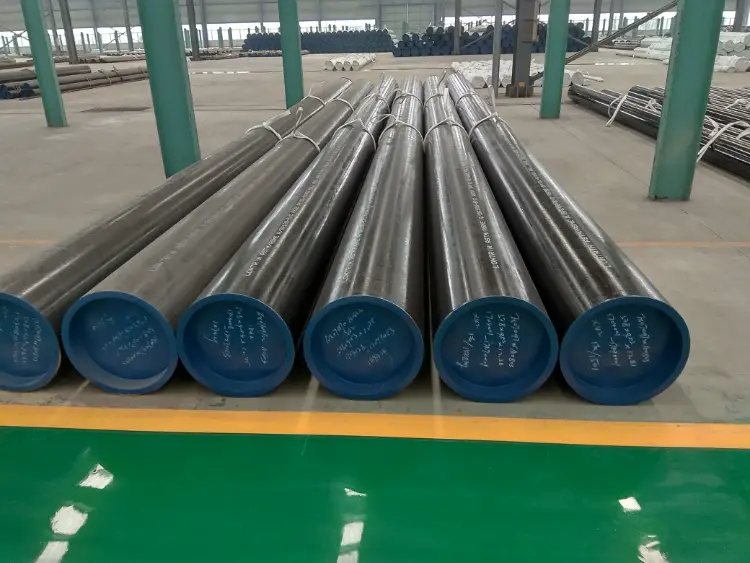
API 5L X42 Pipeline Steel
API 5L X42 Pipeline Steel - Properties, Equivalents & Applications
Full technical data for API 5L X42 pipeline steel: chemical composition, mechanical and thermal properties, equivalent grades, and typical uses in oil and gas transmission.
Hot rolling, normalizing, thermomechanical rolling, welding (ERW, SAW, SMLS), cold forming, bending
- Phone : +8618037372205
- Email : [email protected]
- WhatsApp: Contact via Whtsapp
- WeChat: +8618037372205
API 5L X42 Pipeline Steel Introduction
API 5L X42 (also designated L290 under ISO 3183) is a low‑carbon micro‑alloyed steel primarily used for welded and seamless large‑diameter pipe in petroleum and natural gas pipelines. It offers a minimum yield strength of 290 MPa (42 ksi) and a minimum tensile strength of 414 MPa (60 ksi), ensuring reliable service under high pressure. The alloy is typically supplied in an as‑rolled, normalized, or thermomechanically treated condition, and meets the requirements of both PSL 1 and PSL 2 product specification levels. Its good weldability, moderate strength, and excellent toughness make it a standard choice for transmission of oil, gas, water, and other fluids over long distances.
API 5L X42 Pipeline Steel Chemical Composition
The table below lists the main alloying and residual elements according to API 5L tables for Grade X42. Two rows per element show the maximum allowable values for PSL 1 and PSL 2 where they differ ; for elements with no product specification level distinction, a single value is given.
- PSL 1 – basic requirements ; S and P up to 0.030 %
- PSL 2 – stricter limits for enhanced toughness and weldability ; S ≤0.015 %, P ≤0.025 %
Values are in weight percent unless noted otherwise.
| Chemical Element | Standard Value | Remarks |
|---|---|---|
| C | 0.28 max (PSL 1) / 0.22 max (PSL 2) | Heat analysis |
| Mn | 1.30 max (PSL 1 & PSL 2) | Heat analysis |
| P | 0.030 max (PSL 1) / 0.025 max (PSL 2) | Heat analysis |
| S | 0.030 max (PSL 1) / 0.015 max (PSL 2) | Heat analysis |
| Si | 0.45 max (when required) (PSL 1 & PSL 2) | Heat analysis, for fully killed steel |
| V + Nb + Ti | ≤0.15 (PSL 2 only) | Sum of microalloying elements, heat analysis |
| Cu | 0.50 max (PSL 1 & PSL 2) | Balance of residual copper |
| Ni | 0.50 max (PSL 1 & PSL 2) | Residual |
| Cr | 0.50 max (PSL 1 & PSL 2) | Residual |
| Mo | 0.15 max (PSL 1 & PSL 2) | Residual |
| Al (total) | 0.05 - 0.30 (typical for fully killed) | Often specified for grain refinement |
| N | 0.012 max (PSL 2) | For improved HAZ toughness |
| B | 0.0005 max (PSL 2) | Residual |
API 5L X42 Pipeline Steel Thermal and Electrical Physical Properties
The following properties are not part of the API 5L standard but represent typical values for low‑carbon pipeline steel and can be used for engineering calculations. Actual properties may vary slightly with specific heat treatment and microalloying content.
- Values are given at room temperature unless a temperature range is indicated.
- Electrical resistivity is for direct current at 20 °C.
| Property | Standard Requirement Value | Unit | Test Condition |
|---|---|---|---|
| Density (ρ) | 7.85 | g/cm³ (kg/dm³) | 20 °C |
| Elastic Modulus (E) | 205 | GPa | 20 °C, tension |
| Shear Modulus (G) | 80 | GPa | Calculated from E and ν |
| Poisson's Ratio (ν) | 0.3 | — | 20 °C |
| Thermal Expansion Coefficient (α) | 11.7 | ×10⁻⁶ /°C | 20–100 °C |
| Thermal Conductivity (λ) | 50 | W/(m·K) | 20 °C |
| Specific Heat Capacity (cₚ) | 450 | J/(kg·K) | 20 °C |
| Electrical Resistivity (ρₑ) | 0.15 | µΩ·m | 20 °C, DC |
API 5L X42 Pipeline Steel Mechanical Properties
Tensile properties are based on the API 5L standard for pipe body tests. Elongation is measured on a 50 mm (2 in.) gauge length strip specimen; actual minimum depends on specimen area and tensile strength but a typical minimum of 23 % is often called out by pipe manufacturers for wall thickness ≤12.7 mm. Charpy V‑notch impact requirements apply to PSL 2 only; values for temperatures other than 0 °C may be agreed.
- Yield strength is the stress at 0.5 % total extension under load (ReH).
- Tensile strength is the maximum stress during the test (Rm).
- Impact test specimen orientation is transverse to the pipe axis.
| Property | Standard Requirement | Unit | Test Condition |
|---|---|---|---|
| Yield Strength (ReH) | 290 min | MPa (ksi) | PSL 1 & PSL 2, room temperature |
| Tensile Strength (Rm) | 414 min | MPa (ksi) | PSL 1 & PSL 2, room temperature |
| Yield to Tensile Ratio (YS/TS) | 0.93 max (optional) | — | PSL 2, when specified |
| Elongation (A) | 23 min (typical) | % | Strip test, 50 mm (2 in.) gauge, wall ≤12.7 mm, PSL 1 & PSL 2 |
| Charpy V‑Notch Impact (KV₂) | 27 avg / 21 min single | J | PSL 2, transverse, 0 °C (32 °F) |
API 5L X42 Pipeline Steel Fully Equivalent Material Standards and Replaceable Grades
| Country/Region | Standard | Grade | Remarks |
|---|---|---|---|
| International | ISO 3183 | L290 | Class A or B; direct equivalent to API 5L X42 |
| Europe | EN 10208‑2 | L290NB, L290MB | NB = normalized, MB = thermomechanically rolled; interchangeable for PSL 2 pipeline service |
| Canada | CSA Z245.1 | Gr. 290 | Equivalent for oil and gas line pipe |
| Australia | AS 2885 | X42 | Adopts API 5L X42 for pipelines |
| China | GB/T 9711 | L290 | National standard of China, fully compatible |
API 5L X42 Pipeline Steel Application Introduction
API 5L X42 is designed for the safe, long‑distance conveyance of hydrocarbons and water. Its balance of strength, ductility, and weldability makes it suitable for both onshore and offshore pipelines, gathering systems, and distribution networks. Typical applications include:
Product Applications: Mainline and gathering pipelines for crude oil, natural gas, and refined products, Flowlines and risers for offshore platforms, Distribution mains and service lines for gas and water, Industrial process piping in refineries and chemical plants, Structural pipes for bridges, building columns, and foundation piles
Processed into products: Pipe bends and return bends (induction bends, cold bends), Tees, reducers, and flanges (welded or forged), Welded fittings (elbows, caps, stub ends), Valve bodies and casing components, Pipeline repair sleeves and mechanical connectors
Application industries: Oil and gas exploration and production, Petrochemical and refining plants, Water supply and sewage treatment, Mining and slurry transportation, Power generation (cooling water lines), Civil and structural engineering (piling, casing)
API 5L X42 Pipeline Steel Similar/Comparable Steel Grades
| Country/Region | Standard | Grade | Remarks |
|---|---|---|---|
| USA | API 5L | X46 (L320) | Slightly higher strength (320 MPa YS), otherwise similar chemistry and toughness; often used when economical material substitution is permissible |
| USA | ASTM A106 | Grade B | Seamless carbon steel pipe for high‑temperature service; YS 240 MPa, TS 415 MPa ; may be considered for lower‑pressure piping where X42 is not required |
| USA | ASTM A53 | Grade B | Fire‑protection and structural pipe; YS 240 MPa, TS 415 MPa ; compositions overlap but with less restrictive microalloying |
| International | ISO 3183 | L245 (API 5L B) | Lower strength grade (245 MPa YS) suitable for low‑pressure water or gas lines, often used as a cost‑effective alternative |
Notes:
- Product Specification Levels (PSL): PSL 1 provides basic requirements; PSL 2 adds mandatory Charpy toughness, stricter chemistry, and NDE. Most critical service projects specify PSL 2.
- Coating: External and internal coatings (FBE, 3‑LPE, liquid epoxy) are typically applied for corrosion protection; X42 is fully compatible with all standard pipeline coating systems.
- Welding: X42 has excellent weldability with low‑hydrogen electrodes (E7018, ER70S‑6) and is suitable for SMAW, GMAW, SAW, and FCAW processes under normal preheating and interpass temperature controls.
- Forming: The steel can be cold‑formed into bends with typical bend radius of 3D to 5D without detrimental effect on mechanical properties.
- Share



