
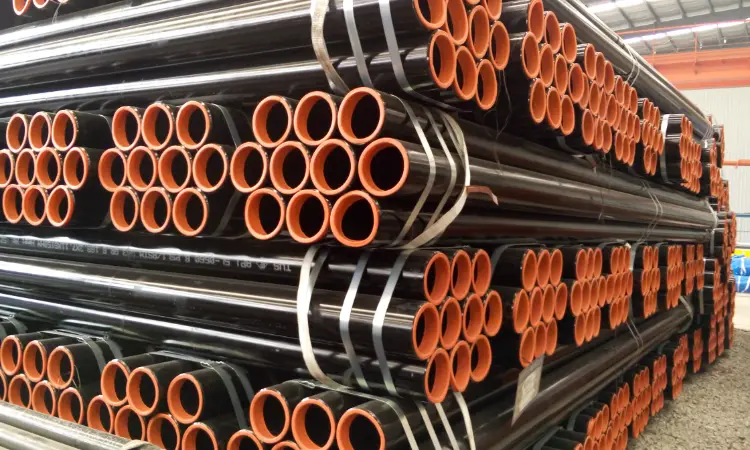
API 5L Grade B Pipeline Steel
API 5L Grade B Pipeline Steel - Material Properties & Equivalent Grades
Comprehensive material data for API 5L Grade B line pipe steel: chemical composition, mechanical and physical properties, international equivalents, and application guide.
Hot rolling, cold drawing, welding, normalizing
- Phone : +8618037372205
- Email : [email protected]
- WhatsApp: Contact via Whtsapp
- WeChat: +8618037372205
API 5L Grade B Pipeline Steel Introduction
API 5L Grade B is a carbon steel line pipe grade specified by the American Petroleum Institute (API). It is widely used for conveying oil, gas, and water in both onshore and offshore pipeline systems. The steel provides a good balance of strength, weldability, and economic efficiency. Typical microstructure is ferritic-pearlitic, offering yield strength of at least 245 MPa (35.5 ksi) and tensile strength between 415 and 655 MPa (60-95 ksi). The material is available in seamless and welded forms and can be supplied in PSL1 (basic quality) or PSL2 (more stringent requirements, including mandatory Charpy V-notch tests and tighter chemistry limits).
- Minimum yield strength 245 MPa
- Good weldability with standard procedures
- Suitable for moderate temperatures and non-sour service (can be ordered with HIC/SSC testing for sour environments)
- Available in various wall thicknesses and diameters up to 60 inches
API 5L Grade B Pipeline Steel Chemical Composition
The chemical composition complies with API 5L 45th Edition. Values shown are for PSL2 (more stringent limits). PSL1 allows slightly wider ranges, e.g., C ≤ 0.28% and Mn ≤ 1.20%. For heavy sections and demanding service, microalloying elements like Nb, V, Ti may be added to refine grain size.
| Element | Standard Value (PSL2) | Remark |
|---|---|---|
| Carbon (C) | ≤ 0.22% | PSL1: ≤ 0.28% |
| Manganese (Mn) | ≤ 1.20% | Minimum 0.30% typical for weldability |
| Silicon (Si) | ≤ 0.45% | Deoxidation element |
| Phosphorus (P) | ≤ 0.025% | PSL1: ≤ 0.030% |
| Sulfur (S) | ≤ 0.015% | PSL1: ≤ 0.030% |
| Vanadium (V) | ≤ 0.05% | Optional microalloy; sum V+Nb+Ti ≤ 0.15% |
| Niobium (Nb) | ≤ 0.05% | Optional microalloy; sum V+Nb+Ti ≤ 0.15% |
| Titanium (Ti) | ≤ 0.04% | Optional microalloy; sum V+Nb+Ti ≤ 0.15% |
| CE(IIW) | ≤ 0.43% | Carbon equivalent for weldability; applicable to PSL2 |
API 5L Grade B Pipeline Steel Thermal and Electrical Physical Properties
Physical properties are typical for carbon steel of this composition and are not mandatory by API 5L. They can vary slightly with heat treatment and exact composition. Values are provided for general engineering calculations.
| Property | Standard Requirement Value | Unit | Test Condition |
|---|---|---|---|
| Density (ρ) | 7.85 | g/cm³ | Room temperature |
| Elastic Modulus (E) | 210 | GPa | Room temperature |
| Shear Modulus (G) | 81 | GPa | Room temperature, estimated from E and ν |
| Poisson's Ratio (ν) | 0.29 | — | Room temperature |
| Thermal Expansion Coefficient (α) | 12.1 | ×10⁻⁶ /K | 20°C to 100°C |
| Thermal Conductivity (λ) | 50.7 | W/(m·K) | 20°C |
| Specific Heat Capacity | 486 | J/(kg·K) | 20°C |
| Electrical Resistivity (ρ_e) | 0.15 | ×10⁻⁶ Ω·m | 20°C |
API 5L Grade B Pipeline Steel Mechanical Properties
Mechanical properties are tested in accordance with API 5L. Transverse specimens taken from pipe body. Elongation values depend on specimen type; the table provides a representative 50 mm gauge length round bar requirement. Charpy impact energy applies to PSL2 at 0°C, full‑size specimen.
| Property | Standard Requirement Value | Unit | Test Condition |
|---|---|---|---|
| Yield Strength (ReH) | ≥ 245 (35,500) | MPa (psi) | Transverse, round bar, 0.5% EUL |
| Tensile Strength (Rm) | 415 – 655 (60,200 – 95,000) | MPa (psi) | Transverse, round bar |
| Elongation (A50) | ≥ 22 | % | 50 mm gauge length, round specimen |
| Bend Test (180°) | No cracks | — | Mandrel diameter = 3t (t = wall thickness) for t ≤ 12.5 mm; larger for thicker wall |
| Charpy Impact Energy (KV) | ≥ 27 (20) | J (ft·lbf) | Transverse, full‑size (10×10 mm), 0°C; PSL2 requirement |
API 5L Grade B Pipeline Steel Equivalent Standards and Substitutable Grades
| Country/Region | Standard | Grade/Designation | Remark |
|---|---|---|---|
| International | ISO 3183 | L245 / Gr. B | Identical technical requirements |
| Europe | EN 10208-2 | L245MB | For flammable fluid pipelines; mechanical properties match |
| China | GB/T 9711 | L245 | Equivalent to API 5L Gr. B |
| Russia | GOST 20295 | 17GS | Similar chemical composition and strength |
| Japan | JIS G3452 / G3454 | SGP / STPG370 | Slightly higher carbon equivalent possible; check tolerances |
API 5L Grade B Pipeline Steel Application Introduction
API 5L Grade B is the backbone of the oil & gas transportation industry. It is often chosen for its balanced mechanical properties, easy welding, and availability in large diameters and thick walls. It can be formed into pipe fittings, flanges, and special components by hot or cold bending, provided post-bend heat treatment respects API 5L requirements.
Product Applications: Long-distance transmission pipelines, Flowlines and gathering lines, Riser and casing pipes, Pressure piping systems, Structural tubular members (e.g., jackets, piles)
Processed into products: Straight and bent pipe segments, Tees, reducers, and elbows (ASME B16.9 type), Flanges and blind flanges, Pipe caps and lap joints, Weld-in anchors and repair sleeves
Application industries: Oil and Gas (onshore/offshore), Petrochemical and Refining, Water Treatment and Desalination, Civil Construction and Infrastructure, Mining and Slurry Transport
API 5L Grade B Pipeline Steel Similar and Alternative Materials
| Country/Region | Standard | Grade/Designation | Remark |
|---|---|---|---|
| USA | ASTM A106 | Grade B | Seamless carbon steel pipe for high-temperature service; YS 240 MPa min |
| USA | ASTM A53 | Grade B | General purpose structural and pressure pipe; YS 240 MPa min |
| USA | ASTM A672 / A672M | C70 Class 12 etc. | Electric-fusion-welded pipe from Grade B plate; matches API 5L B |
| China | GB/T 8162 / 8163 | 20# (20G) | Slightly lower carbon, comparable strength; widely used in structural and fluid tubing |
| International | EN 10210-1 / 10219-1 | S235JRH / S275J0H | Structural hollow sections; minimum YS 235 or 275 MPa; not for pipeline service |
Notes:
- Material can be ordered with supplementary tests: HIC, SSC, SSCC per NACE TM0177 / TM0284 for sour service.
- For welded pipe manufacturing, use filler metals matching the base metal strength (E6010 or E7018 electrodes are typical).
- Post-weld heat treatment (PWHT) is not mandatory for thicknesses below 30 mm unless required by service conditions.
- Maximum hardness values (typically ≤ 22 HRC) may be specified in PSL2 orders.
- Share



