
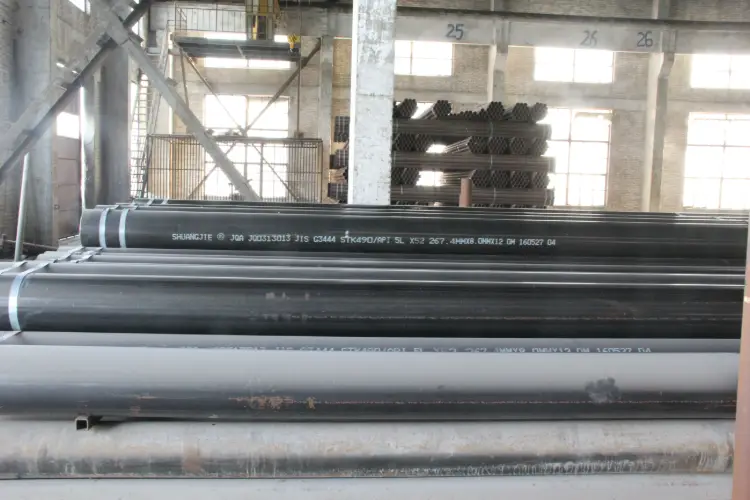
API 5L X52 Pipeline Steel
API 5L X52 Pipeline Steel: Comprehensive Material Data, Properties & Equivalents
Explore API 5L X52 pipeline steel grade: complete chemical composition, mechanical and physical properties, international equivalents, and application guide for oil & gas transmission pipelines.
Hot rolling, thermo-mechanical controlled rolling (TMCP), normalizing, quenching and tempering (depending on product specification level)
- Phone : +8618037372205
- Email : [email protected]
- WhatsApp: Contact via Whtsapp
- WeChat: +8618037372205
API 5L X52 Pipeline Steel Introduction
API 5L X52 is a high-strength low-alloy (HSLA) steel grade primarily used for line pipe in the oil and gas industry. It conforms to the American Petroleum Institute (API) specification 5L, with 'X52' denoting a minimum yield strength of 52 ksi (360 MPa). This steel provides an excellent balance of strength, toughness, and weldability, making it suitable for onshore and offshore pipeline applications. It is manufactured in seamless or welded forms and is normally supplied in PSL 2 requirements for enhanced testing and quality. Key features include good low-temperature impact toughness, resistance to hydrogen-induced cracking (HIC) in sour service variants, and reliable performance in high-pressure transmission systems.
API 5L X52 Pipeline Steel Chemical Composition
The chemical composition of API 5L X52 is specified for both Product Specification Level 1 (PSL 1) and PSL 2. The values below represent the maximum limits for PSL 2 (typical for line pipe), which ensures higher purity and controlled microalloying for improved toughness and weldability. Carbon equivalent (CE) is limited to prevent hardening in the heat-affected zone.
| Element | Standard Value (max, %) | Remarks |
|---|---|---|
| Carbon (C) | 0.22 | Typically 0.08–0.16 for modern low-carbon designs |
| Manganese (Mn) | 1.40 | Usually 1.00–1.35 to achieve strength |
| Phosphorus (P) | 0.025 | Low P for improved toughness and HIC resistance |
| Sulfur (S) | 0.015 | Low S for shape control and sour service |
| Silicon (Si) | 0.45 | Added for deoxidation |
| Vanadium (V) | 0.05 ¹ | Microalloying: V+Nb+Ti ≤0.15% typical |
| Niobium (Nb) | 0.05 ¹ | Grain refinement; can be higher if agreed |
| Titanium (Ti) | 0.04 ¹ | Grain refinement and sulfide shape control |
| Copper (Cu) | 0.50 | Optional for atmospheric corrosion resistance |
| Nickel (Ni) | 0.50 | Optional for toughness |
| Chromium (Cr) | 0.50 | Optional for strength |
| Molybdenum (Mo) | 0.50 | Optional for strength and hardenability |
| Aluminium (Al) | 0.060 ² | Grain refinement (acid-soluble) |
| Nitrogen (N) | 0.012 | Usually controlled to ≤0.009 |
| Carbon Equivalent (CE) IIW | 0.43 | For typical thickness up to 25 mm; value may be adjusted per product thickness |
API 5L X52 Pipeline Steel Thermal and Electrical Physical Properties
The following physical properties are representative of API 5L X52 pipeline steel at ambient temperature, unless otherwise noted. These values are typical for low‑alloy carbon‑manganese steels and may vary slightly with exact chemistry and heat treatment. Data are useful for design calculations involving thermal expansion, heat transfer, and electromagnetic compatibility.
| Property | Standard Value | Unit | Test Condition |
|---|---|---|---|
| Density (ρ) | 7850 | kg/m³ | 20°C |
| Elastic Modulus (E) | 205 | GPa | Room temperature |
| Shear Modulus (G) | 80 | GPa | Room temperature (calculated) |
| Poisson's Ratio (ν) | 0.30 | — | Room temperature (typical) |
| Thermal Expansion Coefficient (α) | 11.7 (20–100°C) | 10⁻⁶ /K | Average linear expansion; increases to ~13.0 at 200°C |
| Thermal Conductivity (λ) | 50 | W/(m·K) | At 20°C; decreases with temperature |
| Specific Heat Capacity | 460 | J/(kg·K) | Room temperature, typical |
| Electrical Resistivity (ρ_e) | 0.20 – 0.25 | μΩ·m | At 20°C |
API 5L X52 Pipeline Steel Mechanical Properties
The mechanical properties of API 5L X52 are determined on test specimens taken from the pipe body. Requirements vary with pipe type (seamless/welded) and test specimen orientation (transverse/longitudinal). Minimum elongation is calculated using the formula A = 1940 · Axc0.2 / U0.9 where Axc is the applicable tensile test specimen cross-sectional area and U is the specified minimum tensile strength in MPa. Charpy V‑notch impact tests at 0°C (or lower) are mandatory for PSL 2.
| Property | Standard Requirement | Unit | Test Condition |
|---|---|---|---|
| Yield Strength (Rt0.5) | 360 – 530 | MPa | Transverse strip specimen, room temperature |
| Tensile Strength (Rm) | 460 – 760 | MPa | Transverse strip specimen, room temperature |
| Yield/Tensile Ratio (Rt0.5/Rm) | ≤ 0.93 (optional per customer) | — | For strain-based design applications |
| Elongation (A) | Calculated per formula (min ~20%) | % | 2-inch (50 mm) gauge length, transverse specimen |
| Charpy Impact Energy (KV) | ≥ 27 (average of 3) | Joule | 10x10 mm specimen, 0°C (PSL 2) – may be specified at lower temperatures |
| Hardness | ≤ 22 HRC / 250 HV10 (typical) | — | Base metal; HAZ hardness per customer agreement |
| Bend Test | No cracks or fissures | — | 180° bend around diameter 90 mm (PSL 2) for D < 60.3 mm |
| Drop Weight Tear Test (DWTT) | ≥ 85% shear area | % | At 0°C (optional for PSL 2 for D ≥ 508 mm) |
API 5L X52 Pipeline Steel Fully Equivalent Standards and Substitute Grades
| Country/Region | Standard | Grade | Remarks |
|---|---|---|---|
| International | ISO 3183 | L360 | Identical technical delivery conditions; PSL 2 corresponds to Annex M |
| Europe | EN 10208-2 | L360MB / L360NB | M for TMCP, N for normalised; comparable to X52 PSL 2 |
| China | GB/T 9711 | L360 | Equivalent to ISO 3183 L360; widely used in Chinese pipeline projects |
| Russia | GOST R 52079 / STO Gazprom | K52 | Close strength level; often use X52 designation |
| Brazil | ABNT NBR 15729 | L360 | Aligned with ISO 3183 |
| India | IS 13843 | X52 / L360 | Adopts ISO 3183 or API 5L directly |
API 5L X52 Pipeline Steel Application Introduction
API 5L X52 is the backbone material for medium‑pressure oil and gas transmission pipelines. Its combination of strength, ductility, and field weldability allows cost‑effective construction of large‑diameter, long‑distance pipelines. The steel can be produced with special requirements for sour service (HIC testing), low‑temperature toughness, and strain‑based design. Typical applications and components are listed below.
Product Applications: Line pipe for mainline and gathering systems, Risers and export lines (offshore), Station piping and manifold sections, Flowlines carrying crude oil or natural gas, Casing and tubing (limited, for non‑well applications)
Processed into products: Pipe bends (induction bends), elbows, tees, reducers, Welded fittings (WPHY 52 grade per MSS SP‑75), Flanges (A694 F52), Pig launchers/receivers, Pressure vessel shells (when dual certified for ASME requirements)
Application industries: Onshore and offshore oil & gas transportation, Petrochemical and refining plants, Water transmission and distribution, Slurry pipelines (mining), Structural tubulars for offshore platforms
API 5L X52 Pipeline Steel Similar / Alternative Grades for Comparison
| Country/Region | Standard | Grade | Remarks |
|---|---|---|---|
| USA / Global | API 5L | X46 | Lower yield strength (320 MPa); may be substituted if wall thickness increase is acceptable |
| USA / Global | API 5L | X56 | Higher strength (390 MPa); used when higher pressure rating is needed |
| International | ISO 3183 | L360Q/L360M | Q = quenched & tempered, M = TMCP; can offer similar mechanical properties with different processing |
| Europe | EN 10028-3 | P355NL1 | Pressure vessel steel with comparable strength; suitable for non-pipeline fabricated components |
| Japan | JIS G 3456 | STPT 370 | Carbon steel pipe for high-temperature service; not directly equivalent but used in some non‑HIC applications |
| China | GB/T 9711 | L290 | Lower strength grade (X42 analog); can be considered for low‑pressure lines |
Notes:
- PSL 1 vs PSL 2: X52 is typically supplied to PSL 2, which mandates Charpy impact testing, non‑destructive inspection of the seam weld (for welded pipe), and stricter chemical limits.
- Sour Service: For environments containing hydrogen sulfide (H2S), X52 can be ordered with supplementary HIC/SWC testing per NACE TM0284 and SSC testing per NACE TM0177; maximum hardness limits (e.g., 22 HRC) apply.
- Welding: Low‑carbon equivalent (CE ≤ 0.43) helps avoid cold cracking; preheat and low‑hydrogen consumables are recommended for field girth welds.
- Coatings: External fusion‑bonded epoxy (FBE), three‑layer polyethylene (3LPE), or coal tar enamel are common; internal coating may be applied for gas flow efficiency.
- Design Factor: Wall thickness selection must consider the applicable design code (ASME B31.4, B31.8, etc.) and material de‑rating for temperature and sour service.
- Share



