
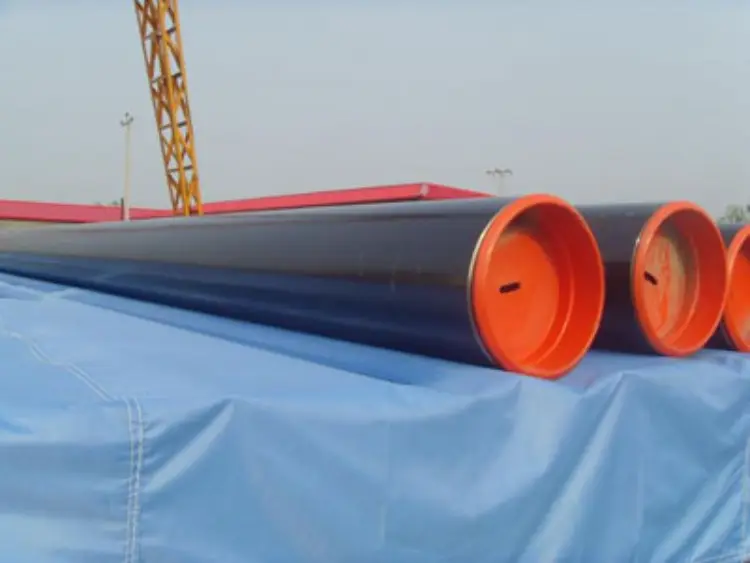
API 5L X56 Pipeline Steel
API 5L X56 Pipeline Steel: High-Strength Low-Alloy for Oil & Gas Transport
Comprehensive material data for API 5L X56 pipeline steel, including chemical composition, mechanical & physical properties, international equivalents, and application guidance.
Controlled rolling, thermo-mechanical controlled processing (TMCP), normalizing, quenching and tempering (if required)
- Phone : +8618037372205
- Email : [email protected]
- WhatsApp: Contact via Whtsapp
- WeChat: +8618037372205
API 5L X56 Pipeline Steel Introduction
API 5L X56 is a high-strength low-alloy (HSLA) steel grade designed for oil and gas transmission pipelines. This grade is defined under the American Petroleum Institute specification 5L, which covers seamless and welded steel line pipe. X56 provides a minimum yield strength of 56 ksi (approximately 390 MPa), offering an excellent balance of strength, toughness, and weldability. It is widely used in onshore and offshore pipelines, pressure piping systems, and structural applications requiring good low-temperature performance.
Key characteristics include:
- Fine-grained microstructure achieved through controlled rolling or thermo-mechanical processing.
- Good resistance to hydrogen-induced cracking (HIC) in sour service when specified with supplementary requirements.
- Compliance with PSL 2 requirements ensures superior toughness and stricter chemical control compared to PSL 1.
- Available in various product forms including plates, coils, and welded or seamless pipes.
API 5L X56 Pipeline Steel Chemical Composition
Typical chemical composition of API 5L X56 PSL 2 pipe as per API 5L Table 4. Limits are maximum unless a range is specified. Carbon equivalent (CEIIW) typically ≤ 0.43% to ensure good field weldability. Microalloying elements such as Nb, V, and Ti are added to refine grain size and improve strength.
| Element | Standard Value (max or range) | Remarks |
|---|---|---|
| C | 0.22% | Maximum for t ≤ 25 mm; for t > 25 mm, max 0.24% |
| Mn | 1.40% | Maximum for all thicknesses |
| P | 0.025% | Maximum |
| S | 0.015% | Maximum; for sour service (HIC) typically ≤ 0.002% |
| Si | 0.45% | Maximum; sometimes lower for improved toughness |
| V | 0.10% | Maximum; combined V+Nb+Ti ≤ 0.15% |
| Nb | 0.05% | Maximum |
| Ti | 0.04% | Maximum |
| Al (total) | 0.020–0.060% | Typical fine-grain practice; soluble Al often specified |
| N | 0.012% | Maximum; nitrogen is typically bound by Ti or Al |
| Cu | 0.50% | Maximum (when specified); may be restricted for certain environments |
| Ni | 0.50% | Maximum (when specified) |
| Cr | 0.30% | Maximum (when specified) |
| Mo | 0.15% | Maximum (when specified) |
| B | 0.001% | Maximum (if added as microalloy) |
API 5L X56 Pipeline Steel Thermal and Electrical Physical Properties
Physical properties are based on typical HSLA pipeline steel data at room temperature unless stated otherwise. These values are not part of API 5L mandatory testing but are provided for design calculations.
| Property | Typical Value | Unit | Test Condition |
|---|---|---|---|
| Density (ρ) | 7.85 | g/cm³ | Room temperature |
| Modulus of Elasticity (E) | 210 | GPa | Room temperature |
| Shear Modulus (G) | 80 | GPa | Calculated from E and ν |
| Poisson's Ratio (ν) | 0.3 | - | Room temperature |
| Thermal Expansion Coefficient (α) | 12.0 × 10⁻⁶ | K⁻¹ | 20 – 100 °C; 12.5 at 20–200 °C |
| Thermal Conductivity (λ) | 45 | W/(m·K) | Room temperature; decreases with temperature |
| Specific Heat Capacity (cₚ) | 475 | J/(kg·K) | Room temperature |
| Electrical Resistivity (ρₑ) | 0.18 | Ω·mm²/m | Room temperature |
API 5L X56 Pipeline Steel Mechanical Properties
Mechanical properties of API 5L X56 PSL 2 base material according to API 5L Table 8. Values depend on product form and testing direction. Transverse tensile properties are mandatory. Charpy V-notch impact testing is required at a specified temperature (commonly -0 °C down to -45 °C for sour or low-temperature service).
| Property | Standard Required Value | Unit | Test Condition |
|---|---|---|---|
| Yield Strength (ReH) | 360 – 530 | MPa | Transverse, based on wall thickness class |
| Tensile Strength (Rm) | 460 – 760 | MPa | Transverse |
| Yield to Tensile Ratio (ReH/Rm) | ≤ 0.93 | - | Maximum allowed for PSL 2 to ensure ductile failure |
| Elongation (A) | ≥ 22 (for t ≤ 20 mm), ≥ 20 (for t > 20 mm) | % | Transverse, gauge length 50 mm |
| Charpy V-notch Impact (KV) | ≥ 27 (avg), ≥ 20 (single) | J | Transverse, at 0 °C (or lower as agreed); typical -10 °C for general, -20 °C for cold service |
| Bend Test (Mandrel Diameter) | 180° bend around mandrel diameter = 3.5t (t = wall thickness) | - | No cracks or openings in weld or base metal |
API 5L X56 Pipeline Steel Complete Equivalent Standards and Replaceable Grades
| Country/Region | Standard | Grade | Remarks |
|---|---|---|---|
| International | ISO 3183 | L390 (PSL 2) | Fully equivalent to API 5L X56 PSL 2 in strength and chemistry. |
| Europe | EN 10208-2 | L390 | European standard for welded steel pipes for combustible fluids; dimensionally interchangeable. |
| China | GB/T 9711 | L390 | Chinese national standard for petroleum and natural gas industry line pipe; equivalent strength. |
| Germany | DIN 17172 (withdrawn) | StE 360 (approximate) | Historical equivalent, still referenced for some legacy projects. |
| Japan | JIS G 3454 | STPG 38 (approximate) | Carbon steel pipes for pressure service, lower strength grade; only functional substitute for low-pressure systems. |
API 5L X56 Pipeline Steel Application Introduction
API 5L X56 steel is primarily used in the transportation of oil, natural gas, and other fluids in the petroleum and petrochemical industries. Its balanced strength and toughness make it suitable for long-distance pipelines across various terrains, including offshore and arctic environments. Supplementary HIC-resistant (sour service) specifications extend its use to hydrogen sulfide-containing media.
Product Applications: Long-distance high-pressure transmission pipelines, Flowlines and gathering lines, Riser pipes and offshore platform piping, Compressor and pumping station piping, Tank farm interconnecting piping, Heavy-wall line pipe for deepwater applications
Processed into products: Line pipe segments (welded or seamless), Induction bends, elbows, tees, reducers, Flanges and bolted connections (made from companion flange material), Valve bodies and fittings (when matched with pipe grade), Structural supports and saddles for piping systems, Piling and structural casings in marine environments
Application industries: Oil & Gas Exploration and Production, Pipeline Transportation (Onshore and Offshore), Petrochemical and Refining Plants, Power Generation (cooling water, steam lines), Marine and Subsea Engineering, Mining and Slurry Transport
API 5L X56 Pipeline Steel Similar / Alternative Material Recommendations
| Country/Region | Standard | Grade | Remarks |
|---|---|---|---|
| USA | API 5L | X52 (L360) | Lower strength grade, similar weldability; can replace X56 in lower-pressure applications or when toughness is more critical. |
| USA | API 5L | X60 (L415) | Higher strength grade; often used as an upgrade with slightly lower ductility; requires careful welding procedure control. |
| Europe | EN 10025-3 | S355ML (Fine-grain structural steel) | Structural steel with similar yield strength (~355 MPa), normalized or TMCP; suitable for non-pipeline structural applications. |
| China | GB/T 1591 | Q390C/Q390D | HSLA structural steel with minimum yield 390 MPa; not intended for pipeline service but can be used for general welded structures. |
Notes:
Supplementary requirements:
- For sour service, HIC and SSC tests according to NACE TM0284 or equivalent are often specified. This may require exceptionally low sulfur content (≤ 0.002%) and Ca treatment for inclusion shape control.
- API 5L X56 can be ordered with PSL 2 (preferred for critical service) which includes mandatory Charpy V-notch testing and stricter chemical limits.
- Weldability is generally good; preheat and interpass temperatures depend on wall thickness and carbon equivalent. Typically, low-hydrogen welding processes are recommended.
- When material is to be used in low-temperature environments (below –30 °C), supplementary impact testing at design temperature is often agreed upon between purchaser and manufacturer.
- Share



