
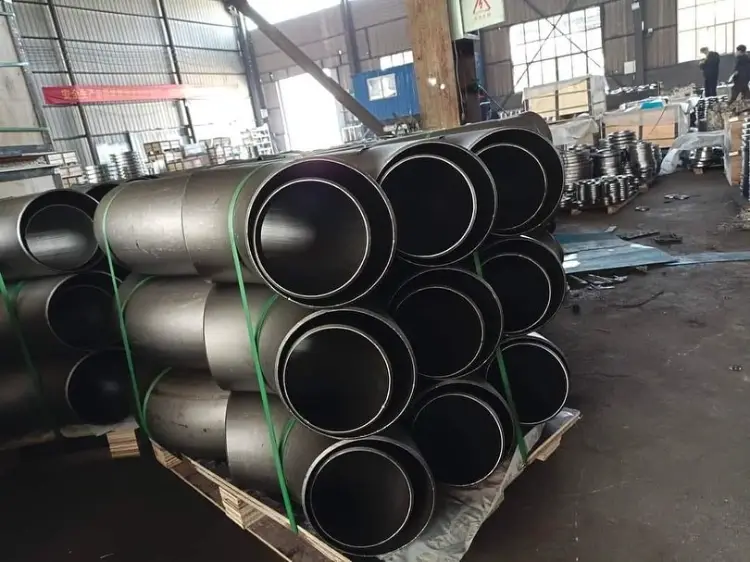
GB/T 9711-2011 L245 PSL1 SSAW Pipe
GB/T 9711-2011 PSL1 L245 SSAW Pipe: Reliable Pipeline Steel for Oil & Gas Transmission
In-depth material data of L245 grade spiral submerged arc welded pipe conforming to GB/T 9711-2011 PSL1, including chemical composition, mechanical properties, and physical characteristics for pipeline engineering.
Hot rolled strip/plate fabricated by spiral submerged arc welding; available with external/internal anti-corrosion coatings (e.g., 3LPE, FBE).
- Phone : +8618037372205
- Email : [email protected]
- WhatsApp: Contact via Whtsapp
- WeChat: +8618037372205
GB/T 9711-2011 L245 PSL1 SSAW Pipe Introduction
L245 steel under GB/T 9711-2011 PSL1 is a carbon-manganese pipeline steel grade primarily used for welded line pipes in petroleum and natural gas transmission systems. The grade name 'L245' specifies a minimum yield strength of 245 MPa, offering a balance of strength, weldability, and ductility. Commonly supplied in SSAW (Spiral Submerged Arc Welded) form, this material is suitable for large-diameter, high-pressure pipelines. It adheres to PSL1 (Product Specification Level 1) requirements, covering basic quality levels with less stringent chemical and mechanical testing compared to PSL2. Typical applications include onshore and offshore flowlines, gathering lines, and distribution networks.
GB/T 9711-2011 L245 PSL1 SSAW Pipe Chemical Composition
Chemical requirements per GB/T 9711-2011, Table 4 for PSL1 L245. The values represent maximum limits unless a range is given. Carbon equivalent (CE) is also controlled to ensure weldability. Microalloying elements like Nb, V, and Ti are not mandatory for PSL1 but may be added at the manufacturer's discretion.
| Element | Specified Value (max, wt%) | Remarks |
|---|---|---|
| Carbon (C) | 0.28 | Heat analysis |
| Manganese (Mn) | 1.20 | Heat analysis |
| Silicon (Si) | — | Not specified in PSL1; typically 0.15–0.35 if deoxidized |
| Phosphorus (P) | 0.030 | Heat analysis |
| Sulfur (S) | 0.030 | Heat analysis |
| Vanadium (V) | — | Not specified for PSL1; commonly ≤0.05 |
| Niobium (Nb) | — | Not specified for PSL1; commonly ≤0.05 |
| Titanium (Ti) | — | Not specified for PSL1; commonly ≤0.04 |
| Carbon Equivalent (CEIIW) | ≤0.43 (typical) | Where CE=C+Mn/6+(Cr+Mo+V)/5+(Ni+Cu)/15, as agreed |
GB/T 9711-2011 L245 PSL1 SSAW Pipe Thermal and Electrical Physical Properties
Physical properties for carbon-manganese steel typical of L245. Values are based on room temperature conditions unless noted. These are not explicitly mandated by GB/T 9711-2011 but are representative for design calculations.
| Property | Typical Value | Unit | Test Condition |
|---|---|---|---|
| Density (ρ) | 7.85 | g/cm³ | At 20°C |
| Elastic Modulus (E) | 205 | GPa | At 20°C |
| Shear Modulus (G) | 80 | GPa | At 20°C |
| Poisson's Ratio (ν) | 0.29 | — | At 20°C |
| Thermal Expansion Coefficient (α) | 11.7 × 10⁻⁶ | K⁻¹ | Between 20–100°C |
| Thermal Conductivity (λ) | 48 | W/(m·K) | At 20°C |
| Specific Heat Capacity | 486 | J/(kg·K) | At 20°C |
| Electrical Resistivity (ρe) | 0.18 × 10⁻⁶ | Ω·m | At 20°C |
GB/T 9711-2011 L245 PSL1 SSAW Pipe Mechanical Properties
Mechanical properties according to GB/T 9711-2011 Table 5, PSL1 for pipe body. Tensile testing is performed transverse to the seam for SSAW pipes. Elongation is based on a gauge length of 50 mm (or 2 in.) and is calculated using a standard formula; the table lists typical requirements. Bend tests are mandatory per standard. Impact testing is not required for PSL1 but may be specified by supplementary agreement; typical values for 0°C Charpy V-notch are shown.
| Property | Required Value | Unit | Test Condition |
|---|---|---|---|
| Yield Strength (ReH) | 245 – 450 | MPa | Transverse, pipe body |
| Tensile Strength (Rm) | 415 – 565 | MPa | Transverse, pipe body |
| Elongation (A) | As per formula: Af = 625 × (At / Rm0.2) but min ≈ 22 (typical for 10 mm wall) | % | Gauge length 50 mm, pipe body |
| Yield to Tensile Ratio (ReH/Rm) | ≤ 0.85 (typical expectation) | — | Not explicitly required for PSL1, but often specified |
| Bend Test (Bend Diameter) | 6 × wall thickness (for wall ≤ 12.7 mm); 8 × wall thickness (for wall > 12.7 mm) | — | 180° bend; no cracks or tears |
| Charpy Impact (KV) at 0°C (if specified) | ≥ 27 (average of 3), ≥ 18 (individual) | J | Transverse, 10×10 mm specimen, 0°C |
GB/T 9711-2011 L245 PSL1 SSAW Pipe Fully Equivalent Material Grades and Substitution Recommendations
| Country/Region | Standard | Grade | Remarks |
|---|---|---|---|
| International (ISO) | ISO 3183:2012 | L245 | Identical technical content; PSL1 |
| United States | API 5L | Grade B (PSL1) | Closest match; yield strength 241 MPa vs. 245 MPa; widely interchangeable in PSL1 applications |
| European Union | EN 10208-1 | L245GA | Steel for pipelines for combustible fluids, similar chemistry and mechanical properties |
| Russia | GOST 33259-2015 | 17G1S-U (analogue for 245 MPa class) | Approximate functional equivalent |
GB/T 9711-2011 L245 PSL1 SSAW Pipe Application Introduction
L245 SSAW pipes under GB/T 9711-2011 PSL1 are extensively used in oil and gas transportation due to their reliable strength, good weldability, and cost-effectiveness. They are suitable for buried, above-ground, and subsea pipelines carrying non-sour fluids under normal design conditions. The spiral weld structure enables economical production of large-diameter pipes (typically 219 mm – 2540 mm OD). Common applications include:
Product Applications: Long-distance cross-country oil pipelines, Natural gas gathering and distribution networks, Subsea flowlines and risers (non-sour service), Fire water systems and cooling water lines, Steel pipe piles and jacket structures
Processed into products: Main line pipe sections (8–12 m lengths), Bends and elbows (induction bends from same pipe), Tee fittings and reducer sections, Flange adapters and connectors, Casing pipes for road/rail crossings
Application industries: Oil and Gas Transmission (Onshore & Offshore), Water Supply and Distribution, Petrochemical and Chemical Processing, Structural and Piling Engineering, Pipeline Rehabilitation and Boring
GB/T 9711-2011 L245 PSL1 SSAW Pipe Similar or Alternative Materials for Reference
| Country/Region | Standard | Grade | Remarks |
|---|---|---|---|
| United States | API 5L | X42 (PSL1) | Higher yield strength (290 MPa) but comparable formability; often used when extra strength is needed |
| China | GB/T 9711-2011 | L290 (X42) | Next higher grade; may be substituted with caution due to strength mismatch |
| European Union | EN 10208-1 | L290GA | Similar role with elevated strength requirements |
| Japan | JIS G 3456 | STPT 370 | Carbon steel pipe for high temperature service; mechanical align to some extent but for different service condition |
Notes:
Supplementary requirements may apply for specific projects, including:
- Hydrostatic testing of every pipe
- Non-destructive testing (UT/RT) of weld seams
- External polyethylene (3LPE) or epoxy coating
- Higher impact toughness (e.g., -20°C Charpy)
- Carbon equivalent limits for improved weldability in field girth welding
PSL1 L245 is not intended for sour service (H₂S-containing environments) unless specifically qualified per NACE MR0175. For critical applications, upgrading to PSL2 L245N or L245M is recommended.
- Share



