
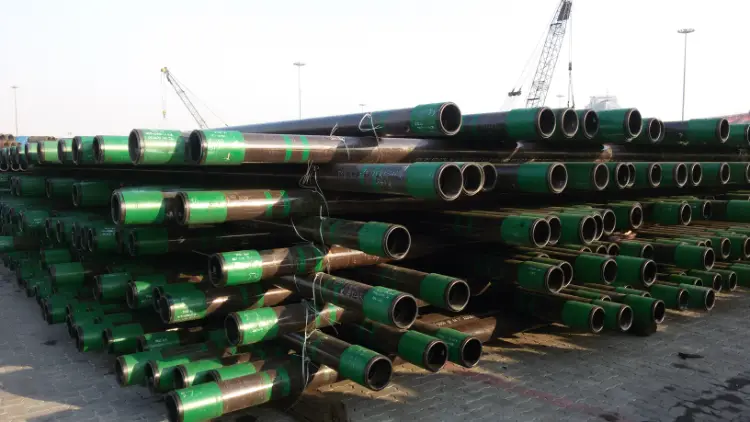
L210 PSL1 SSAW Pipe per GB/T 9711-2011
L210 PSL1 SSAW Pipe per GB/T 9711-2011: Chemical & Mechanical Properties
Complete material data for L210 PSL1 spiral submerged arc welded pipe specified in GB/T 9711-2011. Includes chemical composition, tensile and physical properties, international equivalents, and application guide for oil and gas pipeline systems.
Spiral submerged arc welding, cold forming, SAW longitudinal welding; frequently supplied in as-welded condition
- Phone : +8618037372205
- Email : [email protected]
- WhatsApp: Contact via Whtsapp
- WeChat: +8618037372205
L210 PSL1 SSAW Pipe per GB/T 9711-2011 Introduction
L210 PSL1 is a low-strength pipeline steel grade defined in GB/T 9711-2011 (identical to ISO 3183:2007) for spiral submerged arc welded (SSAW) pipes. It is intended for the transmission of petroleum, natural gas, and water under moderate pressure. The designation "L210" indicates a minimum yield strength of 210 MPa. PSL1 (Product Specification Level 1) represents the standard quality level with basic chemical and tensile requirements, no mandatory impact testing, and no supplementary testing (e.g., HIC or SSCC) unless agreed. This material offers good weldability, adequate ductility, and cost-effectiveness, making it suitable for long-distance onshore pipelines and general structural applications.
L210 PSL1 SSAW Pipe per GB/T 9711-2011 Chemical Composition
The chemical requirements for L210 PSL1 are defined in Table 2 of GB/T 9711‑2011. Only carbon, manganese, phosphorus, and sulfur are subject to mandatory limits. Microalloying elements (V, Nb, Ti) may be added by agreement, but their combined content is restricted. No carbon equivalent (CEV) limit is specified for PSL1.
| Element | Standard Value (max %) | Remarks |
|---|---|---|
| Carbon (C) | 0.22 | Heat analysis; product analysis: +0.02 % tolerance |
| Manganese (Mn) | 0.90 | Heat analysis; product analysis: +0.04 % tolerance |
| Phosphorus (P) | 0.025 | Heat analysis; product analysis tolerance not applicable |
| Sulfur (S) | 0.015 | Heat analysis; product analysis tolerance not applicable |
| V + Nb + Ti | ≤ 0.15 (if added) | Optional; limits by agreement – standard does not mandate their addition |
L210 PSL1 SSAW Pipe per GB/T 9711-2011 Thermal and Electrical Physical Properties
The physical constants listed below are typical for low‑carbon pipeline steels and are not specifically mandated by GB/T 9711‑2011. They are provided as reference for design calculations such as thermal expansion, heat transfer, and eigenfrequency analyses.
| Property | Typical Value | Unit | Conditions |
|---|---|---|---|
| Density (ρ) | 7.85 | g/cm³ | Room temperature |
| Modulus of elasticity (E) | 205 | GPa | Room temperature |
| Shear modulus (G) | 79.3 | GPa | Calculated from E and ν; room temperature |
| Poisson's ratio (ν) | 0.3 | – | Room temperature, elastic range |
| Thermal expansion coefficient (α) | 11.7 | 10⁻⁶ / K | 20–100 °C |
| Thermal conductivity (λ) | 50.7 | W/(m·K) | At 20 °C |
| Specific heat capacity (c) | 486 | J/(kg·K) | At 20 °C |
| Electrical resistivity (ρ_e) | 0.17 | μΩ·m | At 20 °C |
L210 PSL1 SSAW Pipe per GB/T 9711-2011 Mechanical Properties
Tensile testing is performed on flattened transverse specimens taken from the pipe body. PSL1 does not require impact testing or bend testing unless supplementary requirements are specified by the purchaser. Elongation is calculated using the formula given in the standard; the minimum acceptable value is 10 %.
| Property | Required Value | Unit | Test Conditions |
|---|---|---|---|
| Yield strength (ReH / Rt0.5) | ≥ 210 | MPa | Transverse strip test, base metal (0.5 % total extension under load for continuous yielding) |
| Tensile strength (Rm) | ≥ 335 | MPa | Transverse strip test, base metal |
| Elongation after fracture (A) | ≥ calculated value (min. 10 %) | % | A = 1940 · A_xc^0.2 / Rm^0.9; gauge length 50 mm or proportional; A_xc = original cross‑sectional area of test piece (mm²) |
| Bend test | Not required (optional by agreement) | – | Mandatory only for PSL2; for PSL1 can be agreed |
| Charpy V‑notch impact (KV) | Not required (optional by agreement) | J | PSL1 does not stipulate impact energy; test temperature and acceptance criteria to be agreed if invoked |
| Hydrostatic test | Required | – | Each pipe subjected to a hydrostatic test according to standard formula; no leakage allowed |
L210 PSL1 SSAW Pipe per GB/T 9711-2011 Fully Equivalent Material Standards & Substitutable Grades
| Country / Region | Standard | Grade | Remarks |
|---|---|---|---|
| China | GB/T 9711-2011 | L210 PSL1 (SSAW pipe) | Base standard; spiral submerged arc welded pipe |
| International | ISO 3183:2007 | L210 PSL1 | Technically identical to GB/T 9711‑2011 |
| USA | API 5L (46th Ed.) | Grade A PSL1 | Minimum yield strength 205 MPa (slightly lower); chemical composition comparable; can be considered equivalent for many low‑pressure applications |
L210 PSL1 SSAW Pipe per GB/T 9711-2011 Application Introduction
L210 PSL1 SSAW pipe is primarily used in low to medium pressure transmission systems. Its cost‑effective weldability makes it a popular choice for water mains, distribution lines, and structural columns. The material can be formed into various fittings and prefabricated components without impairing its mechanical integrity.
Product Applications: Spiral submerged arc welded pipes, Long seam welded pipes (LSAW) when produced from the same steel, Line pipes for onshore and shallow‑water pipelines, Piling pipes, Water well casings
Processed into products: Pipe bends (induction or cold bends), Equal and reducing tees, Concentric and eccentric reducers, Weld‑neck and slip‑on flanges, Manifolds and headers, Custom fabricated spool pieces
Application industries: Oil and gas gathering and transmission, Water supply and drainage, Structural and civil engineering (piling, bracing), Chemical and petrochemical plants (low‑pressure fluid lines), Slurry and mine tailings transport
L210 PSL1 SSAW Pipe per GB/T 9711-2011 Closely Related / Similar Substitute Materials
| Country / Region | Standard | Grade | Remarks |
|---|---|---|---|
| USA / International | API 5L / ISO 3183 | Grade B / L245 PSL1 | Higher minimum yield strength (245 MPa); often used as an upgrade for increased pressure rating |
| China | GB/T 9711-2011 | L245 PSL1 | Next strength grade in the GB/T 9711 family; offers higher design stress |
| European | EN 10208-1 | L210GA | Similar yield strength (210 MPa) but different standard; used in gas supply pipelines |
Notes:
- PSL1 steel does not impose a mandatory carbon equivalent (CEV) limit; additional requirements (e.g., CEV ≤ 0.43 %) can be agreed for improved field weldability.
- Impact testing, DWT, or corrosion testing (HIC/SSC) is not required by the base standard but may be specified as a supplementary order condition.
- Hydrostatic test pressure is calculated per standard and must be sustained without leakage; pipe ends may be plain, bevelled, or prepared for special connections.
- For sour service or low‑temperature applications, it is advisable to upgrade to a PSL2 grade with stricter chemistry and guaranteed toughness values.
- Share



