
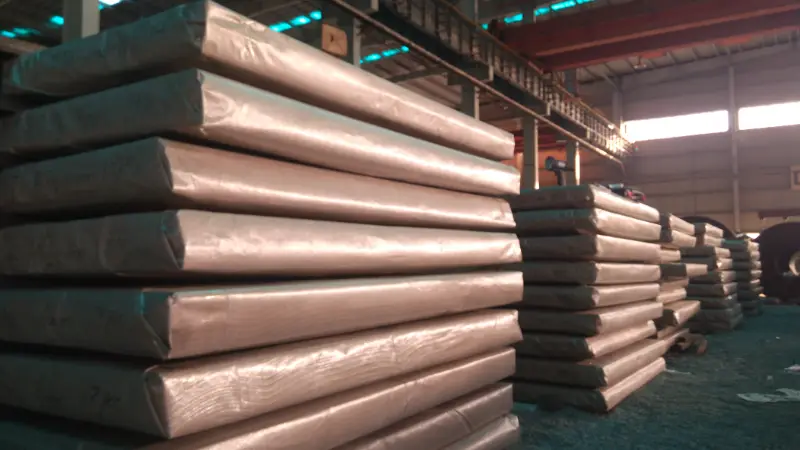
GB/T 4237 022Cr11Ti Ferritic Stainless Steel
022Cr11Ti Ferritic Stainless Steel (GB/T 4237) Data Sheet: Ultra-Low Carbon, Ti-Stabilized Plate/Coil
Complete technical data for 022Cr11Ti hot-rolled stainless steel plate and strip, including chemical composition, mechanical properties, physical properties, international equivalents, and typical applications in exhaust systems and industrial equipment.
Cutting, bending, deep drawing, stamping, welding, cold rolling (after hot rolling), machining
- Phone : +8618037372205
- Email : [email protected]
- WhatsApp: Contact via Whtsapp
- WeChat: +8618037372205
GB/T 4237 022Cr11Ti Ferritic Stainless Steel Introduction
022Cr11Ti is an ultra-low carbon, titanium-stabilized ferritic stainless steel standardized in GB/T 4237 for hot-rolled plates and strips. Its chemical design provides excellent resistance to intergranular corrosion after welding, combined with good oxidation resistance up to moderate temperatures. The alloy offers a balanced combination of formability, weldability, and cost-effectiveness, making it a preferred material for automotive exhaust components, catalytic converter shells, and general industrial applications where atmospheric corrosion resistance and thermal cycling are important.
GB/T 4237 022Cr11Ti Ferritic Stainless Steel Chemical Composition
Chemical composition according to GB/T 4237. The steel is distinguished by ultra-low carbon content and the addition of titanium as a stabilizer. The Ti content is specified relative to the sum of carbon and nitrogen to ensure complete stabilization of interstitial elements, preventing chromium carbide precipitation at grain boundaries during welding.
| Element | Value (wt%) | Remarks |
|---|---|---|
| C | ≤0.030 | - |
| Si | ≤1.00 | - |
| Mn | ≤1.00 | - |
| P | ≤0.040 | - |
| S | ≤0.015 | - |
| Cr | 10.50 ~ 11.75 | - |
| Ti | 6×(C+N) ~ 0.75 | Minimum Ti ensures stabilization; calculated as 6×(C+N) |
| N | ≤0.030 | - |
GB/T 4237 022Cr11Ti Ferritic Stainless Steel Thermal and Electrical Physical Properties
Typical physical properties for the ferritic stainless steel 022Cr11Ti (1.4512 type). These values provide guidance for thermal and structural design calculations. Data are representative for the annealed condition and may vary slightly depending on the exact composition and processing.
| Property | Value | Unit | Test Condition / Temperature |
|---|---|---|---|
| Density (ρ) | 7.7 | g/cm³ | 20°C |
| Modulus of elasticity (E) | 200 | GPa | 20°C |
| Shear modulus (G) | 78 | GPa | 20°C |
| Poisson's ratio (ν) | 0.28 | - | 20°C |
| Thermal expansion coefficient (α) | 10.5 | 10⁻⁶/K | 20 ~ 100°C |
| Thermal expansion coefficient (α) | 11.0 | 10⁻⁶/K | 20 ~ 200°C |
| Thermal expansion coefficient (α) | 11.5 | 10⁻⁶/K | 20 ~ 300°C |
| Thermal expansion coefficient (α) | 12.0 | 10⁻⁶/K | 20 ~ 400°C |
| Thermal expansion coefficient (α) | 12.5 | 10⁻⁶/K | 20 ~ 500°C |
| Thermal conductivity (λ) | 25.0 | W/m·K | 20°C |
| Thermal conductivity (λ) | 25.0 | W/m·K | 100°C |
| Thermal conductivity (λ) | 25.5 | W/m·K | 200°C |
| Thermal conductivity (λ) | 26.0 | W/m·K | 300°C |
| Thermal conductivity (λ) | 26.5 | W/m·K | 400°C |
| Thermal conductivity (λ) | 27.0 | W/m·K | 500°C |
| Specific heat capacity (cp) | 460 | J/kg·K | 20°C |
| Electrical resistivity (ρe) | 0.60 | µΩ·m | 20°C |
GB/T 4237 022Cr11Ti Ferritic Stainless Steel Mechanical Properties
Minimum mechanical property requirements per GB/T 4237 for hot-rolled plate/strip in the solution annealed condition. The values apply to thicknesses commonly supplied. Bend testing demonstrates the material's high ductility and suitability for forming operations.
| Property | Requirements | Unit | Test Condition |
|---|---|---|---|
| Tensile strength (Rm) | ≥380 | MPa | Room temperature, annealed |
| Yield strength (ReH) | ≥175 | MPa | Room temperature, annealed, 0.2% offset |
| Elongation (A) | ≥20 | % | Room temperature, gauge length 50 mm (A50) or proportional specimen |
| Bend test (180°) | Mandrel diameter = 1a | - | Bend angle 180°, a = specimen thickness, no cracks acceptable |
GB/T 4237 022Cr11Ti Ferritic Stainless Steel Fully Equivalent Material Standards and Substitute Grades
| Country / Region | Standard | Grade | Remarks |
|---|---|---|---|
| China | GB/T 4237 | 022Cr11Ti | Ultra-low carbon, Ti-stabilized ferritic stainless steel plate/strip |
| Europe | EN 10088-2 | X2CrTi12 (1.4512) | Identical chemistry and application; fully equivalent |
| International | ISO 15510 | X2CrTi12 | Fully equivalent grade in ISO standard |
| Japan | JIS G4304 | SUS409L | Corresponding low-carbon Ti-stabilized grade; fully equivalent |
GB/T 4237 022Cr11Ti Ferritic Stainless Steel Application Introduction
022Cr11Ti is a versatile ferritic stainless steel designed for demanding environments where corrosion resistance, weldability, and moderate high-temperature performance are required. Its titanium stabilization prevents grain boundary sensitization and intergranular corrosion after welding, making it an ideal choice for fabricated assemblies. Typical processing includes cold forming, deep drawing, and conventional welding techniques.
Product Applications: Exhaust system components (pipes, mufflers, manifolds), Catalytic converter shells and shields, Heat exchangers and recuperators, Storage tanks and containers for mildly corrosive media, Decorative trim and architectural cladding
Processed into products: Automotive exhaust pipes and connectors, Muffler bodies and end caps, Catalytic converter canisters, Welded brackets and mounting hardware, Road tanker bodies, Dishwasher and washing machine parts
Application industries: Automotive and transportation, Industrial equipment manufacturing, Food processing equipment, Architectural and building paneling, Household appliances
GB/T 4237 022Cr11Ti Ferritic Stainless Steel Similar / Comparable Alternative Materials
| Country / Region | Standard | Grade | Remarks |
|---|---|---|---|
| USA | ASTM A240 / A240M | Type 409 (UNS S40900) | Higher carbon content (max 0.08); not fully equivalent in corrosion resistance after welding; suitable for many non-critical applications |
| Europe | EN 10088-2 | 1.4003 (X2CrNi12) | Economical ferritic stainless steel with low carbon and slight nickel addition; different corrosion resistance profile but used in similar structural and automotive applications |
| China | GB/T 4237 | 06Cr13 (0Cr13) | Ferritic stainless steel without Ti stabilization; lower cost, but may require post-weld annealing for optimal corrosion resistance |
Notes:
Welding: 022Cr11Ti can be welded using all common techniques (TIG, MIG, resistance welding) with matching or slightly over-alloyed filler metals (e.g., E/ER409L). To avoid excessive grain growth, heat input should be kept low and interpass temperature controlled below 150°C. Post-weld heat treatment is generally not required. Corrosion: Provides good resistance to atmospheric corrosion, dilute organic acids, and automotive exhaust condensates, but is not suitable for strongly reducing or halogen-containing media. Forming: The annealed condition offers excellent formability comparable to low-carbon steels; however, springback is slightly higher. Delivery: Standard surface finishes include No.1 (hot-rolled, annealed and pickled) and, for cold-rolled products derived from this grade, 2B/2D finishes.
- Share



