
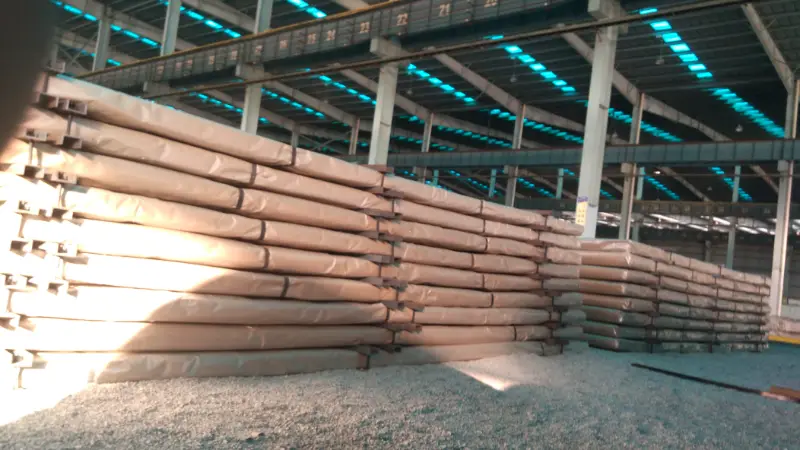
06Cr13Al (0Cr13Al) Ferritic Stainless Steel
06Cr13Al (0Cr13Al) Ferritic Stainless Steel: High-Temperature Oxidation Resistance & Moderate Corrosion Resistance
Comprehensive data sheet for 06Cr13Al (formerly 0Cr13Al) ferritic stainless steel to GB/T 4237. Includes chemical composition, mechanical & physical properties, international equivalents, and typical applications in high-temperature oxidizing environments.
Hot rolling, cold rolling, annealing, pickling, descaling, cutting, forming, bending, welding (with preheat and post-weld heat treatment)
- Phone : +8618037372205
- Email : [email protected]
- WhatsApp: Contact via Whtsapp
- WeChat: +8618037372205
06Cr13Al Ferritic Stainless Steel Introduction
06Cr13Al (designated 0Cr13Al in older standards) is a ferritic chromium stainless steel with a controlled aluminum addition, standardized in China under GB/T 4237 for hot-rolled plates, sheets and strips. It belongs to the AISI 405 type (UNS S40500) and is characterized by good resistance to high-temperature oxidation and sulfur-containing atmospheres, combined with moderate corrosion resistance in mild environments. The alloy exhibits a fully ferritic microstructure at all temperatures, ensuring excellent resistance to stress corrosion cracking and good thermal conductivity. Its aluminum content (0.10–0.30%) promotes the formation of a tightly adherent alumina-rich oxide scale, which significantly enhances oxidation resistance up to approximately 815°C in intermittent service. The steel is typically supplied in the annealed condition, offering a balanced combination of strength (tensile ≥410 MPa) and ductility (elongation ≥20%), with low hardness suitable for forming and bending. Welding is feasible with preheating and post-weld heat treatment, though toughness in thick sections may be limited. 06Cr13Al is widely used in petroleum refining equipment, heat exchangers, automotive exhaust components, and general engineering parts exposed to elevated temperatures and mildly corrosive media.
06Cr13Al Ferritic Stainless Steel Chemical Composition
The chemical composition complies with GB/T 4237-2015 for grade 06Cr13Al. The specified elements are intentionally added; residual elements such as Ni and Cu may be present within the limits shown as residual elements. A balanced Cr and Al content ensures good oxidation resistance and a stable ferritic structure.
| Element | Standard Value | Remarks |
|---|---|---|
| Carbon (C) | ≤0.06 | Key for strength and carbide formation; low level maintains ductility |
| Silicon (Si) | ≤1.00 | Deoxidizer; improves oxidation resistance |
| Manganese (Mn) | ≤1.00 | Deoxidizer and desulfurizer; aids hot workability |
| Phosphorus (P) | ≤0.040 | Impurity; kept low to avoid embrittlement |
| Sulfur (S) | ≤0.030 | Impurity; low content improves hot workability and welding |
| Chromium (Cr) | 11.50 – 14.50 | Primary alloying element for corrosion and oxidation resistance |
| Aluminum (Al) | 0.10 – 0.30 | Enhances high-temperature oxidation resistance by forming Al₂O₃ scale |
| Nickel (Ni) | ≤0.60 | Residual element; not intentionally added |
| Copper (Cu) | ≤0.30 | Residual element; may originate from scrap |
06Cr13Al Ferritic Stainless Steel Thermal and Electrical Physical Properties
Physical properties are based on published data for ferritic stainless steel type AISI 405 (S40500/X6CrAl13). These values are typical and not mandatory in product standards; they serve as design guidelines. Properties are measured at room temperature unless otherwise noted.
| Property | Typical Value | Unit | Test Condition |
|---|---|---|---|
| Density (ρ) | 7.75 | g/cm³ | 20°C |
| Elastic Modulus (E) | 200 | GPa | 20°C, tension |
| Shear Modulus (G) | 77 | GPa | 20°C, calculated from E and ν |
| Poisson's Ratio (ν) | 0.30 | — | 20°C, elastic range |
| Thermal Expansion Coefficient (α) | 10.4 | 10⁻⁶/K | 20–100°C |
| Thermal Expansion Coefficient (α) | 11.2 | 10⁻⁶/K | 20–315°C |
| Thermal Expansion Coefficient (α) | 11.7 | 10⁻⁶/K | 20–540°C |
| Thermal Conductivity (λ) | 27.0 | W/(m·K) | at 100°C |
| Thermal Conductivity (λ) | 26.0 | W/(m·K) | at 500°C |
| Specific Heat Capacity | 460 | J/(kg·K) | 0–100°C |
| Electrical Resistivity (ρₑ) | 0.60 | μΩ·m | 20°C |
06Cr13Al Ferritic Stainless Steel Mechanical Properties
Mechanical properties per GB/T 4237-2015 for hot-rolled plates up to specified thickness (generally ≤12 mm for annealed plate). Tests are performed at room temperature in the annealed condition. Values are minimum unless a range is indicated. Hardness and bending requirements ensure sufficient formability for manufacturing.
| Property | Standard Required Value | Unit | Test Condition |
|---|---|---|---|
| Tensile Strength (Rm) | ≥410 | MPa | Room temperature, longitudinal specimen |
| Yield Strength (Rp0.2) | ≥175 | MPa | Room temperature, 0.2% offset |
| Elongation (A) | ≥20 | % | Gauge length A50 for thickness ≥3 mm; A80 for <3 mm |
| Bend Test (180°) | d=a (mandrel diameter = specimen thickness) | — | No cracks, annealed plate, room temperature |
| Hardness, Brinell | ≤183 | HBW | Typical for annealed material |
| Hardness, Rockwell | ≤88 | HRB | For thicknesses sufficient for rockwell testing |
| Hardness, Vickers | ≤200 | HV | General conversion from HRB |
06Cr13Al Ferritic Stainless Steel Fully Equivalent Material Standards and Substitutable Grades
| Country/Region | Standard | Grade | Remarks |
|---|---|---|---|
| China | GB/T 4237, GB/T 3280 | 06Cr13Al (0Cr13Al, S11348) | Original ferritic Al-killed grade |
| USA | ASTM A240/A240M | Type 405 (UNS S40500) | Same composition and properties; widely used |
| Japan | JIS G4304, JIS G4305 | SUS405 | Identical chemistry and applications |
| Europe | EN 10088-2, EN 10088-3 | X6CrAl13 (1.4002) | Harmonized European designation for ferritic Cr-Al steel |
| International | ISO 15510 | X6CrAl13 | Matches EN and GB grades |
06Cr13Al Ferritic Stainless Steel Application Introduction
06Cr13Al stainless steel is specifically suited for applications demanding resistance to high-temperature oxidation and mild corrosive media. Its aluminum content provides a self-healing protective scale, enabling use in air and sulfur-laden atmospheres up to approximately 815°C. The alloy is readily formed, bent, and moderately welded, making it ideal for structural parts in heat and process industries. Due to limited corrosion resistance in chloride environments, it is not recommended for severe pitting conditions. Typical fabrication includes cutting, bending, rolling, and light drawing.
Product Applications: Heat exchanger shells and tubesheets, Annealing boxes and furnace muffles, Hot gas ducts and expansion joints, Automotive exhaust manifolds and catalytic converter shells, Oil refinery piping and pressure vessel internals
Processed into products: Turbine blades and nozzles (low-stress, high-temperature areas), Flanges, gaskets, and bolting for moderate-temperature service, Welded or bended exhaust system parts, Support brackets and hangers in hot zones, Stamped and formed burner components
Application industries: Petroleum refining and petrochemical processing, Power generation (turbine components, heat recovery), Automotive manufacturing (exhaust systems, mufflers), Industrial furnace and heat treatment equipment, General engineering for moderately elevated temperatures
06Cr13Al Ferritic Stainless Steel Recommendations for Similar/Alternative Grades
| Country/Region | Standard | Grade | Remarks |
|---|---|---|---|
| China | GB/T 4237 | 06Cr13 (S41008) / 0Cr13 | Martensitic stainless steel without Al; higher strength in heat-treated condition, inferior oxidation resistance; suitable where high-temperature scaling is not critical |
| USA | ASTM A240 | Type 409 (UNS S40900, 022Cr11Ti) | Ti-stabilized ferritic grade; better weldability and similar corrosion resistance, widely used in automotive exhaust, but lower oxidation limit |
| Europe | EN 10088-2 | X2CrTi12 (1.4512) | Low-carbon Ti-stabilized 12% Cr steel; good formability and weldability; often used as an alternative for non-Al 12Cr applications |
Notes:
Welding considerations: 06Cr13Al is weldable using standard austenitic or matching ferritic filler metals. To prevent cold cracking, preheat to 150–260°C is recommended, followed by a full anneal at 780–830°C and rapid cooling to restore ductility and remove residual stresses. Grade 06Cr13Al may be subject to 475°C embrittlement after prolonged exposure between 400–500°C; avoid long-term service in this range. In thick sections, toughness at low temperatures may be limited; impact testing is not guaranteed unless agreed. All data above reflects standard requirements; for critical applications, consult the material supplier for specific test reports.
- Share



