
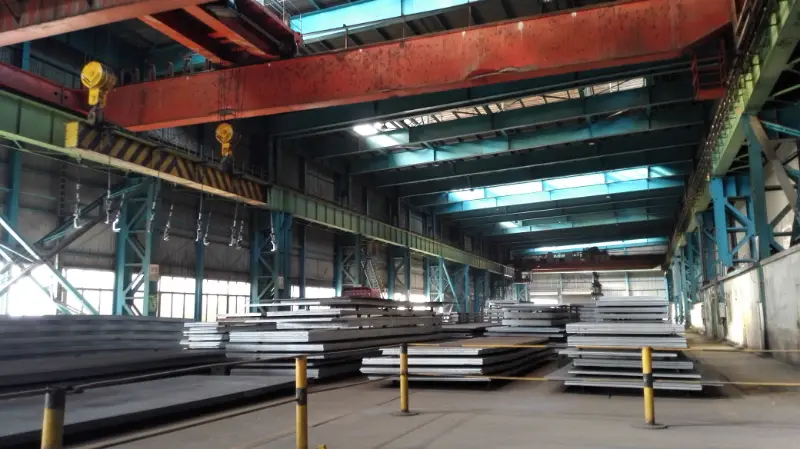
022Cr11NbTi (S11173) Ferritic Stainless Steel Plate/Coil to GB/T 4237
022Cr11NbTi (S11173) Ferritic Stainless Steel Plate/Coil to GB/T 4237: Data & Equivalents
Explore the full material data of 022Cr11NbTi ferritic stainless steel plate and coil, including chemical composition, mechanical properties, thermal and electrical performance, international equivalent grades, and application guidance for automotive exhaust and structural applications.
Hot rolling, cold rolling, annealing and pickling, forming, welding, deep drawing, bending
- Phone : +8618037372205
- Email : [email protected]
- WhatsApp: Contact via Whtsapp
- WeChat: +8618037372205
022Cr11NbTi Ferritic Stainless Steel Plate/Coil to GB/T 4237 Introduction
022Cr11NbTi, designated as S11173 in GB/T 20878, is a niobium‑titanium dual‑stabilized ferritic stainless steel specified in GB/T 4237 for hot‑rolled plates and coils. The grade features an ultra‑low carbon content (≤0.030%) combined with intentional additions of Nb and Ti, which refine grain structure and provide excellent resistance to intergranular corrosion and sensitization during welding. Its 11% chromium content ensures good oxidation resistance up to approximately 800°C, while maintaining toughness and formability at room temperature.
- Excellent weldability with low susceptibility to hot cracking
- Good high‑temperature strength and thermal fatigue resistance
- Superior deep drawability and bending performance
- Cost‑effective alternative to austenitic grades in non‑severe corrosive environments
This material is widely used in automotive exhaust systems, catalytic converter shells, heat exchangers, and architectural panels.
022Cr11NbTi Ferritic Stainless Steel Plate/Coil to GB/T 4237 Chemical Composition
The following table lists the controlled elements for 022Cr11NbTi as specified in GB/T 20878–2007 and referenced by GB/T 4237. The dual stabilization with Nb and Ti ensures carbon and nitrogen are bound, preventing martensite formation and preserving a fully ferritic structure. Residual nickel is ≤0.50%.
| Element | Standard Value (wt%) | Remarks |
|---|---|---|
| Carbon (C) | ≤0.030 | Essential for intergranular corrosion control |
| Silicon (Si) | ≤1.00 | Deoxidizer; promotes oxidation resistance |
| Manganese (Mn) | ≤1.00 | Desulfurizing element |
| Phosphorus (P) | ≤0.040 | Residual element |
| Sulfur (S) | ≤0.015 | Controlled for improved toughness |
| Chromium (Cr) | 10.50–11.70 | Key element for ferrite formation and oxidation resistance |
| Nickel (Ni) | ≤0.50 | Residual; not intentionally added |
| Niobium (Nb) | 0.15–0.50 | Carbonitride former, enhances high‑temperature strength |
| Titanium (Ti) | 0.15–0.50 | Stabilizer, prevents sensitization |
| Nitrogen (N) | ≤0.030 | Controlled to avoid austenite formation |
| Iron (Fe) | Balance | Matrix element |
022Cr11NbTi Ferritic Stainless Steel Plate/Coil to GB/T 4237 Thermal and Electrical Physical Properties
These physical properties are representative for fully‑ferritic 11% Cr stainless steels in the annealed condition. They are not stipulated in GB/T 4237 but are widely accepted engineering data. The low thermal expansion and moderate thermal conductivity suit applications involving thermal cycling, such as exhaust components.
| Property | Typical Value | Unit | Test Condition / Temperature |
|---|---|---|---|
| Density (ρ) | 7.70 | g/cm³ | 20°C |
| Elastic Modulus (E) | 200 | GPa | 20°C |
| Shear Modulus (G) | 77 | GPa | Calculated from E and ν |
| Poisson's Ratio (ν) | 0.30 | — | 20°C |
| Thermal Expansion Coefficient (α) | 10.5 | 10⁻⁶/K | 20–100°C |
| Thermal Expansion Coefficient (α) | 11.0 | 10⁻⁶/K | 20–300°C |
| Thermal Expansion Coefficient (α) | 11.5 | 10⁻⁶/K | 20–500°C |
| Thermal Conductivity (λ) | 25 | W/(m·K) | 20°C |
| Thermal Conductivity (λ) | 28 | W/(m·K) | 500°C |
| Specific Heat Capacity (cp) | 460 | J/(kg·K) | 20°C |
| Electrical Resistivity (ρe) | 0.60 | μΩ·m | 20°C |
022Cr11NbTi Ferritic Stainless Steel Plate/Coil to GB/T 4237 Mechanical Properties
Mechanical properties are specified in GB/T 4237–2015 for hot‑rolled plates and coils in the solution annealed condition. The following values represent minimum requirements at room temperature for thicknesses ≤13.5 mm. The high elongation reflects excellent formability, and the grade maintains good strength at elevated temperatures.
| Property | Standard Requirement Value | Unit | Test Condition |
|---|---|---|---|
| Yield Strength (Rp0.2) | ≥205 | MPa | Room temperature, longitudinal |
| Tensile Strength (Rm) | ≥360 | MPa | Room temperature, longitudinal |
| Elongation (A) | ≥22 | % | Gauge length 50 mm, thickness ≤13.5 mm |
| Hardness | ≤85 | HRB | Annealed condition |
| Bend Test (180°) | D=2a | — | Bend diameter twice the specimen thickness |
022Cr11NbTi Ferritic Stainless Steel Plate/Coil to GB/T 4237 Fully Equivalent Material Standards and Substitutable Grades
| Country / Region | Standard | Grade Designation | Remarks |
|---|---|---|---|
| China | GB/T 4237 | 022Cr11NbTi (S11173) | Reference grade for hot‑rolled plate/coil |
| International | ISO 15510 | X2CrTiNb11 | Identical chemical composition to 022Cr11NbTi |
| USA | ASTM A240 | UNS S40977 | Ti+Nb stabilized 11% Cr ferritic stainless steel |
| Europe | EN 10088‑2 | 1.4003 | X2CrNi12; contains small Ni addition (0.3–1.0%), compositionally very close but not identical; may be accepted as substitute in many applications |
022Cr11NbTi Ferritic Stainless Steel Plate/Coil to GB/T 4237 Application Introduction
022Cr11NbTi is engineered for applications where a combination of moderate corrosion resistance, excellent oxidation resistance up to 800°C, and good formability is required. Its dual stabilization makes it especially suitable for welded fabrications that undergo thermal cycling.
Product Applications: Hot‑rolled plate and coil for exhaust manifold stampings, Cold‑rolled strip for deep‑drawn muffler bodies, Welded pipes for exhaust tubing and catalytic converter shells, Pre‑fabricated architectural panels and curtain walls, Heat exchanger plates and shell‑and‑tube components
Processed into products: Press‑formed muffler shells and end caps, Bent and welded exhaust pipes and flanges, Laser‑welded or resistance‑welded catalytic converter bodies, Deep‑drawn components for automotive EGR coolers, Brackets, heat shields, and mounting hardware
Application industries: Automotive (exhaust systems, catalytic converters, mufflers), Railway and mass transportation (exhaust components, body panels), Industrial heat recovery (heat exchangers, economizers), Architecture and construction (roofing, cladding, structural elements), Home appliances (oven components, flue pipes)
022Cr11NbTi Ferritic Stainless Steel Plate/Coil to GB/T 4237 Similar / Alternative Materials for Comparison
| Country / Region | Standard | Grade Designation | Remarks |
|---|---|---|---|
| Europe | EN 10088‑2 | 1.4512 (X2CrTi12) | Ti‑only stabilized; slightly lower oxidation resistance; widely used in exhaust systems |
| USA | ASTM A240 | Type 409 (UNS S40900) | Ti‑only stabilized; standard automotive exhaust grade; Nb absent |
| Japan | JIS G4304 | SUS409L | Ti‑stabilized; equivalent to 1.4512 |
| China | GB/T 4237 | 06Cr11Ti (S11168) | Ti‑stabilized; similar application but without Nb, lower high‑temperature strength |
Notes:
Welding Considerations: The low carbon content and Nb+Ti stabilization allow excellent weldability without preheating. Filler metals matching 022Cr11NbTi (e.g., AWS ER409Nb) are recommended to preserve stabilization. Post‑weld annealing is usually not required, but pickling to remove heat tint improves corrosion resistance. Forming: The material shows good deep drawability and bending; however, due to the ferritic structure, forming at room temperature may cause slight surface roughening (ridging). Warm forming above 150°C can reduce this effect. Surface Finish: Supplied in 1D (hot‑rolled, annealed, pickled) or 2D (cold‑rolled, annealed, pickled) finishes; bright annealing (2B) is available for aesthetic applications.
- Share



