
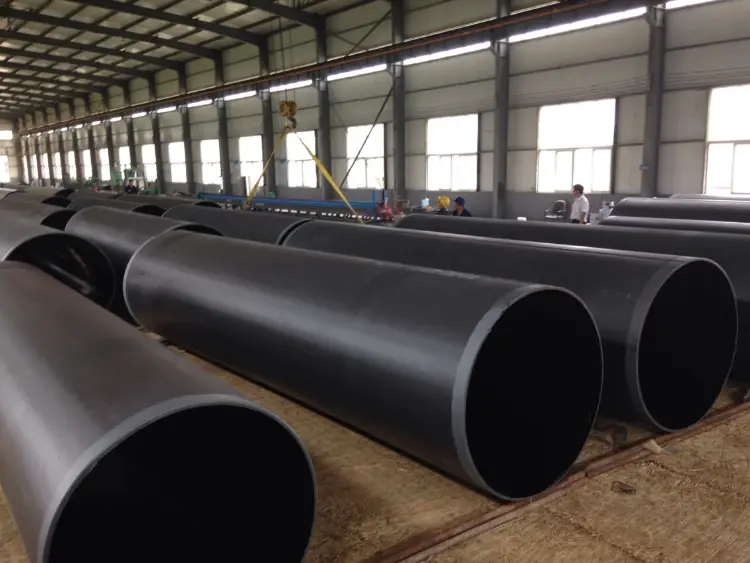
GB 5310 10Cr9Mo1VNbN Alloy Steel Pipe
GB 5310 10Cr9Mo1VNbN Alloy Steel Pipe for High-Temperature Boiler and Pressure Vessel Service
Comprehensive material data for 10Cr9Mo1VNbN steel under GB 5310 standard, including chemical composition, mechanical and physical properties, international equivalents, and application guidance for power generation and petrochemical industries.
Hot-rolled, cold-drawn, heat treatment (normalizing + tempering)
- Phone : +8618037372205
- Email : [email protected]
- WhatsApp: Contact via Whtsapp
- WeChat: +8618037372205
GB 5310 10Cr9Mo1VNbN Alloy Steel Pipe Introduction
10Cr9Mo1VNbN is a high-chromium martensitic heat-resistant alloy steel pipe specified in GB 5310, designed for seamless boiler tubes and pressure vessels in elevated temperature service. It features 9% chromium, molybdenum, vanadium, niobium, and controlled nitrogen additions to provide exceptional creep rupture strength, oxidation resistance, and corrosion resistance at temperatures up to 600°C. Key characteristics include:
- Excellent thermal fatigue and creep resistance for long-term high-temperature exposure
- Good weldability with proper preheating and post-weld heat treatment
- High tensile and yield strength in both ambient and elevated temperature conditions
- Wide application in ultra-supercritical (USC) power plant boilers, headers, and steam piping
GB 5310 10Cr9Mo1VNbN Alloy Steel Pipe Chemical Composition
The chemical composition of 10Cr9Mo1VNbN according to GB 5310 is precisely controlled to ensure optimal creep rupture strength and oxidation resistance. Key elements such as chromium, molybdenum, vanadium, and niobium provide solution strengthening and carbide/nitride precipitation hardening. Nitrogen is intentionally added to enhance creep strength through fine dispersed nitrides. The phosphorus and sulfur contents are strictly limited to maintain toughness and weldability.
| Element | Standard Value | Remarks |
|---|---|---|
| Carbon (C) | 0.08 - 0.12 | Key for hardenability and carbide formation |
| Silicon (Si) | 0.20 - 0.50 | Deoxidizer, improves oxidation resistance at high temperature |
| Manganese (Mn) | 0.30 - 0.60 | Deoxidizer and desulfurizer, enhances hot workability |
| Phosphorus (P) | ≤ 0.020 | Controlled as impurity for toughness |
| Sulfur (S) | ≤ 0.010 | Controlled as impurity for hot workability and weldability |
| Chromium (Cr) | 8.00 - 9.50 | Primary element for oxidation and corrosion resistance |
| Molybdenum (Mo) | 0.85 - 1.05 | Solid solution strengthener, improves creep resistance |
| Vanadium (V) | 0.18 - 0.25 | Precipitation strengthening via V(C,N) and VN |
| Niobium (Nb) | 0.06 - 0.10 | Forms fine Nb(C,N) precipitates for grain refinement and creep strength |
| Nitrogen (N) | 0.030 - 0.070 | Enhances creep strength through nitride and carbonitride precipitation |
| Aluminum (Al) | ≤ 0.040 | Trace residual element; limited for inclusion control |
| Nickel (Ni) | ≤ 0.40 | May be present as residual; limited to avoid phase stability issues |
| Titanium (Ti) | ≤ 0.010 | Controlled to very low level to prevent coarse TiN |
| Zirconium (Zr) | ≤ 0.010 | Trace element; may be present but not specified |
GB 5310 10Cr9Mo1VNbN Alloy Steel Pipe Thermal and Electrical Physical Properties
Physical properties of 10Cr9Mo1VNbN are critical for design and operation of high-temperature components. The data represent typical values for the alloy in the quenched and tempered condition. Thermal conductivity and expansion coefficient influence thermal stress and fatigue life under cyclic operation. The lower thermal expansion compared to austenitic stainless steels provides better dimensional stability. Electrical resistivity is relevant for induction heating calculations.
| Property Item | Typical Value | Unit | Test Condition |
|---|---|---|---|
| Density (ρ) | 7.80 | g/cm³ | At 20°C |
| Elastic Modulus (E) | 216 | GPa | At 20°C |
| Elastic Modulus (E) | 195 | GPa | At 500°C |
| Elastic Modulus (E) | 180 | GPa | At 600°C |
| Shear Modulus (G) | 84 | GPa | At 20°C, calculated |
| Poisson's Ratio (ν) | 0.29 | --- | At 20°C |
| Mean Coefficient of Thermal Expansion (α) | 11.0 × 10⁻⁶ | 1/K | 20 - 100°C |
| Mean Coefficient of Thermal Expansion (α) | 11.8 × 10⁻⁶ | 1/K | 20 - 300°C |
| Mean Coefficient of Thermal Expansion (α) | 12.2 × 10⁻⁶ | 1/K | 20 - 500°C |
| Mean Coefficient of Thermal Expansion (α) | 12.5 × 10⁻⁶ | 1/K | 20 - 600°C |
| Thermal Conductivity (λ) | 28 | W/(m·K) | At 20°C |
| Thermal Conductivity (λ) | 30 | W/(m·K) | At 500°C |
| Thermal Conductivity (λ) | 31 | W/(m·K) | At 600°C |
| Specific Heat Capacity (cp) | 460 | J/(kg·K) | At 20°C |
| Specific Heat Capacity (cp) | 550 | J/(kg·K) | At 500°C |
| Specific Heat Capacity (cp) | 600 | J/(kg·K) | At 600°C |
| Electrical Resistivity (ρe) | 0.60 | μΩ·m | At 20°C |
GB 5310 10Cr9Mo1VNbN Alloy Steel Pipe Mechanical Properties
Mechanical properties of 10Cr9Mo1VNbN seamless pipes under GB 5310 are evaluated at room temperature and elevated temperatures after normalizing and tempering heat treatment. The specified values ensure adequate load-bearing capacity and ductility for high-temperature pressure parts. Yield strength, tensile strength, elongation, and impact toughness are the key acceptance criteria. Values depend on wall thickness and product form; typical data for pipe thickness ≤ 30 mm are provided. Hardness is commonly controlled within 180-250 HBW.
| Property Item | Standard Required Value | Unit | Test Condition |
|---|---|---|---|
| Yield Strength (ReH) | ≥ 415 | MPa | Room Temperature (20°C) |
| Tensile Strength (Rm) | 585 - 760 | MPa | Room Temperature (20°C) |
| Elongation after Fracture (A, longitudinal) | ≥ 20 | % | Gauge length 5.65√S0, Room Temperature |
| Elongation after Fracture (A, transverse) | ≥ 16 | % | Gauge length 5.65√S0, Room Temperature |
| Impact Energy (KV2, longitudinal) | ≥ 40 | J | Charpy V-notch, Room Temperature |
| Impact Energy (KV2, transverse) | ≥ 27 | J | Charpy V-notch, Room Temperature |
| Bend Test (Bend Angle 180°) | No cracks or defects | --- | Bend diameter 3× specimen thickness for wall thickness ≤ 25 mm |
| Bend Test (Bend Angle 180°) | No cracks or defects | --- | Bend diameter 4× specimen thickness for wall thickness > 25 mm |
| Yield Strength at 500°C (Rp0.2) | ≥ 280 (Typical) | MPa | Elevated Temperature Reference |
| Yield Strength at 550°C (Rp0.2) | ≥ 230 (Typical) | MPa | Elevated Temperature Reference |
| Tensile Strength at 500°C (Rm) | ≥ 350 (Typical) | MPa | Elevated Temperature Reference |
| Tensile Strength at 550°C (Rm) | ≥ 300 (Typical) | MPa | Elevated Temperature Reference |
| Brinell Hardness (HBW) | 180 - 250 | --- | After final heat treatment, reference |
| Rupture Strength 100,000 h at 600°C | ≥ 98 (Typical) | MPa | Creep rupture test, extrapolated |
GB 5310 10Cr9Mo1VNbN Alloy Steel Pipe Complete Equivalent Material Standards and Replaceable Grade Recommendations
| Country/Region | Standard | Grade | Remarks |
|---|---|---|---|
| China | GB 5310 | 10Cr9Mo1VNbN | Base standard; seamless boiler tubes and pipes |
| USA | ASTM A213/A213M | T91 | Seamless ferritic and austenitic alloy-steel boiler, superheater, and heat-exchanger tubes; widely used in power plants |
| USA | ASTM A335/A335M | P91 | Seamless ferritic alloy-steel pipe for high-temperature service; main steam and hot reheat piping |
| EU | EN 10216-2 | X10CrMoVNb9-1 (1.4903) | Seamless steel tubes for pressure purposes with specified elevated temperature properties; identical chemistry |
| Japan | JIS G 3458 | STPA 28 | Alloy steel pipes for high temperature service; equivalent to P91 class |
| Japan | JIS G 3462 | STBA 28 | Alloy steel boiler and heat exchanger tubes; equivalent to T91 class |
| ISO | ISO 2604-2 | TS9 | Steel products for pressure purposes – quality requirements – Part 2: Seamless tubes |
| India | IS 14448 | 9Cr-1Mo-V-Nb | Indian standard for boiler and superheater tubes, equivalent composition |
GB 5310 10Cr9Mo1VNbN Alloy Steel Pipe Application Introduction
10Cr9Mo1VNbN is primarily engineered for the most demanding high-temperature sections of modern power generation and process plants. Its excellent creep strength and corrosion resistance make it the standard material for ultra-supercritical steam conditions. Careful fabrication practices, including controlled heat input during welding and mandatory post-weld heat treatment, are essential to maintain joint integrity and toughness.
Product Applications: Ultra-supercritical boiler superheaters and reheaters, Main steam and hot reheat piping systems, High-temperature boiler headers and manifolds, Steam turbine crossover piping, Hydroprocessing furnace tubes in oil refineries
Processed into products: Seamless tubes for superheater/reheater bundles (straight lengths and U-bends), Thick-walled headers with forged outlet connections, Seamless pipes for main steam and hot reheat circuits (large diameter, heavy wall), Reducers, tees, and elbows fabricated from pipe, P91 pre-fabricated spools with welded supports, Tube-to-tube friction or orbital welded panels
Application industries: Fossil fuel and biomass power generation plants (USC and supercritical boilers), Nuclear power plant secondary circuit piping, Petrochemical and refinery processing (catalytic crackers, reformers), District heating and combined heat and power (CHP) systems, Waste incineration and energy recovery boilers
GB 5310 10Cr9Mo1VNbN Alloy Steel Pipe Similar/Comparable Substitute Material Recommendations
| Country/Region | Standard | Grade | Remarks |
|---|---|---|---|
| EU | EN 10216-2 | X10CrWMoVNb9-2 (P92) | Contains tungsten (W) for improved creep strength; used for thicker sections and higher temperatures up to 620°C |
| USA | ASTM A335/A335M | P92 | Enhanced martensitic steel with W and B; higher creep rupture strength than P91; may replace P91 in advanced USC plants |
| Japan | JIS G 3458 | STPA 29 | Japanese grade equivalent to P92; enhanced creep performance |
| China | GB 5310 | 10Cr9MoW2VNbBN (P92) | National standard grade for P92; higher temperature capability; not direct substitute but successor in some designs |
| USA | ASTM A213/A213M | T22 (2.25Cr-1Mo) | Lower chromium version; used at lower temperatures up to 550°C; may be economic substitute where 9Cr not needed |
Notes:
Fabrication and Inspection Notes:
- Heat treatment: Normalize at 1040-1090°C followed by tempering at 730-800°C.
- Welding requires preheating to 200-300°C and immediate post-weld heat treatment at 730-760°C.
- Hardness testing after PWHT should be within specified limits (typically 180-250 HBW) to ensure adequate creep ductility.
- Hydrogen bake-out may be required before PWHT for heavy sections.
- NDT: Ultrasonic or eddy current testing per GB 5777 or equivalent is mandatory for seamless pipes.
- Share



