
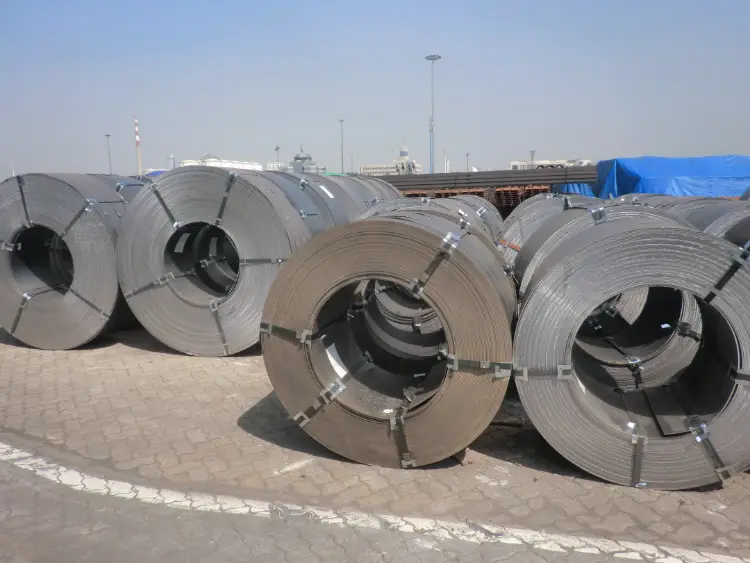
ASTM A572 Grade 55 Carbon and Low-Alloy High-Strength Steel Coil
ASTM A572 Grade 55 Carbon and Low-Alloy High-Strength Steel Coil: Properties, Equivalents & Applications
Comprehensive analysis of ASTM A572 Grade 55 steel coil, covering chemical composition, mechanical and thermal properties, international equivalents, and application guide.
Hot rolling, cold forming, machining, welding, shot blasting
- Phone : +8618037372205
- Email : [email protected]
- WhatsApp: Contact via Whtsapp
- WeChat: +8618037372205
ASTM A572 Grade 55 Carbon and Low-Alloy High-Strength Steel Coil Introduction
ASTM A572 Grade 55 is a high-strength low-alloy (HSLA) structural steel specified in ASTM A572/A572M. It is characterized by a minimum yield strength of 55 ksi (380 MPa) and a minimum tensile strength of 70 ksi (485 MPa). The grade is typically supplied as hot-rolled coils and plates, offering excellent strength-to-weight ratio, good weldability, and moderate corrosion resistance.
- Key features: improved strength over plain carbon steel while maintaining formability
- Commonly used in structural applications such as bridges, buildings, and heavy equipment
- Contains micro-alloying elements like niobium, vanadium, or titanium for grain refinement and precipitation strengthening
ASTM A572 Grade 55 Carbon and Low-Alloy High-Strength Steel Coil Chemical Composition
Chemical requirements per ASTM A572/A572M for Grade 55. In addition to the base elements, the steel must contain at least one of the grain-refining elements (Nb, V, Ti, etc.) in the specified minimum amount. Note: Silicon is optional and may be specified by the purchaser. The values below are maximums unless a range is given.
| Element | Standard Value (max %) | Remarks |
|---|---|---|
| Carbon (C) | 0.25 | Max |
| Manganese (Mn) | 1.35 | Max |
| Phosphorus (P) | 0.040 | Max |
| Sulfur (S) | 0.050 | Max |
| Silicon (Si) | 0.15 – 0.40 | If specified; may be omitted |
| Niobium (Nb) | 0.005 – 0.05 | Minimum one grain refiner required |
| Vanadium (V) | 0.01 – 0.15 | Minimum one grain refiner required |
| Titanium (Ti) | 0.006 – 0.04 | Optional grain refiner |
| Nitrogen (N) | 0.015 max (if combined with V) | Optional; for vanadium-nitrogen strengthening |
ASTM A572 Grade 55 Carbon and Low-Alloy High-Strength Steel Coil Thermal and Electrical Physical Properties
Typical physical properties for low-alloy steel at room temperature, unless otherwise noted. These values are representative for ASTM A572 Grade 55 and are not mandatory part of the standard. They assist in design calculations.
| Property | Typical Value | Unit | Test Condition |
|---|---|---|---|
| Density (ρ) | 7.85 | g/cm³ | Room temperature |
| Elastic Modulus (E) | 200 | GPa | Room temperature |
| Shear Modulus (G) | 80 | GPa | Calculated from E and ν |
| Poisson's Ratio (ν) | 0.3 | — | Room temperature |
| Thermal Expansion Coefficient (α) | 12.0 | 10⁻⁶/°C | Ambient to 100°C |
| Thermal Conductivity (λ) | 50 | W/(m·K) | At 20°C |
| Specific Heat Capacity (c) | 450 | J/(kg·K) | Room temperature |
| Electrical Resistivity (ρₑ) | 0.15 | µΩ·m | At 20°C |
ASTM A572 Grade 55 Carbon and Low-Alloy High-Strength Steel Coil Mechanical Properties
Tensile and bending properties as required by ASTM A572/A572M for Grade 55. Elongation values depend on material thickness and specimen type (e.g., 50 mm or 200 mm gauge length). Bend test requirements are typically specified as 180° cold bending around a pin of specified diameter.
| Property | Standard Requirement | Unit | Test Condition |
|---|---|---|---|
| Yield Strength (ReH) | ≥ 55 | ksi (MPa) | 380 min, for thicknesses ≤ 4 in. (100 mm) |
| Tensile Strength (Rm) | ≥ 70 | ksi (MPa) | 485 min |
| Elongation (A) - 50 mm | ≥ 17 | % | Thickness ≤ 20 mm (0.75 in.) |
| Elongation (A) - 50 mm | ≥ 17 | % | Thickness 20–40 mm (0.75–1.5 in.) |
| Elongation (A) - 50 mm | ≥ 16 | % | Thickness 40–80 mm (1.5–3 in.) |
| Elongation (A) - 200 mm | ≥ 14 | % | Thickness ≤ 20 mm (alternative specimen) |
| Bend Test (bend diameter) | 1.5 t | — | Thickness ≤ 20 mm (0.75 in.), 180° bend |
| Bend Test (bend diameter) | 2 t | — | Thickness 20–40 mm (0.75–1.5 in.), 180° bend |
ASTM A572 Grade 55 Carbon and Low-Alloy High-Strength Steel Coil Internationally Equivalent Standards and Substitutable Grades
| Country/Region | Standard | Grade | Remarks |
|---|---|---|---|
| Europe | EN 10025-3 | S460N / S460M | Higher yield (460 MPa); not directly equal but often used for higher strength. Grade 55 fills a gap between S355 and S460. |
| China | GB/T 1591 | Q390 (e.g., Q390C/D/E) | Yield ≥390 MPa, tensile 490–650 MPa; closest Chinese match but slightly higher yield requirement. |
| Japan | JIS G3106 | SM490A / SM490B | Tensile strength 490–610 MPa, yield 325–365 MPa; lower yield than Grade 55. |
| International | ISO 4950-2 | E390 / E420 | Yield 390–420 MPa; E390 is similar but not identical. |
ASTM A572 Grade 55 Carbon and Low-Alloy High-Strength Steel Coil Application Introduction
ASTM A572 Grade 55 is a versatile structural steel widely used in welded construction where weight savings are important. Its high strength and good formability make it suitable for a broad range of applications. Typical fabrication methods include
- Shearing, punching, and bending (cold forming)
- Gas cutting and plasma cutting
- All common welding processes (SMAW, GMAW, FCAW, SAW) with low-hydrogen practices recommended for thicker sections
- Hot-dip galvanizing for corrosion protection
Product Applications: Steel coils and sheets for roll-formed sections, Hot-rolled plates for fabrication, Structural shapes (H-beams, channels, angles) produced to ASTM A572 Grade 55, Welded pipes and hollow sections, Painted or galvanized components
Processed into products: Bridge girders and diaphragms, Columns and beams in steel-framed buildings, Chassis members and frame rails for heavy trucks, Boom and arm plates for excavators, Tower sections for wind turbines, Bulkheads and stiffeners in ship hulls, Base plates and connection plates
Application industries: Construction and Infrastructure (buildings, bridges, stadiums), Transportation (truck frames, trailers, railcars, shipbuilding), Energy (transmission towers, wind turbine towers, offshore platforms), Heavy Machinery (crane booms, excavator arms, agricultural equipment), Storage and Material Handling (silos, storage tanks, pressure vessels subject to code limitations)
ASTM A572 Grade 55 Carbon and Low-Alloy High-Strength Steel Coil Similar or Closely Matching Alternative Materials
| Country/Region | Standard | Grade | Remarks |
|---|---|---|---|
| USA | ASTM A572 | Grade 50 | Lower yield (50 ksi); same family, often a cost-effective alternative when strength allows. |
| USA | ASTM A588 | Grade A / B | Weathering steel with similar strength (50 ksi yield), but better corrosion resistance. |
| Europe | EN 10025-2 | S355J2 / S355K2 | Yield 355 MPa; lower strength, but widely available and may be upgraded by thickness reduction. |
| Europe | EN 10025-3 | S420N / S420M | Yield 420 MPa; higher strength, can substitute Grade 55 with slight design modifications. |
| China | GB/T 1591 | Q420 | Yield ≥420 MPa, higher; can be used as a stronger alternative. |
Notes:
Additional Information: Charpy impact requirements (e.g., at 0°C, -20°C) are not mandatory by default but can be ordered under Supplementary Requirement S5 in ASTM A572. When toughness is required, fine-grain practice with controlled rolling or normalizing is recommended. The typical carbon equivalent (CEV) for Grade 55 is around 0.38–0.43%, ensuring good weldability with appropriate preheat. Always consult the latest ASTM A572/A572M standard and the steel producer's data sheet for the specific product form and thickness.
- Share



