
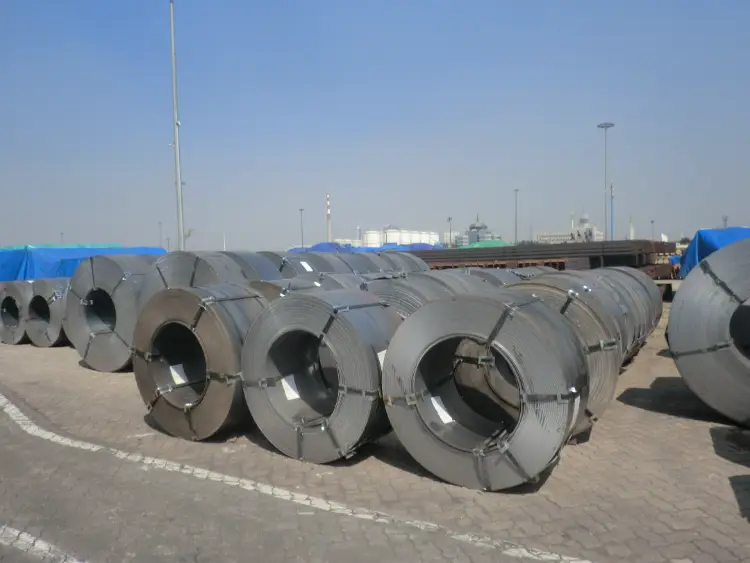
ASTM A572 Grade 50 Steel Coil
ASTM A572 Grade 50 Steel Coil: In-Depth Material Data for High-Strength Structural Applications
Complete technical reference for ASTM A572 Grade 50 carbon and low-alloy high-strength steel coil. Includes chemical composition, mechanical and physical properties, international equivalents, and detailed application guide for construction and heavy engineering.
Hot rolling, controlled rolling, cold forming, welding, gas cutting, machining, punching
- Phone : +8618037372205
- Email : [email protected]
- WhatsApp: Contact via Whtsapp
- WeChat: +8618037372205
ASTM A572 Grade 50 Steel Coil Introduction
ASTM A572 Grade 50 is a high-strength low-alloy (HSLA) structural steel designed to provide enhanced mechanical properties and improved weldability compared to conventional carbon steels. It is characterized by a fine-grained microstructure achieved through microalloying elements such as niobium and vanadium, which promote precipitation strengthening and grain refinement. The steel exhibits a minimum yield strength of 345 MPa (50 ksi) and a minimum tensile strength of 450 MPa (65 ksi), making it suitable for weight-saving designs in heavy structures. Its low carbon content and controlled chemistry ensure excellent formability, toughness, and crack resistance, especially in thick sections. Typical delivery condition is hot-rolled coil or plate, and it can be subsequently processed by cutting, bending, welding, and machining with standard practices. The grade is widely accepted in building and bridge construction, offshore platforms, transportation equipment, and heavy machinery due to its balanced combination of strength, ductility, and cost-effectiveness.
ASTM A572 Grade 50 Steel Coil Chemical Composition
The chemical requirements for ASTM A572 Grade 50 are intended to provide a good balance of strength, weldability, and toughness. The maximum limits are given for carbon, manganese, phosphorus, and sulfur. Silicon is not mandatory but is typically specified when the steel is deoxidized. Microalloying elements such as niobium, vanadium, and titanium may be added singly or in combination to achieve grain refinement and precipitation strengthening, though they are not mandated by the standard.
| Element | Standard Value (max %) | Remarks |
|---|---|---|
| Carbon (C) | 0.23 | Improves strength; higher levels may reduce weldability. |
| Manganese (Mn) | 1.35 | Essential for strength and hardenability; may be increased by agreement for thicknesses > 40 mm. |
| Phosphorus (P) | 0.030 | Impurity; kept low to avoid embrittlement. |
| Sulfur (S) | 0.030 | Impurity; controlled for improved toughness and formability. |
| Silicon (Si) | 0.40 | Optional deoxidizer; value applies only if Si is specified in the purchase order. |
| Niobium (Nb) / Vanadium (V) / Titanium (Ti) | Not specified | Microalloying elements may be added for grain refinement and precipitation strengthening; typical combined additions are below 0.15%. |
ASTM A572 Grade 50 Steel Coil Thermal and Electrical Properties
The following physical properties are not mandated by ASTM A572/A572M but represent typical values for low-carbon, high-strength structural steel in the rolled condition. Actual values may vary slightly depending on production route, thickness, and testing temperature. These data are useful for engineering calculations related to thermal expansion, heat transfer, and structural behavior.
| Property | Typical Value | Unit | Test Condition |
|---|---|---|---|
| Density (ρ) | 7.85 | g/cm³ | Room temperature |
| Modulus of Elasticity (E) | 200–210 | GPa | Room temperature |
| Shear Modulus (G) | 80 | GPa | Room temperature |
| Poisson's Ratio (ν) | 0.30 | Dimensionless | Room temperature |
| Thermal Expansion Coeff. (α) | 12.0 | 10⁻⁶/°C | 20–100 °C |
| Thermal Expansion Coeff. (α) | 12.5 | 10⁻⁶/°C | 20–200 °C |
| Thermal Expansion Coeff. (α) | 13.0 | 10⁻⁶/°C | 20–300 °C |
| Thermal Conductivity (λ) | 45 | W/(m·K) | at 20 °C |
| Specific Heat Capacity | 470 | J/(kg·K) | at 20 °C |
| Electrical Resistivity (ρ_e) | 0.15–0.16 | µΩ·m | at 20 °C |
ASTM A572 Grade 50 Steel Coil Mechanical Properties
The mechanical properties are determined on test specimens taken from rolled products in the as-delivered condition. The values below conform to ASTM A572/A572M for Grade 50 and apply to coils, plates, and cut lengths up to 100 mm (4 in.) in thickness. Unlike grades with specific impact requirements, Grade 50 does not mandate notch toughness testing unless specified in the purchase order. Therefore, Charpy impact values are not included in the standard requirements.
| Property | Standard Requirement | Unit | Test Condition |
|---|---|---|---|
| Yield Strength (ReH) | ≥ 345 (≥ 50) | MPa (ksi) | Transverse test, thickness ≤ 100 mm |
| Tensile Strength (Rm) | ≥ 450 (≥ 65) | MPa (ksi) | Transverse test, thickness ≤ 100 mm |
| Elongation (A, 200 mm gauge) | ≥ 18 | % | Thickness ≤ 20 mm (≤ 3/4 in.) |
| Elongation (A, 50 mm gauge) | ≥ 21 | % | Thickness ≤ 20 mm (≤ 3/4 in.) |
| Elongation (A, 200 mm gauge) | ≥ 17 | % | Thickness 20–50 mm (>3/4 to 1.5 in.) |
| Elongation (A, 50 mm gauge) | ≥ 19 | % | Thickness 20–50 mm (>3/4 to 1.5 in.) |
| Bending – Longitudinal (180°) | Bend radius ≤ 1.5 × thickness | – | Thickness ≤ 20 mm |
| Bending – Transverse (180°) | Bend radius ≤ 2.0 × thickness | – | Thickness ≤ 20 mm |
| Bending – Longitudinal (180°) | Bend radius ≤ 2.0 × thickness | – | Thickness 20–40 mm |
| Bending – Transverse (180°) | Bend radius ≤ 2.5 × thickness | – | Thickness 20–40 mm |
ASTM A572 Grade 50 Steel Coil Fully Equivalent International Grades and Substitution Options
| Country/Region | Standard | Grade | Remarks |
|---|---|---|---|
| Europe | EN 10025-2 | S355JR | Yield strength 355 MPa; chemistry comparable; widely accepted direct substitute. |
| China | GB/T 1591 | Q345B | Yield strength 345 MPa; identical strength level and similar composition. |
| Japan | JIS G3106 | SM490A | Yield strength 325–365 MPa; used interchangeably in structural applications. |
| India | IS 2062 | E350BR | Yield strength 350 MPa; chemical and mechanical equivalent. |
| ISO | ISO 4950-2 | S355 | Yield strength 355 MPa; international reference grade. |
ASTM A572 Grade 50 Steel Coil Application Introduction
ASTM A572 Grade 50 coil and plate are extensively used where high strength, good weldability, and moderate corrosion resistance are required. The material's balance of mechanical properties allows designers to reduce section thicknesses and weight while maintaining structural integrity. It performs well in both static and dynamic loading conditions and can be formed into complex shapes without cracking.
Product Applications: Structural beams (I, H, channels), Steel plate for bridge decks and caissons, Welded pipe and hollow sections, Heavy-duty crane booms, Dump truck bodies and trailers, Transmission tower legs, Platform grating and industrial flooring, Storage tank shells
Processed into products: Welded built-up girders, Cut-to-length stiffeners and gusset plates, Flame-cut flanges and base plates, Cold-formed purlins and rails, Machined sleeves and connectors, Bent end plates and brackets
Application industries: Civil and structural engineering, Bridge and highway construction, Heavy machinery and earthmoving equipment, Ship and barge building, Offshore oil & gas platforms, Railway cars and rolling stock, Wind energy tower fabrication, Automotive chassis and frames
ASTM A572 Grade 50 Steel Coil Materials with Comparable Properties
| Country/Region | Standard | Grade | Remarks |
|---|---|---|---|
| USA | ASTM A572/A572M | Grade 55 | Higher strength (55 ksi / 380 MPa yield); slightly lower formability. |
| USA | ASTM A36/A36M | - | Lower strength (36 ksi / 250 MPa yield); easier to form but heavier sections needed. |
| USA | ASTM A992/A992M | Grade 50 [345] | Same strength range; primarily used for wide-flange shapes and structural profiles. |
| Europe | EN 10025-2 | S355J0 / S355J2 | Higher guaranteed impact temperatures (0°C / -20°C); suitable for cold regions. |
| Europe | EN 10025-3 | S355N / S355NL | Normalized fine-grain steel with improved toughness; a premium alternative. |
| Russia/CIS | GOST 19281 | St3sp5 | Comparable yield strength; common structural steel in CIS markets. |
Notes:
ASTM A572 Grade 50 coil material is typically produced to both ASTM A572/A572M and the general requirements of ASTM A6/A6M for plates, shapes, and sheet piling. Unless otherwise specified, the steel is furnished in the as-rolled condition. When improved low-temperature impact properties are required, the user should specify a Charpy V-notch test on the purchase order, and the steel may be supplied in a normalized or controlled-rolled condition. Preheating during welding is generally not required for sections up to 40 mm, but thicker sections may require 50–100 °C preheat to avoid hydrogen-induced cracking. The steel is not intended for applications requiring high atmospheric corrosion resistance; for such cases, weathering grades (ASTM A588) or galvanized coatings should be considered.
- Share



