
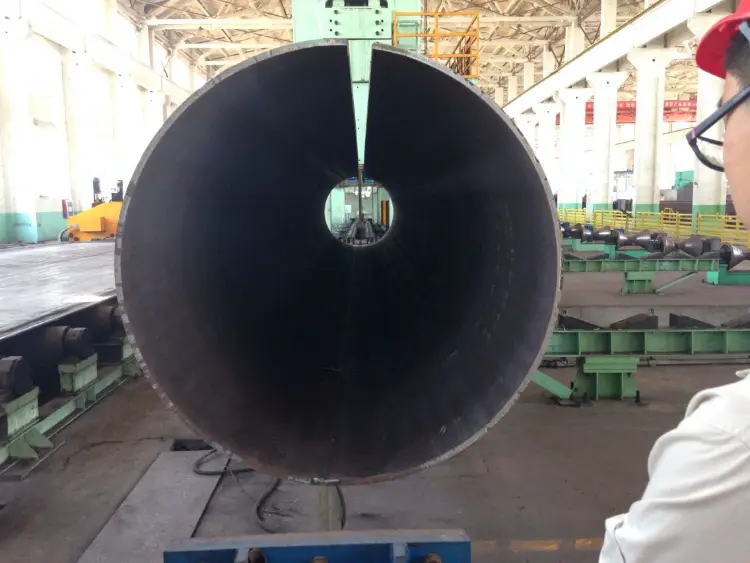
GB5310 12Cr2MoWVTiB Boiler Steel Pipe
12Cr2MoWVTiB (GB 5310) Boiler Steel Pipe: Chemistry, Properties & Equivalent Grades
Comprehensive material data for 12Cr2MoWVTiB alloy steel tube under GB 5310, including chemical composition, mechanical and thermal properties, international equivalents, and application guidance.
Hot-finished (normalized + tempered), cold-drawn followed by stress-relief heat treatment
- Phone : +8618037372205
- Email : [email protected]
- WhatsApp: Contact via Whtsapp
- WeChat: +8618037372205
GB5310 12Cr2MoWVTiB Boiler Steel Pipe Introduction
12Cr2MoWVTiB is a low-alloy ferritic-bainitic heat-resistant steel originally developed in China and standardized under GB 5310 Seamless steel tubes and pipes for high pressure boiler. It is also known by its code name Steel 102. The steel is micro-alloyed with tungsten, vanadium, titanium, and boron to achieve superior creep strength and oxidation resistance at elevated temperatures up to about 600°C. Typical delivery condition is normalizing + tempering. The microstructure consists mainly of bainite with fine carbides precipitated during tempering, providing a good combination of strength, toughness, and long-term thermal stability. It is widely used in Chinese power plants for superheater, reheater, and main steam piping of subcritical and supercritical boilers. Compared to conventional 2.25Cr-1Mo steel, the addition of W, V, Ti, B enhances high-temperature rupture strength significantly, making it suitable for service around 580–600°C.
GB5310 12Cr2MoWVTiB Boiler Steel Pipe Chemical Composition , Heat Analysis According to GB 5310-2017
The chemical composition limits for 12Cr2MoWVTiB are specified in GB 5310-2017. The alloy relies on a Cr–Mo base strengthened by W, V, Ti, and B. Sulphur and phosphorus are strictly controlled to low levels to ensure good hot workability and service performance.
- Boron (B) is a key micro-alloying element that enhances hardenability and creep strength.
- Titanium (Ti) fixes nitrogen and protects boron from forming BN, allowing the full benefit of boron.
- Tungsten (W) and V provide solid-solution and precipitation strengthening at high temperatures.
| Element | Standard Value (wt.%) | Remarks |
|---|---|---|
| Carbon (C) | 0.08 – 0.15 | |
| Silicon (Si) | 0.45 – 0.75 | |
| Manganese (Mn) | 0.45 – 0.65 | |
| Phosphorus (P) | ≤ 0.025 | Max. |
| Sulfur (S) | ≤ 0.015 | Max. |
| Chromium (Cr) | 1.60 – 2.10 | |
| Molybdenum (Mo) | 0.50 – 0.65 | |
| Tungsten (W) | 0.30 – 0.55 | |
| Vanadium (V) | 0.28 – 0.42 | |
| Titanium (Ti) | 0.08 – 0.18 | |
| Boron (B) | 0.002 – 0.008 | |
| Nickel (Ni) | ≤ 0.30 | Residual |
| Copper (Cu) | ≤ 0.20 | Residual |
| Aluminium (Al) | ≤ 0.04 (if specified) | Usually controlled for deoxidation |
GB5310 12Cr2MoWVTiB Boiler Steel Pipe Thermal and Electrical Physical Properties
The physical properties are representative values for the normalized + tempered condition. Values are derived from published material handbooks and may vary slightly with actual heat treatment and composition.
- Density and elastic moduli are given at room temperature.
- Thermal expansion coefficients and thermal conductivity are provided for temperatures up to 600°C to support design of high-temperature components.
- Electrical resistivity is for estimating resistance heating and eddy current inspection.
| Property | Typical Value | Unit | Temperature / Condition |
|---|---|---|---|
| Density (ρ) | 7850 | kg/m³ | 20°C |
| Elastic modulus (E) | 213 | GPa | 20°C |
| Shear modulus (G) | 81 | GPa | 20°C, calculated |
| Poisson's ratio (ν) | 0.3 | — | 20°C |
| Thermal expansion coefficient (α) | 11.5 | 10⁻⁶/K | 20 – 100°C |
| Thermal expansion coefficient (α) | 12.5 | 10⁻⁶/K | 20 – 200°C |
| Thermal expansion coefficient (α) | 13.1 | 10⁻⁶/K | 20 – 300°C |
| Thermal expansion coefficient (α) | 13.6 | 10⁻⁶/K | 20 – 400°C |
| Thermal expansion coefficient (α) | 14.0 | 10⁻⁶/K | 20 – 500°C |
| Thermal expansion coefficient (α) | 14.3 | 10⁻⁶/K | 20 – 600°C |
| Thermal conductivity (λ) | 36.8 | W/(m·K) | 20°C |
| Thermal conductivity (λ) | 38.5 | W/(m·K) | 100°C |
| Thermal conductivity (λ) | 38.9 | W/(m·K) | 200°C |
| Thermal conductivity (λ) | 37.7 | W/(m·K) | 300°C |
| Thermal conductivity (λ) | 35.6 | W/(m·K) | 400°C |
| Thermal conductivity (λ) | 33.5 | W/(m·K) | 500°C |
| Specific heat capacity (cp) | 461 | J/(kg·K) | 20°C |
| Specific heat capacity (cp) | 502 | J/(kg·K) | 100°C |
| Specific heat capacity (cp) | 527 | J/(kg·K) | 200°C |
| Specific heat capacity (cp) | 553 | J/(kg·K) | 300°C |
| Specific heat capacity (cp) | 590 | J/(kg·K) | 400°C |
| Specific heat capacity (cp) | 624 | J/(kg·K) | 500°C |
| Specific heat capacity (cp) | 667 | J/(kg·K) | 600°C |
| Electrical resistivity (ρe) | 0.62 | μΩ·m | 20°C |
GB5310 12Cr2MoWVTiB Boiler Steel Pipe Mechanical Properties , Room Temperature
Tensile testing is performed on longitudinal test pieces in accordance with GB/T 228.1. Impact testing follows GB/T 229 using Charpy V-notch specimens. Values listed are for the delivery condition: normalized + tempered.
- Yield strength refers to the upper yield strength (ReH) or 0.2% proof strength (Rp0.2).
- The specified impact energy ensures sufficient toughness for thick-walled components.
| Property | Required Value | Unit | Test Condition |
|---|---|---|---|
| Tensile strength (Rm) | 540 – 735 | MPa | Room temperature, longitudinal |
| Yield strength (ReH or Rp0.2) | ≥ 345 | MPa | Room temperature, longitudinal |
| Elongation after fracture (A) | ≥ 18 | % | Gauge length 5.65√So, longitudinal |
| Impact absorbed energy (KV2) | ≥ 40 | J | Room temperature, longitudinal, Charpy V-notch |
GB5310 12Cr2MoWVTiB Boiler Steel Pipe Exact Equivalent Materials & Substitution Grades
| Country/Region | Standard | Designation | Remarks |
|---|---|---|---|
| China | GB 5310 | 12Cr2MoWVTiB | Original grade; also known as Steel 102 |
| — | — | No exact international equivalent | Closest chemistry & performance are found in the similar materials table below |
GB5310 12Cr2MoWVTiB Boiler Steel Pipe Application Introduction
12Cr2MoWVTiB is purpose-designed for high-temperature, high-pressure boiler components. Its enhanced creep resistance over standard Cr-Mo steels allows thinner wall tubes and longer service life in supercritical and ultra-supercritical boilers. The steel is generally used in environments with steam temperatures up to 600°C and metal temperatures up to 620°C.
- Post-weld heat treatment (PWHT) is mandatory to restore toughness and reduce residual stress.
- The material shows good oxidation and hot corrosion resistance in steam and flue gas environments typical of coal-fired power plants.
- It is often selected when a step up from 2.25Cr-1Mo (T22/P22) is required but 9% Cr steels are not yet needed.
Product Applications: Superheater and reheater tube bundles, Main steam piping and hot reheat piping, High-pressure boiler headers and manifolds, Steam surface piping in ultra-supercritical power plants
Processed into products: Boiler superheater and reheater tubes, Waterwall tubes (for high heat-flux zones), Main steam lines and hot reheat lines, High-temperature collector headers, Transition pieces and Y-pieces for piping, Desuperheater spray nozzles and thermowells
Application industries: Thermal power generation (coal-fired, oil-fired, gas-fired), Nuclear power (conventional island piping), Industrial boiler manufacturing, Petrochemical and refinery (hydrogen service at elevated temperatures, though less common)
GB5310 12Cr2MoWVTiB Boiler Steel Pipe Similar or Comparable Material Recommendations
| Country/Region | Standard | Designation | Remarks |
|---|---|---|---|
| USA / International | ASTM A213 / ASME SA213 | T23 (2.25Cr-1.6WVNbB) | Similar base Cr~2.0, with W+V+Nb+B; no Ti. Higher W (1.45–1.75%), lower Mo (0.05–0.30%). Creep strength comparable; may substitute after requalification. |
| USA / International | ASTM A213 / ASME SA213 | T22 (2.25Cr-1Mo) | Traditional grade without W, V, Ti, B. Lower creep strength. Can be used for lower temperature sections only. |
| EU | EN 10216-2 | X10CrMoVNb9-1 (1.4903 / T91/P91) | 9Cr-1Mo-V-Nb type; much higher Cr, no W or Ti. Used for higher temperature but different structural design. Not a direct substitute. |
Notes:
Welding considerations: 12Cr2MoWVTiB has good weldability when appropriate preheat (≥200°C) and low-hydrogen consumables are used. Matching filler metals (e.g., TIG wire or SMAW electrodes of similar composition) are required. Heat treatment after welding: A post-weld heat treatment at 740–780°C is essential to achieve the desired mechanical properties and to avoid cold cracking. Service limit: Designed for long-term service up to approximately 600°C; prolonged exposure above 620°C may accelerate creep degradation. Procurement notes: When ordering to GB 5310, additional requirements such as hardness limits, grain size, decarburization, and non-destructive testing (UT/ET) should be agreed upon.
- Share



