
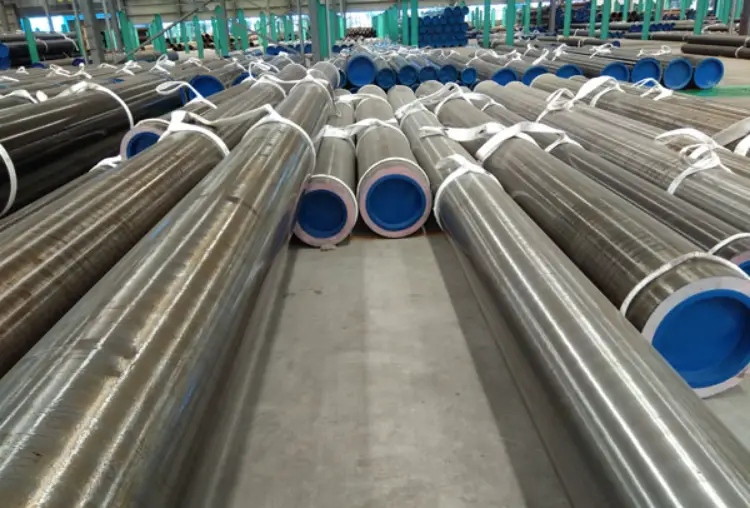
GB 3087 20# Boiler Steel Pipe
GB 3087 20# Boiler Steel Pipe: Seamless Carbon Steel for Low & Medium Pressure Boilers
Explore GB 3087 20# boiler steel pipe, a seamless carbon steel tube for low and medium pressure boilers. Get accurate chemical composition, mechanical properties, thermal data, equivalent grades, and application guide.
Hot rolling, cold drawing, cold rolling, expanding, normalizing, stress relief annealing
- Phone : +8618037372205
- Email : [email protected]
- WhatsApp: Contact via Whtsapp
- WeChat: +8618037372205
GB 3087 20# Boiler Steel Pipe Introduction
GB 3087 20# boiler steel pipe is a high-quality seamless carbon structural steel tube specifically designed for manufacturing heating surface pipes of low and medium pressure boilers, including boiling water pipes, superheated steam pipes, and water wall tubes. It complies with the Chinese national standard GB 3087-2008. The material exhibits a good combination of strength and plasticity, making it suitable for working temperatures up to 450°C under medium pressure conditions. Key characteristics:
- Excellent weldability and cold bending properties
- Stable mechanical performance at elevated temperatures
- High dimensional accuracy and uniform wall thickness
- Cost-effective for general boiler applications
Typically delivered in hot-rolled or cold-drawn condition, and can also be supplied in normalized state to further refine the grain structure and improve ductility.
GB 3087 20# Boiler Steel Pipe Chemical Composition
The chemical composition of 20# steel is strictly controlled by GB/T 3087-2008. The low carbon content ensures good weldability, while manganese and silicon provide adequate strength. Impurities such as phosphorus and sulfur are held to low limits to avoid hot shortness and improve ductility. Residual elements like chromium, nickel, and copper are restricted to maintain consistency in mechanical properties.
| Element | Standard Value (%) | Remarks |
|---|---|---|
| Carbon (C) | 0.17 - 0.23 | Ensures strength and hardenability |
| Silicon (Si) | 0.17 - 0.37 | Deoxidizer; improves strength |
| Manganese (Mn) | 0.35 - 0.65 | Counters hot brittleness from sulfur |
| Phosphorus (P) | ≤ 0.035 | Impurity; limited for ductility |
| Sulfur (S) | ≤ 0.035 | Impurity; restricted for weldability |
| Chromium (Cr) | ≤ 0.25 | Residual, not intentionally added |
| Nickel (Ni) | ≤ 0.30 | Residual, not intentionally added |
| Copper (Cu) | ≤ 0.20 | Residual, not intentionally added |
GB 3087 20# Boiler Steel Pipe Thermal and Electrical Physical Properties
Physical properties are based on typical values for carbon steel grade 20#. These reference data are useful for thermal and structural calculations in boiler design. Values are provided at ambient temperature unless otherwise specified. Thermal conductivity and expansion coefficient are critical for evaluating thermal stress in boiler components.
| Property | Standard Requirement Value | Unit | Test Condition |
|---|---|---|---|
| Density (ρ) | 7.85 | g/cm³ | Room temperature |
| Elastic Modulus (E) | 206 | GPa | Room temperature |
| Shear Modulus (G) | 79.4 | GPa | Room temperature |
| Poisson's Ratio (ν) | 0.30 | - | Room temperature |
| Thermal Expansion Coefficient (α) | 11.5 | 10⁻⁶/K | 20 - 100 °C |
| Thermal Expansion Coefficient (α) | 12.5 | 10⁻⁶/K | 20 - 200 °C |
| Thermal Expansion Coefficient (α) | 13.2 | 10⁻⁶/K | 20 - 300 °C |
| Thermal Conductivity (λ) | 50.6 | W/(m·K) | 20 °C |
| Specific Heat Capacity | 486 | J/(kg·K) | 50 - 100 °C |
| Electrical Resistivity (ρ_e) | 0.17 | Ω·mm²/m | Room temperature |
GB 3087 20# Boiler Steel Pipe Mechanical Properties
Mechanical properties are tested at room temperature according to GB/T 228.1. Tubes are usually sampled in the longitudinal direction. The tensile test reveals a good combination of strength and elongation, suitable for boiler applications where both pressure-bearing capacity and formability are required. Note that yield strength may be slightly reduced for wall thicknesses exceeding 16 mm, as per the standard.
| Property | Standard Requirement | Unit | Test Condition |
|---|---|---|---|
| Tensile Strength (Rm) | 410 - 550 | MPa | Room temperature, longitudinal specimen |
| Yield Strength (ReH) | ≥ 245 (for wall thickness ≤ 16 mm) | MPa | Room temperature, 0.2% offset |
| Yield Strength (ReH) | ≥ 235 (for wall thickness > 16 mm) | MPa | Room temperature, 0.2% offset |
| Elongation (A) | ≥ 20 (longitudinal) | % | Gauge length 5.65√So |
| Elongation (A) | ≥ 18 (transverse) | % | Gauge length 5.65√So |
GB 3087 20# Boiler Steel Pipe Fully Equivalent Material Standards and Substitute Grade Recommendations
The following international standards contain grades that are either identical or closely aligned with GB 3087 20# in terms of chemical composition, mechanical properties, and intended use. They can be used as direct substitutes in boiler tube applications, subject to mutual agreement and compliance with local regulations.
| Country/Region | Standard | Grade | Remarks |
|---|---|---|---|
| China | GB/T 3087-2008 | 20# | Base material |
| USA | ASTM A192 | A192 | Seamless carbon steel boiler tubes for high-pressure service; similar chemistry and strength |
| USA | ASTM A210/A210M | Grade A-1 | Seamless medium-carbon steel boiler and superheater tubes; comparable performance |
| European Union | EN 10216-2 | P195GH (approximate) | Seamless steel tubes for pressure purposes; slightly different chemistry but comparable mechanicals |
| Germany | DIN 17175 | St35.8 | Historic equivalent; now superseded but still referenced in many contexts |
| UK | BS 3059-2 | 320 | Seamless carbon and carbon-manganese steel boiler tubes; equivalent strength level |
| Japan | JIS G3461 | STB340 | Carbon steel boiler and heat exchanger tubes; overlaps in strength range |
GB 3087 20# Boiler Steel Pipe Application Introduction
GB 3087 20# boiler steel pipe is widely employed in the energy and industrial sectors where low to medium pressure steam and water are handled. Its good machinability, weldability, and reliable elevated-temperature strength make it an economical choice for moderate service conditions. Typical applications include:
Product Applications: Low and medium pressure boiler tubes (evaporator, water wall), Superheater and reheater tubes (up to 450°C), Economizer coils, Steam headers and downcomer pipes, Heat exchanger bundles, Air preheater tubes
Processed into products: Boiler water wall panels and headers, Seamless U-bends for heat exchange, Tube-to-tube sheet connections, Field-welded pipe spools for steam distribution, Expanded and welded tube joints in boiler drum
Application industries: Power generation (thermal power plants, coal-fired, biomass), Industrial boilers (heating, process steam), Petrochemical and refining (heat exchangers, waste heat recovery), Shipbuilding (marine boilers), Railway locomotives, Pharmaceutical and food processing (indirect heating equipment)
GB 3087 20# Boiler Steel Pipe Similar/Alternative Material Recommendations
These materials are not exact equivalents but share similar properties and can sometimes serve as substitutes in less demanding boiler or structural applications. Always consult design standards and perform qualification tests before substitution.
| Country/Region | Standard | Grade | Remarks |
|---|---|---|---|
| China | GB/T 8162 | 20# | Seamless carbon structural steel pipe; similar chemistry but without boiler specific quality requirements |
| China | GB/T 699 | 20# (Q235B) | High-quality carbon structural steel; used for general engineering; lower guaranteed yield strength |
| Japan | JIS G4051 | S20C | Machine structural carbon steel; not for pressure purposes but similar base composition |
| USA | ASTM A53/A53M | Grade B | Welded and seamless steel pipe for general use; not specifically boiler-rated but occasionally used for low-pressure steam lines |
| USA | ASTM A106 | Grade B | Seamless carbon steel pipe for high-temperature service; higher strength, for higher pressure applications |
Notes:
- All data is based on GB/T 3087-2008 and typical published values. Actual product properties may vary within standard limits.
- For welded structures, post-weld heat treatment (PWHT) is recommended to relieve stress, especially for thick-walled sections.
- Tubes can be supplied with hydrostatic test certificates and non-destructive testing (eddy current, ultrasonic) per order requirements.
- 20# steel is not intended for continuous service above approximately 450°C due to potential graphitization and creep limitations.
- While this material is suitable for low and medium pressure, high-pressure boilers should use alloy steels like 15CrMoG or 12Cr1MoVG.
- Share



