
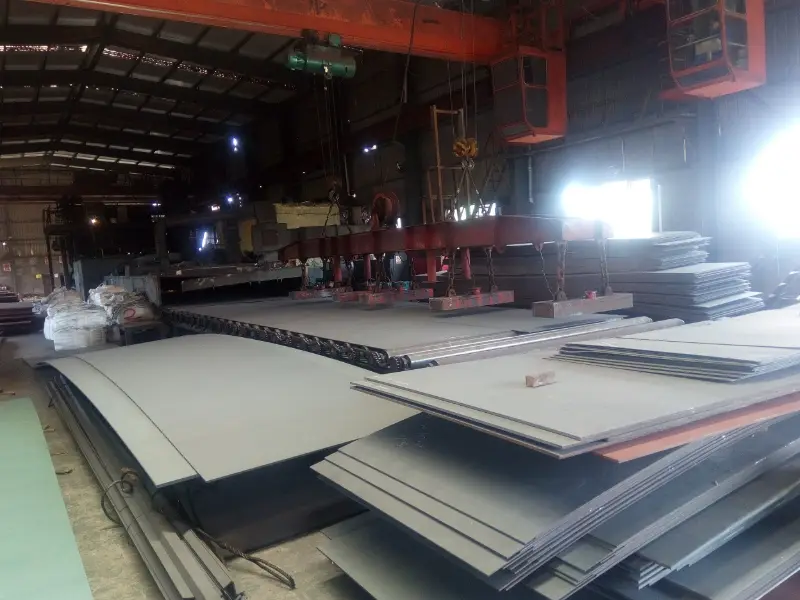
ASTM A514 Grade E High-Strength Quenched & Tempered Steel
ASTM A514 Grade E High-Strength Steel Plate: Properties & Equivalents
Discover chemical composition, mechanical and physical properties, and international equivalents of ASTM A514 Grade E high-strength steel coil.
Hot rolling, quenching and tempering, cutting, welding, forming (limited cold forming), machining
- Phone : +8618037372205
- Email : [email protected]
- WhatsApp: Contact via Whtsapp
- WeChat: +8618037372205
ASTM A514 Grade E High-Strength Quenched & Tempered Steel Introduction
ASTM A514/A514M Grade E is a quenched and tempered high-yield-strength alloy steel plate intended for structural applications. It offers an excellent combination of high strength (minimum yield strength 690 MPa), good weldability, and notch toughness at low temperatures. The alloy contains chromium, molybdenum, and boron to enhance hardenability, ensuring uniform properties in thick sections. This grade is widely used in heavy equipment, cranes, bridges, and offshore structures where weight savings and high load capacity are critical.
ASTM A514 Grade E High-Strength Quenched & Tempered Steel Chemical Composition
The chemical composition of ASTM A514 Grade E steel as specified by ASTM A514/A514M. Elements are controlled to ensure high strength and good weldability. Boron is added for hardenability. Note: single values are maximums unless otherwise indicated.
| Element | Content (%) | Notes |
|---|---|---|
| Carbon (C) | 0.12 - 0.20 | Range |
| Manganese (Mn) | 0.40 - 0.70 | Range |
| Phosphorus (P) | 0.025 max | Maximum |
| Sulfur (S) | 0.025 max | Maximum |
| Silicon (Si) | 0.20 - 0.35 | Range |
| Chromium (Cr) | 1.40 - 2.00 | Range |
| Molybdenum (Mo) | 0.40 - 0.60 | Range |
| Titanium (Ti) | 0.01 - 0.10 | Range |
| Boron (B) | 0.001 - 0.005 | Range |
ASTM A514 Grade E High-Strength Quenched & Tempered Steel Thermal and Electrical Physical Properties
Typical physical properties for quenched and tempered low-alloy steel like ASTM A514 Grade E. These are reference values and may vary slightly with actual composition and heat treatment.
| Property | Typical Value | Unit | Test Condition |
|---|---|---|---|
| Density (ρ) | 7850 | kg/m³ | Room temperature |
| Elastic Modulus (E) | 205 | GPa | Room temperature |
| Shear Modulus (G) | 80 | GPa | Room temperature |
| Poisson's Ratio (ν) | 0.3 | – | Room temperature |
| Thermal Expansion Coeff. (α) | 11.7 | 10&supminus;&sup6;/K | 20 – 100 °C |
| Thermal Expansion Coeff. (α) | 12.2 | 10&supminus;&sup6;/K | 20 – 200 °C |
| Thermal Expansion Coeff. (α) | 12.8 | 10&supminus;&sup6;/K | 20 – 300 °C |
| Thermal Conductivity (λ) | 42 | W/(m·K) | at 100 °C |
| Specific Heat Capacity | 475 | J/(kg·K) | Room temperature |
| Electrical Resistivity (ρe) | 0.21 | µΩ·m | Room temperature |
ASTM A514 Grade E High-Strength Quenched & Tempered Steel Mechanical Properties
Mechanical properties of ASTM A514 Grade E in the quenched and tempered condition. Values vary with plate thickness. Elongation is measured in a 2-inch (50 mm) gauge length. Bend test requires 180° bending without cracking.
| Property | Required Value | Unit | Test Condition |
|---|---|---|---|
| Yield Strength (ReH) | 100 min | ksi (690 MPa) | Thickness ≤ 2.5 in. (63.5 mm) |
| Tensile Strength (Rm) | 110 - 130 | ksi (760 - 895 MPa) | Thickness ≤ 2.5 in. (63.5 mm) |
| Elongation (A) | 18 min | % | Thickness ≤ 3/4 in. (19 mm), 2 in. GL |
| Elongation (A) | 16 min | % | Thickness > 3/4 in. to 2.5 in. (19 - 63.5 mm), 2 in. GL |
| Bend Test (180°) | D = 2t | — | Thickness ≤ 3/4 in. (19 mm) |
| Bend Test (180°) | D = 3t | — | Thickness > 3/4 in. to 1 in. (19 - 25.4 mm) |
| Bend Test (180°) | D = 3t | — | Thickness > 1 in. to 2 in. (25.4 - 50.8 mm) |
| Bend Test (180°) | D = 4t | — | Thickness > 2 in. to 2.5 in. (50.8 - 63.5 mm) |
ASTM A514 Grade E High-Strength Quenched & Tempered Steel Fully Equivalent Standards and Replaceable Grades
| Country/Region | Standard | Grade | Notes |
|---|---|---|---|
| Europe | EN 10025-6 | S690QL (1.8928) | Quenched and tempered, similar Cr-Mo-B chemistry, equivalent strength and toughness. |
| International | ISO 4950-2 | FeE690K (KK, KT or KTT) | High yield strength steel, comparable mechanical properties. |
ASTM A514 Grade E High-Strength Quenched & Tempered Steel Application Introduction
ASTM A514 Grade E steel is suitable for demanding structural applications where high strength-to-weight ratio, good weldability, and moderate low-temperature toughness are required. It is commonly used in construction, heavy machinery, and transportation industries.
- Industries: Construction, Crane & Heavy Lift, Mining, Shipbuilding, Offshore, Transportation, Agricultural Equipment.
- Products: Mobile crane telescopic booms, truck frames, trailer beams, mining truck bodies, bridge girders, offshore platform components, pressure vessel shells (with supplementary requirements).
- Typical Components: Boom sections, chassis frames, heavy-duty wear plates, structural nodes, lifting lugs, and welded fabrications.
Product Applications: Mobile crane booms, Truck frames, Trailer beams, Mining truck bodies, Bridge girders, Offshore platform components, Pressure vessel shells (with additional testing)
Processed into products: Boom sections, Chassis frames, Structural nodes, Lifting lugs, Heavy-duty wear plates, Welded fabrications, Hydraulic cylinder mounts
Application industries: Construction, Crane & Heavy Lift, Mining, Shipbuilding, Offshore, Transportation, Agricultural Equipment
ASTM A514 Grade E High-Strength Quenched & Tempered Steel Similar or Near Equivalent Material Options
| Country/Region | Standard | Grade | Notes |
|---|---|---|---|
| USA | ASTM A514/A514M | Grade Q | Same standard, different composition (Cr-Ni-Mo-V). Slightly higher toughness, commonly used. |
| USA | ASTM A709/A709M | Grade 690 (Type Q or Q&T) | Structural steel for bridges, similar strength. |
| China | GB/T 1591 | Q690D / Q690E | High strength low alloy structural steel, quenched and tempered, similar yield strength. |
| Japan | JIS G 3128 | SHY685 | High yield strength steel for welded structures, with Ni, Cr, Mo, V. Suitable for heavy applications. |
Notes:
Welding must follow proper preheating and interpass temperature control (typically 150-200°C). Post-weld heat treatment is generally not required for thicknesses up to 2.5 in. but may be applied for stress relief. Forming should be performed with caution; hot forming may alter mechanical properties. Consult ASTM A514/A514M standard for detailed requirements.
- Share



