
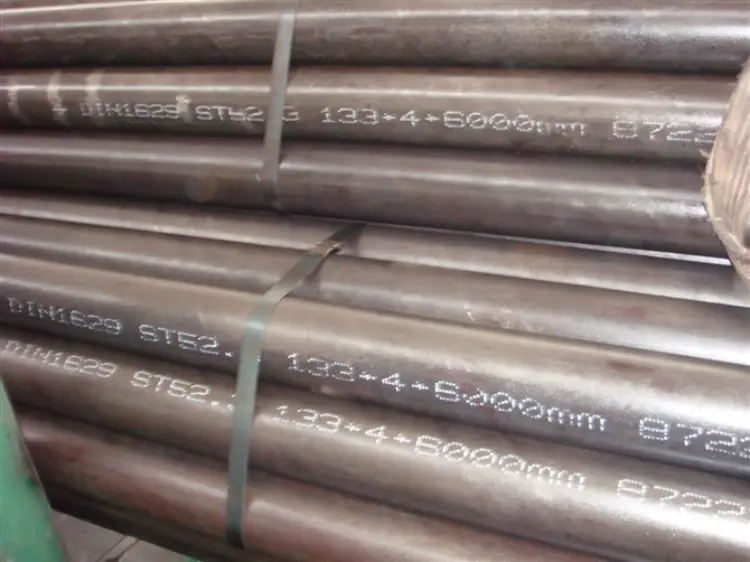
DIN 1629 ST37 Seamless Carbon Steel Pipe
DIN 1629 ST37 Seamless Carbon Steel Pipe: Specifications, Mechanical Data & Global Equivalents
Explore detailed material data for DIN 1629 ST37 boiler steel pipe: chemical composition, mechanical and physical properties, international standards cross-reference, and application guidance for pressure and structural service.
Hot rolling, cold drawing, welding (as secondary fabrication), cutting, bending, threading, hot-formed bends
- Phone : +8618037372205
- Email : [email protected]
- WhatsApp: Contact via Whtsapp
- WeChat: +8618037372205
DIN 1629 ST37 Seamless Carbon Steel Pipe Introduction
DIN 1629 ST37 is a seamless unalloyed carbon steel pipe widely used in general mechanical engineering, pressure equipment, and boiler construction. Manufactured according to the German standard DIN 1629 (withdrawn but still referenced), it corresponds to the St37.0 quality grade in the hot-rolled or cold-drawn condition.
The steel exhibits a minimum tensile strength of 350 MPa and minimum yield strength of 215 MPa for wall thicknesses up to 16 mm. It is characterized by good weldability, formability, and moderate strength. Delivery condition is typically as-rolled or normalized, without specific impact testing requirements. The material is suitable for static and low-pressure applications where toughness is not critical. The pipe is supplied in circular hollow sections with outside diameters from approx. 10.2 mm up to 610 mm and wall thicknesses ranging from 1.5 mm to 65 mm, depending on the manufacturing process.
DIN 1629 ST37 Seamless Carbon Steel Pipe Chemical Composition
Chemical composition limits according to the DIN 1629 standard for St37.0. The steel is an unalloyed carbon steel with carbon content controlled to ensure good weldability. Silicon and manganese are present for deoxidation and strength enhancement. Phosphorus and sulfur are restricted to ensure adequate ductility and toughness. Nitrogen (N) is not explicitly limited in DIN 1629 but may be controlled in modern equivalent grades like EN 10216-1 P235TR1 (N ≤ 0.012%). Other residual elements (Cr, Ni, Mo, Cu) are typically below 0.30% each.
| Chemical element | Typical value / Limit | Remarks |
|---|---|---|
| C | ≤ 0.17 | Max. |
| Si | ≤ 0.35 | Max. |
| Mn | ≥ 0.35 (no upper limit specified in DIN 1629; usually ≤ 0.65) | Min. required |
| P | ≤ 0.040 | Max. |
| S | ≤ 0.040 | Max. |
| Cr | ≤ 0.30 | Residual; not specified in standard, typical trace |
| Ni | ≤ 0.30 | Residual; typical |
| Mo | ≤ 0.08 | Residual; typical |
| Cu | ≤ 0.30 | Residual; typical |
| N | ≤ 0.012 (referenced from P235TR1 equivalent) | Informative; not part of original DIN 1629 |
DIN 1629 ST37 Seamless Carbon Steel Pipe Thermal and Electrical Physical Properties
Typical physical properties for unalloyed carbon steel (grade St37.0) at ambient temperature unless otherwise noted. These values are derived from published data for similar carbon steels and are suitable for engineering calculations. Actual values may vary slightly depending on exact chemical composition and processing history. Thermal properties are provided for the temperature range 20–500 °C where applicable.
| Property | Typical value | Unit | Test condition / temperature |
|---|---|---|---|
| Density (ρ) | 7.85 | g/cm³ | At 20 °C |
| Elastic modulus (E) | 210 | GPa | At 20 °C, static |
| Shear modulus (G) | 81 | GPa | Approximated from E and ν |
| Poisson's ratio (ν) | 0.30 | – | At room temperature |
| Thermal expansion coefficient (α) | 12.2 × 10⁻⁶ | K⁻¹ | 20–100 °C |
| Thermal expansion coefficient (α) | 13.5 × 10⁻⁶ | K⁻¹ | 20–300 °C |
| Thermal expansion coefficient (α) | 14.4 × 10⁻⁶ | K⁻¹ | 20–500 °C |
| Thermal conductivity (λ) | 53.6 | W/(m·K) | At 20 °C |
| Thermal conductivity (λ) | 48.6 | W/(m·K) | At 200 °C |
| Thermal conductivity (λ) | 42.7 | W/(m·K) | At 400 °C |
| Specific heat capacity (cp) | 460 | J/(kg·K) | 20–100 °C (average) |
| Specific heat capacity (cp) | 540 | J/(kg·K) | 200 °C |
| Electrical resistivity (ρe) | 0.143 | Ω·mm²/m | At 20 °C |
| Electrical resistivity (ρe) | 0.220 | Ω·mm²/m | At 200 °C |
DIN 1629 ST37 Seamless Carbon Steel Pipe Mechanical Properties
Tensile and bend testing data as per DIN 1629 for St37.0 at room temperature. Yield strength varies with wall thickness; values are guaranteed in longitudinal direction. Elongation is measured on gauge length L0 = 5.65√S0 (A5). The standard does not require notched bar impact testing (KV); tube intended for low-temperature or dynamic loading should be specified with a supplementary test or a different grade. Bend test is performed at 180° on strip specimens.
The following table presents properties derived from standard requirements and typical manufacturing practice.
| Property | Standard required value | Unit | Test condition / Remarks |
|---|---|---|---|
| Yield strength (ReH) | ≥ 215 | MPa | Wall thickness t ≤ 16 mm, longitudinal |
| Yield strength (ReH) | ≥ 205 | MPa | Wall thickness 16 < t ≤ 40 mm |
| Yield strength (ReH) | ≥ 195 | MPa | Wall thickness 40 < t ≤ 65 mm |
| Tensile strength (Rm) | 350 – 480 | MPa | For all wall thicknesses |
| Elongation after fracture (A) | ≥ 25 (longitudinal) / ≥ 23 (transverse) | % | Gauge length L0 = 5.65√S0; at fracture |
| Bending test (mandrel diameter) | 4 × wall thickness (for t ≤ 10 mm); 6 × wall thickness (for t > 10 mm) | mm | 180° bend; no cracks or defects permitted |
| Impact toughness (KV) | Not required by DIN 1629 ST37.0 | J | Testing only by agreement; typical base material delivers KV2 ≥ 27 J at +20 °C (informative) |
DIN 1629 ST37 Seamless Carbon Steel Pipe Fully Equivalent Material Standards and Substitution Grades
| Country/Region | Standard | Grade | Remarks |
|---|---|---|---|
| EU/Europe | EN 10216-1 | P235TR1 | Direct replacement; non-alloy seamless pipe; also P235TR2 with lower S content |
| Germany (modern) | DIN EN 10216-1 | P235TR1 | Harmonized standard; replaces DIN 1629 St37.0 |
| China | GB/T 8163 | 10 | Seamless steel pipe for liquid service; similar chemical and mechanical properties |
| Japan | JIS G3454 | STPG370 | Carbon steel pipes for pressure service; very close tensile range |
| USA | ASTM A53 | Grade A (type E/S) | Seamless or welded; similar usage; tensile 330 MPa min, slightly lower than ST37 |
| United Kingdom | BS 3602-1 | HFS 360 / SFS 360 (360 specifies min UTS) | Former British standard; now superseded by EN 10216-1 |
DIN 1629 ST37 Seamless Carbon Steel Pipe Application Introduction
DIN 1629 ST37 steel pipe is a versatile carbon steel tube widely adopted for fluid transport, structural frameworks, and mechanical components. Its reliable weldability and moderate strength make it a primary choice in general engineering and low-pressure boiler circuits. Typical wall thickness ranges from 1.5 mm to 65 mm, covering a broad spectrum of pressure ratings. The material is not suitable for low-temperature notch-impact service unless supplemented with specific toughness requirements. In modern projects, the specification is often replaced by EN 10216-1 P235TR1, but ST37 remains in use for spare parts and legacy infrastructure.
Product Applications: Boiler tubes (evaporator, economizer, superheater in low-pressure boilers), Heat exchanger shells and tubular bodies, Steam and condensate return lines, Compressed air and gas piping, Rollers and shafts for light machinery, Fire protection sprinkler pipes (non-UL listed), Metal furniture frames and lightweight structures
Processed into products: Pipe spools, elbows, and tees (fabricated from seamless pipe), Flanged pipe sections and threaded nipples, Machine tool guide rails and bearing sleeves, Rollers for belt conveyors and idlers, Pump casings and impeller housings (light duty), Static structural columns and bracing members
Application industries: Power generation (low-pressure boiler tubes and feedwater piping), Oil and gas (instrument air lines, structural support for piping), Chemical and petrochemical (utility lines, heat exchanger shells), Water treatment and district heating (pressure pipes, distribution networks), Mechanical engineering (machine frames, conveyor rollers, hydraulic cylinders), Construction and infrastructure (handrails, bollards, sign posts, structural hollow sections)
DIN 1629 ST37 Seamless Carbon Steel Pipe Similar / Alternative Materials for Consideration
| Country/Region | Standard | Grade | Remarks |
|---|---|---|---|
| USA | ASTM A106 | Grade A | Seamless carbon steel pipe for high-temperature service; tensile 330 MPa min, with impact and heat performance |
| USA | ASTM A53 | Grade B | Higher tensile (415 MPa min) and yield; more strength but lower ductility than St37.0 |
| EU | EN 10216-2 | P235GH | Non-alloy quality steel for pressure purposes with elevated temperature properties; suitable for boiler systems |
| China | GB/T 3087 | 10 | Seamless steel tubes for low and medium pressure boiler; similar chemical limits |
| Japan | JIS G3456 | STPT370 | Carbon steel pipes for high temperature service; somewhat higher carbon and tensile strength |
| Russia | GOST 8731 | 10 (Сталь 10) | Seamless hot-worked pipes; comparable strength and composition |
Notes:
Important considerations when working with DIN 1629 ST37 pipe:
- Corrosion allowance: Unalloyed carbon steel is susceptible to atmospheric corrosion; protective coatings (painting, galvanizing) are recommended for outdoor or wet service.
- Welding: Good suitability for all common arc welding processes (TIG, MIG/MAG, stick electrode). Preheating generally not required for wall thickness <30 mm. Post-weld stress relief may be applied if service conditions demand it.
- Pressure/temperature limits: The material is typically used up to 400 °C in pressure applications when allowed by design codes (e.g., ASME B31.1, EN 13480). Consult the relevant boiler code for allowable stress values.
- Replacement documentation: For new projects, the EN 10216-1 P235TR1 grade should be specified; original DIN 1629 certificates may no longer be issued. Verification of chemical and mechanical properties is necessary when mixing old and new stock.
- Surface quality: Seamless pipes comply with surface quality class L (standard) according to EN 10216-1; repair of defects by welding is permitted within limits.
- Share



