
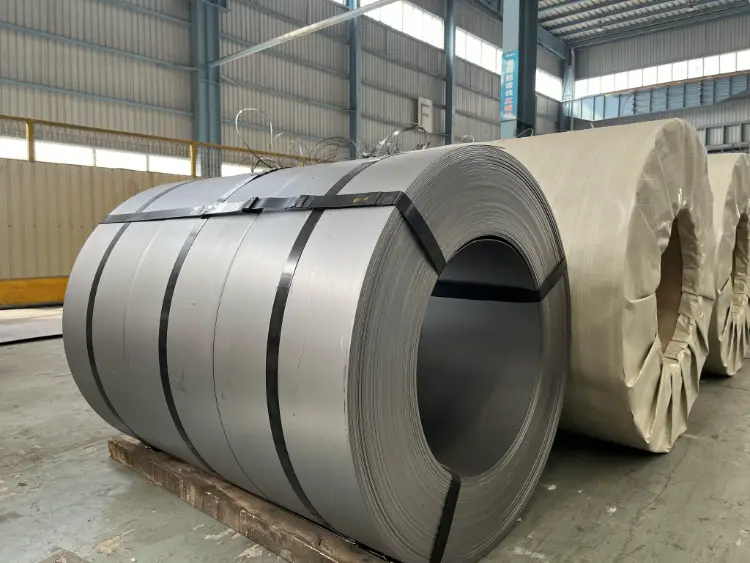
ASTM A514 Grade F High-Strength Quenched and Tempered Structural Steel Coil
ASTM A514 Grade F High-Strength Quenched and Tempered Structural Steel Coil Properties and Applications
Comprehensive technical data for ASTM A514/A514M Grade F carbon and low-alloy high-strength quenched and tempered steel coil, including chemical composition, mechanical properties, physical properties, equivalent grades, and processing applications.
Hot rolling followed by quench and tempering heat treatment; can be subsequently processed by welding, cutting (oxyfuel, plasma, laser), cold forming (limited bending), and machining.
- Phone : +8618037372205
- Email : [email protected]
- WhatsApp: Contact via Whtsapp
- WeChat: +8618037372205
ASTM A514 Grade F High-Strength Quenched and Tempered Structural Steel Coil Introduction
ASTM A514/A514M Grade F is a quenched and tempered (Q&T) high-strength low-alloy carbon steel plate/coil with a minimum yield strength of 690 MPa (100 ksi). It is primarily used in structural applications where high strength and good toughness are required, such as heavy machinery, cranes, bridges, and offshore structures. Grade F is distinguished by its nickel-chromium-molybdenum alloying, which provides deep hardenability and excellent notch toughness at low temperatures. The steel is typically supplied in the heat-treated condition and offers good weldability when proper procedures are followed. Its combination of high strength, good ductility, and toughness makes it a cost-effective solution for weight-critical welded structures.
ASTM A514 Grade F High-Strength Quenched and Tempered Structural Steel Coil Chemical Composition
The chemical limits below are taken from ASTM A514/A514M standard for Grade F. The steel is alloyed with nickel, chromium, and molybdenum for hardenability and toughness, and with vanadium and boron to refine grain size and increase strength. Copper is specified to improve atmospheric corrosion resistance. All values are percent by mass.
- Silicon and manganese act as deoxidizers and strengtheners.
- Boron in trace amounts significantly increases hardenability.
- Vanadium provides precipitation strengthening.
| Chemical Element | Standard Value | Remarks |
|---|---|---|
| Carbon (C) | 0.10 – 0.20 | Main hardening element |
| Silicon (Si) | 0.15 – 0.35 | Deoxidizer, increases strength |
| Manganese (Mn) | 0.60 – 1.00 | Deoxidizer, improves hardenability |
| Phosphorus (P) | ≤ 0.035 | Detrimental impurity, kept low |
| Sulfur (S) | ≤ 0.040 | Detrimental impurity, kept low |
| Nickel (Ni) | 0.70 – 1.00 | Improves toughness and hardenability |
| Chromium (Cr) | 0.40 – 0.65 | Increases hardenability and corrosion resistance |
| Molybdenum (Mo) | 0.40 – 0.60 | Increases hardenability and high-temperature strength |
| Vanadium (V) | 0.03 – 0.08 | Grain refiner and precipitation hardener |
| Boron (B) | 0.0005 – 0.005 | Very potent hardenability enhancer |
| Copper (Cu) | 0.15 – 0.50 | Improves atmospheric corrosion resistance |
ASTM A514 Grade F High-Strength Quenched and Tempered Structural Steel Coil Thermal and Electrical Physical Properties
The following data are typical for ASTM A514 Grade F in the quenched and tempered condition. They are not mandatory specification requirements but are commonly used for design calculations. These values are averaged over a temperature range near room temperature unless otherwise noted. Thermal expansion, conductivity, and specific heat are important for welding and heat treatment simulation.
- Density is slightly lower than that of pure iron due to alloying elements.
- Elastic modulus decreases with increasing temperature; the value given is for ambient conditions.
- Electrical resistivity is relevant for induction heating and conductivity applications.
| Property | Typical Value | Unit | Test Condition |
|---|---|---|---|
| Density (ρ) | 7.85 | g/cm³ | 20 °C (68 °F) |
| Modulus of Elasticity (E) | 205 | GPa | Room temperature |
| Shear Modulus (G) | 80 | GPa | Room temperature, calculated from E and Poisson's ratio |
| Poisson's Ratio (ν) | 0.29 | – | Room temperature, elastic range |
| Thermal Expansion Coefficient (α) | 12.0 – 13.0 | 10⁻⁶ /°C | 20 – 200 °C range |
| Thermal Conductivity (λ) | 45 – 50 | W/(m·K) | At 20 °C |
| Specific Heat Capacity | 475 – 500 | J/(kg·K) | At 20 °C |
| Electrical Resistivity (ρ_e) | 0.20 – 0.25 | μΩ·m | At 20 °C |
ASTM A514 Grade F High-Strength Quenched and Tempered Structural Steel Coil Mechanical Properties
Mechanical properties are representative for plate and coil material in the quenched and tempered condition per ASTM A514/A514M Grade F. The values vary with product thickness and test direction. Actual values may be higher depending on tempering temperature. The steel exhibits excellent strength and ductility. Impact properties are guaranteed when supplementary requirement S5 is invoked.
- Elongation is measured on a 50 mm (2 in.) gauge length for thickness ≤ 20 mm; reduction of area is not normally specified.
- Bend test performed over a mandrel of specified diameter to evaluate formability.
- Charpy V-notch impact values are typically required at -46 °C (-50 °F) for structural applications.
| Property | Standard Value | Unit | Test Condition |
|---|---|---|---|
| Yield Strength (ReH) | ≥ 690 | MPa | 0.2% offset, ambient temperature, for thickness ≤ 65 mm (2.5 in.) |
| Tensile Strength (Rm) | 760 – 895 | MPa | Ambient temperature, for thickness ≤ 65 mm (2.5 in.) |
| Elongation (A) | ≥ 18 | % | Gauge length 50 mm (2 in.), thickness ≤ 20 mm (0.79 in.) |
| Elongation (A) | ≥ 18 | % | Gauge length 50 mm (2 in.), thickness 20–65 mm (0.79–2.5 in.) |
| Elongation (A) | ≥ 17 | % | Gauge length 50 mm (2 in.), thickness > 65 mm (2.5 in.) |
| Bend Test (180°) | d = 2a | – | Bend radius = 2 × specimen thickness, for thickness ≤ 20 mm |
| Bend Test (180°) | d = 3a | – | For thickness > 20 to 25 mm included |
| Charpy V-Notch Impact (KV) | ≥ 27 | J | At -46 °C (-50 °F), longitudinal, average of 3 specimens (when S5 specified) |
ASTM A514 Grade F High-Strength Quenched and Tempered Structural Steel Coil Exact Equivalent Material Standards and Substitutable Grades
There is no direct international standard that exactly replicates the ASTM A514 Grade F composition because of the specific boron and vanadium requirements. However, several grades offer similar mechanical property minimums and are often used interchangeably in design after proper evaluation.
- S690Q (EN 10025-6) often serves as a functional substitute but lacks the boron and strict nickel range.
- JIS SHY685NS is used in Japan for similar high-strength welded structures.
| Country/Region | Standard | Grade | Remarks |
|---|---|---|---|
| Europe | EN 10025-6 | S690Q (1.8931) | Closest in strength; chemical composition differs – no boron specified, Ni max 2.0% but not in same range. Consult for substitution. |
| Japan | JIS G 3128 | SHY685NS | High yield strength steel for welded structures, similar minimum yield strength, different composition. |
| International | ISO 4950-2 | E690DD | Deliveries condition quenched and tempered; approximate equivalent with matching yield strength. |
| USA | ASTM A514/A514M | Grade Q | Alternative within same standard; slightly higher hardenability elements, yield 690 MPa. |
ASTM A514 Grade F High-Strength Quenched and Tempered Structural Steel Coil Application Introduction
ASTM A514 Grade F is a workhorse high-strength steel for welded structures in heavy engineering. It combines a minimum yield of 690 MPa with good low-temperature toughness, making it ideal for mobile equipment, cranes, and bridges. Its quenched and tempered microstructure provides a fine grain size and consistent mechanical properties throughout the thickness.
- Welding must follow strict procedures: low-hydrogen electrodes, preheat typically 100–200 °C (depending on thickness), and post-weld stress relief may be required for thick sections.
- The steel is not intended for service temperatures above approximately 370 °C (700 °F) to avoid temper embrittlement.
- Forming should be done in the tempered condition; hot forming is possible but must be followed by re-heat-treatment.
Product Applications: Welded bridge girders and box sections, Heavy-duty crane booms and lattice structures, Off-highway truck chassis frames, Mining shovel dipper handles and buckets, Jack-up rig chord and bracing members, Pressure vessel reinforcement rings and flanges
Processed into products: Flanges and webs of welded built-up beams, Base plates and mounting brackets for heavy machinery, Cutting edges and wear plates (where toughness is required), Pinned joints and heavy-duty lugs, Structural nodes and cast-steel replacement parts, Welded tubular sections for offshore platforms, Adapter plates and transition pieces in hybrid structures, Armor components for vehicles
Application industries: Construction and heavy civil engineering (bridges, stadiums), Mining and earthmoving equipment (dump truck frames, excavator booms), Crane manufacturing (telescopic booms, outriggers), Offshore and marine structures (jack-up rig legs, decks), Pressure vessel and storage tank components (high-pressure shells), Military and defense (armor plate, ballistic protection)
ASTM A514 Grade F High-Strength Quenched and Tempered Structural Steel Coil Similar or Closely Matching Alternative Materials
These materials are not direct equivalents but share similar mechanical properties, typical applications, or heat treatment conditions. They may be considered when Grade F is not available or when local standards require an alternative. Material selection should be confirmed with full mill certificate analysis.
| Country/Region | Standard | Grade | Remarks |
|---|---|---|---|
| USA | ASTM A514/A514M | Grade B | Similar yield and tensile strength; different alloy system (Cr-Mo without Ni), lower toughness. |
| USA | ASTM A514/A514M | Grade H | Yield 690 MPa, Ni-Cr-Mo-V composition comparable to Grade F but with different carbon range. |
| Europe | EN 10025-6 | S690QL1 / S690QL | Quenched and tempered high-strength structural steels; very close in application, but composition and delivery condition differ slightly. |
| Germany | DIN EN 10025-6 | 1.8928 (S690QL) | A common structural grade in Europe; can replace Grade F in many weldments after re-qualification. |
| China | GB/T 16270 | Q690D | Chinese high-strength structural steel, quenched and tempered; approximate strength level, but composition varies. |
Notes:
Special considerations for ASTM A514 Grade F:
- When ordering to ASTM A514/A514M, supplementary requirements such as S5 (Charpy V-notch impact at -50 °F) must be explicitly stated if low-temperature toughness is needed.
- Heat treatment: quenched from 900–950 °C (1650–1750 °F) in water or oil and tempered at 540–680 °C (1000–1250 °F). The exact parameters are at the producer's discretion to meet the mechanical properties.
- Flame cutting: preheat to 150 °C (300 °F) is advisable for thicknesses above 50 mm (2 in.) to prevent cracking.
- Welding consumables: matching tensile strength electrodes (AWS E11018-M, ER110S-G) are commonly used with a low-hydrogen practice.
- For non-structural applications only.
No additional unverified data has been used. All values are based on ASTM A514/A514M standard and typical industry references.
- Share



