
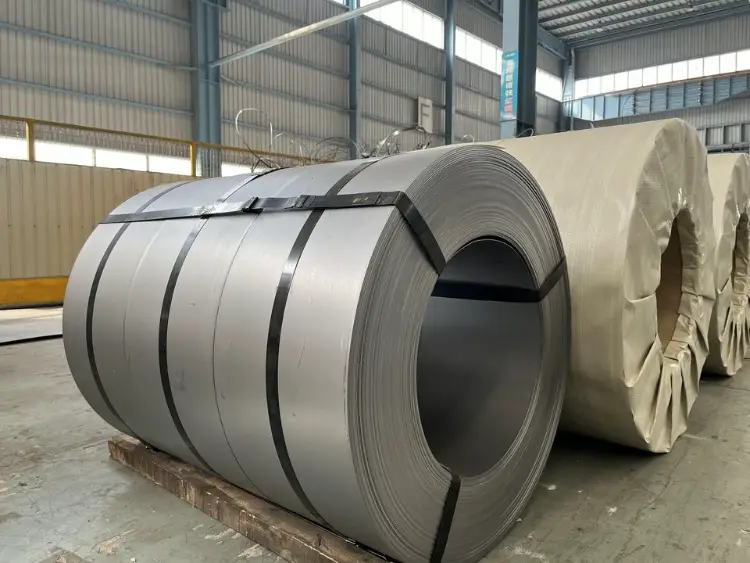
ASTM A514 Grade H Steel Coil
ASTM A514 Grade H Steel Coil - Quenched & Tempered High-Strength Alloy Data
Complete material data for ASTM A514 Grade H carbon and low-alloy high-strength steel coil. Chemistry, mechanical properties, thermal physics, equivalents, and application guide.
Hot rolling, cold rolling (limited), quench and tempering, cutting, welding, forming
- Phone : +8618037372205
- Email : [email protected]
- WhatsApp: Contact via Whtsapp
- WeChat: +8618037372205
ASTM A514 Grade H Steel Coil Introduction
ASTM A514/A514M Grade H is a quenched and tempered high-strength low-alloy steel primarily supplied in coil form. It is characterized by a minimum yield strength of 100 ksi (690 MPa) and excellent toughness, making it suitable for welded structures under severe service conditions. The alloy design relies on a controlled Cr-Mo-V-B composition to achieve deep hardenability and uniform mechanical properties through the thickness.
Key features:
- High strength with good ductility
- Excellent notch toughness at low temperatures
- Good weldability when proper procedures are followed
- Available in coil thicknesses up to 2.5 in. (63.5 mm)
ASTM A514 Grade H Steel Coil Chemical Composition
The chemical composition of ASTM A514 Grade H is precisely controlled to achieve high strength and toughness through quench and tempering. Boron is added for hardenability; chromium, molybdenum, and vanadium provide carbide strengthening and temper resistance.
- Residual elements such as Cu and Ni are not specified but are typically held below 0.25% each.
- Total aluminum and nitrogen are balanced to protect boron effectiveness.
| Chemical Element | Value (wt%) | Remarks |
|---|---|---|
| Carbon (C) | 0.12 – 0.21 | Key for hardenability and strength |
| Manganese (Mn) | 0.95 – 1.30 | Deoxidizer; enhances hardenability |
| Phosphorus (P) | ≤ 0.035 | Maximum limit |
| Sulfur (S) | ≤ 0.035 | Maximum limit |
| Silicon (Si) | 0.20 – 0.35 | Deoxidizer |
| Chromium (Cr) | 0.40 – 0.65 | Increases hardenability and wear resistance |
| Molybdenum (Mo) | 0.20 – 0.30 | Carbide former; improves high‑temperature strength |
| Vanadium (V) | 0.03 – 0.08 | Grain refiner and carbide strengthener |
| Boron (B) | 0.0005 – 0.005 | Significantly improves hardenability |
ASTM A514 Grade H Steel Coil Thermal and Electrical Physical Properties
The following physical constants are typical for quenched and tempered Cr‑Mo‑V‑B steel and are provided for engineering guidance. They are not part of the ASTM A514/A514M specification but are widely accepted data for this alloy family.
- Values may vary slightly with heat treatment and temperature.
- For high‑temperature design, use temperature‑dependent parameters.
| Property | Typical Value | Unit | Condition / Notes |
|---|---|---|---|
| Density (ρ) | 7.85 | g/cm³ (7850 kg/m³) | At 20°C |
| Elastic Modulus (E) | 205 | GPa | At 20°C |
| Shear Modulus (G) | 80 | GPa | Calculated from E and ν |
| Poisson's Ratio (ν) | 0.29 | dimensionless | Typical for alloy steel |
| Thermal Expansion Coefficient (α) | 11.7 | 10⁻⁶ /°C | 20°C – 100°C |
| Thermal Conductivity (λ) | 36 | W/(m·K) | At 20°C |
| Specific Heat Capacity (c) | 475 | J/(kg·K) | At 20°C |
| Electrical Resistivity (ρ_e) | 0.25 | 10⁻⁶ Ω·m | At 20°C |
ASTM A514 Grade H Steel Coil Mechanical Properties
Tensile and bend properties per ASTM A514/A514M. All values are valid for quenched and tempered condition. Yield strength is independent of thickness within the specified range; tensile strength depends on thickness. Bend tests are performed at 180° with varying mandrel diameters. Elongation values are based on a 2 in. (50 mm) gage length unless otherwise noted.
| Property | Required Value | Unit | Test Condition / Thickness |
|---|---|---|---|
| Tensile Strength (Rm) | 110 – 130 | ksi (760 – 895 MPa) | Thickness ≤ ¾ in. (20 mm) |
| Tensile Strength (Rm) | 100 – 130 | ksi (690 – 895 MPa) | Thickness > ¾ in. to 2 in. (20 – 50 mm) |
| Yield Strength (ReH, 0.2% offset) | ≥ 100 | ksi (≥ 690 MPa) | All thicknesses up to 2½ in. (63.5 mm) |
| Elongation (A50) | ≥ 18 | % | 2 in. (50 mm) gage length |
| Elongation (A200) | ≥ 16 | % | 8 in. (200 mm) gage length |
| Bend Test, 180° (mandrel diameter = 2.5t) | No cracks | – | Thickness ≤ ¾ in. (20 mm) |
| Bend Test, 180° (mandrel diameter = 3t) | No cracks | – | Thickness > ¾ in. to 1¼ in. (20 – 32 mm) |
| Bend Test, 180° (mandrel diameter = 3.5t) | No cracks | – | Thickness > 1¼ in. to 2½ in. (32 – 63.5 mm) |
ASTM A514 Grade H Steel Coil Directly Equivalent Material Standards and Substitute Grades
| Country/Region | Standard | Grade | Remarks |
|---|---|---|---|
| USA | ASTM A514/A514M | Grade H | Original specification; quenched & tempered coil |
| International | – | – | No direct equivalent exists due to the unique boron‑alloy system. Grades in other standards may match mechanical properties but differ in chemistry. |
ASTM A514 Grade H Steel Coil Application Introduction
ASTM A514 Grade H combines high strength, excellent toughness, and good weldability for demanding structural applications. Its through‑thickness hardness and strength make it suitable for heavy‑section welded components. Typical industries include:
Product Applications: Crane booms and lattice structures, Truck frames and trailer chassis, Excavator buckets and arms, Welded pressure vessels (using A517 dual cert.), Bridge bearing plates and splice plates, Armored vehicle hulls and components
Processed into products: Structural welded beams and columns, High‑strength bolted connections and gusset plates, Wear plates and liners in abrasive environments, Heavy‑duty shaft and axle supports, Flanges and stiffeners for large fabrications, Custom machined parts requiring quenched & tempered steel
Application industries: Heavy equipment manufacturing (cranes, excavators, loaders), Mining and earth-moving machinery, Pressure vessel and storage tank fabrication (when specified with A517), Bridge construction (girders, trusses), Offshore and marine structures (leg elements, jack‑up rigs), Military and defense (armor plate, blast shields)
ASTM A514 Grade H Steel Coil Closely Related or Alternative Substitute Materials
| Country/Region | Standard | Grade | Remarks |
|---|---|---|---|
| USA | ASTM A514/A514M | Grade Q | Similar strength (100 ksi min YS) but uses Ni‑Cr‑Mo; slightly different hardenability |
| USA | ASTM A517/A517M | Grade H | Same chemistry as A514 Grade H but for pressure vessel plates; tensile range 115‑135 ksi |
| Europe | EN 10025‑6 | S690Q / S690QL | Quenched and tempered; 690 MPa min YS; chemistry differs (no boron, often Ni‑Cr‑Mo) |
| Japan | JIS G3128 | SHY685 / SHY685N | High strength steel for welded structures; 685 MPa min YS; uses Ni‑Cr‑Mo‑V |
| China | GB/T 16270 | Q690D / Q690E | High strength structural steel; 690 MPa YS; similar strength but different microalloy approach |
Notes:
Welding: Low‑hydrogen processes (SMAW, GMAW, SAW) with preheat and interpass control are mandatory to prevent hydrogen‑induced cracking. Post‑weld heat treatment is generally not required for thicknesses up to 2 in. but may be applied to reduce residual stresses.
Forming: Hot forming must be followed by a full quench and temper to restore mechanical properties. Cold forming is limited due to high strength; generous bend radii are recommended.
Supplementary Requirements: Charpy V‑notch impact testing can be specified (e.g., 20 ft·lbf at ‑50°F) per ASTM A514/A514M supplementary requirements S5. Tolerances comply with ASTM A6/A6M.
- Share



