
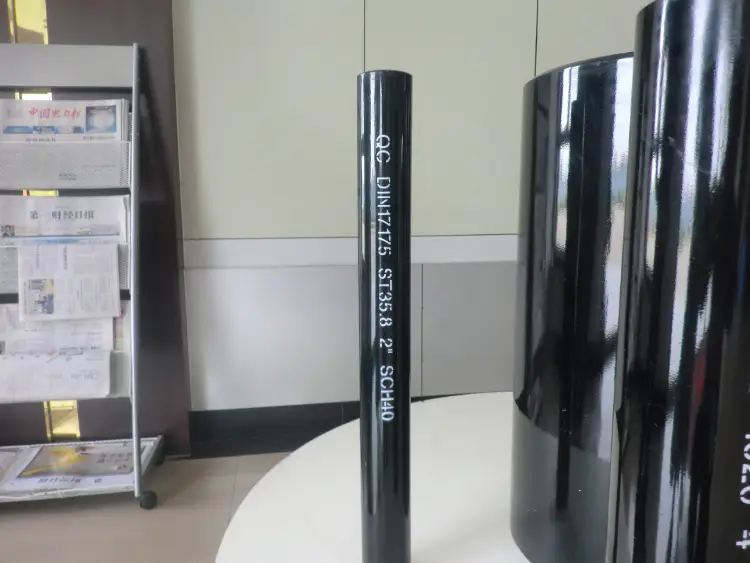
DIN 17175 ST35-8 Boiler Steel Pipe
DIN 17175 ST35-8 Boiler Steel Pipe: Properties, Equivalents & Applications
Explore the chemical composition, mechanical & thermal properties, international equivalents, and typical applications of ST35-8 boiler steel tube per DIN 17175.
Normalizing, welding, bending, flanging, hot/cold forming
- Phone : +8618037372205
- Email : [email protected]
- WhatsApp: Contact via Whtsapp
- WeChat: +8618037372205
DIN 17175 ST35-8 Boiler Steel Pipe Introduction
DIN 17175 ST35-8 is a seamless carbon steel tube primarily used for boiling and superheating units in power plants, chemical industries, and high-temperature service. It is known for its good weldability, reliable mechanical strength at elevated temperatures, and resistance to thermal fatigue. The material is delivered in a normalized state and complies with the requirements of German standard DIN 17175 (now partly superseded by EN 10216-2). This steel is widely recognized under the material number 1.0305 and is suitable for pressure parts up to approximately 450°C. Key characteristics include a well-balanced carbon content, controlled silicon and manganese levels, and full aluminum killing for fine grain structure.
DIN 17175 ST35-8 Boiler Steel Pipe Chemical Composition
The ladle analysis of ST35-8 according to DIN 17175. The steel is fully aluminum-killed (Al ≥ 0.020%) to ensure fine grain structure and improve high-temperature properties. Residual elements are strictly limited to maintain weldability and toughness.
| Element | Standard Value (wt%) | Remarks |
|---|---|---|
| C | ≤ 0.17 | Carbon |
| Si | 0.10 – 0.35 | Silicon |
| Mn | 0.40 – 0.80 | Manganese |
| P | ≤ 0.040 | Phosphorus |
| S | ≤ 0.040 | Sulfur |
| Cr | ≤ 0.30 | Chromium |
| Mo | ≤ 0.08 | Molybdenum |
| Ni | ≤ 0.30 | Nickel |
| Altot | ≥ 0.020 | Total aluminum for grain refinement |
| Cu | ≤ 0.30 | Copper (may be agreed up to 0.40) |
| Nb+Ti+V | trace | Not specified; may be present as residuals |
DIN 17175 ST35-8 Boiler Steel Pipe Thermal and Electrical Physical Properties
The following typical physical data are valid for ST35-8 at room temperature and elevated temperatures. These values are derived from the general characteristics of low-carbon steel and from handbook data for 1.0305 grade. Slight variations may occur depending on the exact production route.
| Property | Typical Value | Unit | Test Condition / Temperature |
|---|---|---|---|
| Density (ρ) | 7.85 | kg/dm³ | 20°C |
| Modulus of elasticity (E) | 210 | GPa | 20°C |
| Shear modulus (G) | 81 | GPa | 20°C |
| Poisson's ratio (ν) | 0.29 | – | 20°C |
| Thermal expansion coefficient (α) | 12.5 | 10⁻⁶/K | 20 – 100°C |
| Thermal expansion coefficient (α) | 13.5 | 10⁻⁶/K | 20 – 200°C |
| Thermal expansion coefficient (α) | 14.0 | 10⁻⁶/K | 20 – 300°C |
| Thermal conductivity (λ) | 51 | W/(m·K) | 20°C |
| Thermal conductivity (λ) | 47 | W/(m·K) | 200°C |
| Thermal conductivity (λ) | 43 | W/(m·K) | 400°C |
| Specific heat capacity (cp) | 461 | J/(kg·K) | 20°C |
| Specific heat capacity (cp) | 500 | J/(kg·K) | 200°C |
| Specific heat capacity (cp) | 550 | J/(kg·K) | 400°C |
| Electrical resistivity (ρe) | 0.22 | Ω·mm²/m | 20°C |
DIN 17175 ST35-8 Boiler Steel Pipe Mechanical Properties at Room Temperature
Tensile and impact properties are guaranteed for the delivered condition (normalized). Tensile testing is performed in the longitudinal direction unless otherwise specified. The yield strength values depend on the wall thickness of the tube. Impact energy (KV) is measured on Charpy-V specimens at 0°C when required.
| Property | Required Value | Unit | Test Condition |
|---|---|---|---|
| Tensile strength (Rm) | 360 – 480 | MPa | Longitudinal, room temperature |
| Upper yield strength (ReH) | ≥ 235 | MPa | For wall thickness ≤ 16 mm |
| Upper yield strength (ReH) | ≥ 225 | MPa | For wall thickness 16 < T ≤ 40 mm |
| Upper yield strength (ReH) | ≥ 215 | MPa | For wall thickness 40 < T ≤ 60 mm |
| Elongation (A5) | ≥ 25 | % | Longitudinal; gauge length 5.65√So |
| Elongation (A5) | ≥ 23 | % | Transverse; gauge length 5.65√So |
| Impact energy (KV2) | ≥ 27 | J | Charpy-V, 0°C, longitudinal (if ordered) |
| Hardness | ≤ 155 | HBW | Typical as-delivered (not mandatory in DIN 17175) |
DIN 17175 ST35-8 Boiler Steel Pipe Completely Equivalent Standards & Substitutable Grades
| Country/Region | Standard | Grade | Remarks |
|---|---|---|---|
| Germany | DIN 17175 | St35.8 (1.0305) | Original standard; obsolete but still recognized |
| European Union | EN 10216-2 | P235GH (1.0345) | Direct successor; minor C and P/S differences, but fully interchangeable for boiler service |
| USA | ASTM A106/A106M | Grade A | Similar carbon steel tube for high temperature; check NDE requirements |
| Japan | JIS G3456 | STPT370 | Carbon steel tubes for high temperature service; equivalent performance |
| China | GB/T 5310 | 20G | Common boiler tube steel; slightly higher carbon (0.17–0.23), verify heat treatment |
DIN 17175 ST35-8 Boiler Steel Pipe Application Introduction
ST35-8 is a classic material for pressurized components working at temperatures up to around 450°C. Its balanced composition provides excellent bending, welding, and hot-forming characteristics. Typical products and industries are listed below.
Product Applications: Water-wall tubes and panels in boilers, Superheater and reheater tubes, Headers and steam drums, Heat exchanger U-bundles, Steam distribution piping, Flue gas heat recovery systems
Processed into products: Straight boiler tubes (plain, with expanded ends), Bent tube elements (180° return bends, serpentine coils), Welded tube-to-tube sheet joints, Forged tube fittings (elbows, tees, reducers), Flanged pipe sections, Collector headers with stubs
Application industries: Power generation (utility and industrial boilers), Petrochemical and refining (heat exchangers, reformer tubes), Chemical processing (high-temperature piping), Heating and ventilation (district heating, steam lines), Marine and shipbuilding (exhaust gas boilers)
DIN 17175 ST35-8 Boiler Steel Pipe Similar / Alternative Material Recommendations
| Country/Region | Standard | Grade | Remarks |
|---|---|---|---|
| European Union | EN 10216-2 | P195GH (1.0348) | Lower strength, similar weldability; for lower pressure parts |
| European Union | EN 10216-2 | P265GH (1.0425) | Higher strength; suitable for higher pressure but lower ductility |
| USA | ASTM A179 | Grade A (cold-drawn low-carbon steel) | For heat exchangers and condensers; seamless cold-drawn tube, may have tighter tolerances |
| USA | ASTM A192 | Carbon Steel Tubes for High-pressure Boilers | Designed for high-pressure service; similar chemical range but different inspection |
| China | GB/T 8163 | 20# | General-purpose seamless pipe; not intended for elevated temperature, but usable in non-critical heating |
Notes:
Welding: ST35-8 is easily weldable with all common processes (TIG, MIG/MAG, SMAW). Preheating is not required for thin sections (<30 mm). Post-weld heat treatment (PWHT) is recommended for thick sections and to restore toughness. Corrosion resistance: This is a plain carbon steel; it is not resistant to wet corrosion, especially in acidic or chloride-containing environments. Protective coatings or cathodic protection should be considered. Inspection and testing: DIN 17175 specifies non-destructive testing options; eddy current and ultrasonic testing are commonly applied. Ensure compliance with the latest EN 10216-2 when procuring new material, as most mills now supply to that standard.
- Share



