
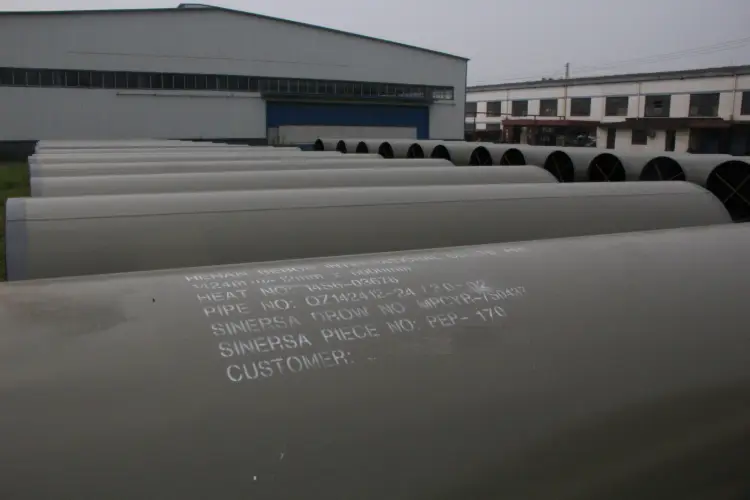
EN10025-6 S690QL1 Steel for SSAW Pipe
EN10025-6 S690QL1 Steel for SSAW Pipe: High Strength Quenched & Tempered Structural Steel
Detailed material data for EN10025-6 S690QL1, a high yield strength quenched and tempered fine-grain structural steel used for spiral submerged arc welded (SSAW) pipes. Includes chemical composition, mechanical properties, thermal and electrical properties, international equivalents, and application guidelines.
Welding (SAW, GMAW, SMAW), hot forming (controlled), cold forming (with precautions), machining
- Phone : +8618037372205
- Email : [email protected]
- WhatsApp: Contact via Whtsapp
- WeChat: +8618037372205
EN10025-6 S690QL1 Steel for SSAW Pipe Introduction
S690QL1 is a high strength quenched and tempered structural steel defined in EN 10025‑6, delivering a minimum yield strength of 690 MPa and excellent low‑temperature toughness down to ‑20 °C. It belongs to the family of fine‑grain weldable steels intended for demanding welded structures.
The 'Q' denotes quenched and tempered condition, 'L1' specifies guaranteed impact energy (27 J) at ‑20 °C. It is commonly supplied as hot‑rolled plate suitable for forming spiral submerged arc welded (SSAW) pipes used in offshore, pressure vessel, and structural applications.
Key features:
- High strength‑to‑weight ratio enabling weight reduction
- Good weldability with controlled carbon equivalent (CEV typically ≤ 0.65)
- Excellent notch toughness at low temperatures
- Uniform properties across thickness due to quenching and tempering
EN10025-6 S690QL1 Steel for SSAW Pipe Chemical Composition
The following chemical composition limits are according to EN 10025‑6:2019, Table 2 (heat analysis). All values are maximum unless a range is indicated. The steel is fine‑grain treated and may contain alloying elements to achieve required strength and toughness.
- Maximum carbon equivalent (CEV) is typically ≤ 0.65 for good weldability.
- Optional addition of B, Nb, Ti, V, and Zr for grain refinement and precipitation hardening.
| Element | Standard Value (max %) | Remarks |
|---|---|---|
| C | 0.20 | Carbon |
| Si | 0.80 | Silicon |
| Mn | 1.70 | Manganese |
| P | 0.020 | Phosphorus |
| S | 0.010 | Sulfur |
| N | 0.015 | Nitrogen |
| B | 0.005 | Boron (optional) |
| Cr | 1.50 | Chromium |
| Cu | 0.50 | Copper |
| Mo | 0.70 | Molybdenum |
| Nb | 0.06 | Niobium (columbium) |
| Ni | 2.0 | Nickel |
| Ti | 0.05 | Titanium |
| V | 0.12 | Vanadium |
| Zr | 0.15 | Zirconium (optional) |
EN10025-6 S690QL1 Steel for SSAW Pipe Thermal and Electrical Properties
The following physical properties are typical for quenched and tempered structural steels and are not part of EN 10025‑6 delivery requirements. They are provided for design and calculation purposes. Actual values may vary slightly depending on exact composition and heat treatment.
- Density, elastic moduli, and Poisson's ratio are measured at room temperature.
- Thermal conductivity and specific heat are given at 20 °C and 100 °C.
- Electrical resistivity is for reference at ambient temperature.
| Property | Typical Value | Unit | Test Condition |
|---|---|---|---|
| Density (ρ) | 7850 | kg/m³ | Room temperature (20 °C) |
| Modulus of elasticity (E) | 210 | GPa | Room temperature |
| Shear modulus (G) | 80 | GPa | Room temperature (calculated from E and ν) |
| Poisson's ratio (ν) | 0.3 | – | Room temperature |
| Thermal expansion coefficient (α) | 11.5 | 10⁻⁶/K | 20 – 100 °C |
| Thermal expansion coefficient (α) | 12.5 | 10⁻⁶/K | 20 – 200 °C |
| Thermal conductivity (λ) | 42 | W/(m·K) | At 20 °C |
| Thermal conductivity (λ) | 40 | W/(m·K) | At 100 °C |
| Specific heat capacity | 460 | J/(kg·K) | At 20 °C |
| Specific heat capacity | 490 | J/(kg·K) | At 100 °C |
| Electrical resistivity (ρ_e) | 0.25 | µΩ·m | At 20 °C, approximate |
EN10025-6 S690QL1 Steel for SSAW Pipe Mechanical Properties
Mechanical properties are specified in EN 10025‑6:2019, Table 5. Values depend on product thickness and sampling direction. Unless stated otherwise, tensile test specimens are transverse to the rolling direction.
- Yield strength (ReH) is the upper yield strength, if not present then Rp0.2 is used.
- Bend test mandrel diameters are expressed as multiples of thickness (t).
- Impact test uses Charpy V‑notch specimens (10×10 mm), longitudinal direction.
| Property | Standard Value | Unit | Test Condition |
|---|---|---|---|
| Yield strength (ReH) | 690 | MPa | Thickness ≤ 50 mm |
| Yield strength (ReH) | 650 | MPa | 50 mm < thickness ≤ 100 mm |
| Yield strength (ReH) | 630 | MPa | 100 mm < thickness ≤ 150 mm |
| Tensile strength (Rm) | 770 – 940 | MPa | All thicknesses (≤ 150 mm) |
| Elongation (A) | 14 | % | Thickness ≤ 50 mm, L0=5.65√S0, transverse |
| Elongation (A) | 14 | % | 50 mm < thickness ≤ 100 mm |
| Elongation (A) | 13 | % | 100 mm < thickness ≤ 150 mm |
| Bend test (180°) | 2t | – | Thickness ≤ 16 mm |
| Bend test (180°) | 3t | – | 16 mm < thickness ≤ 50 mm |
| Bend test (180°) | 4t | – | 50 mm < thickness ≤ 150 mm |
| Impact energy (KV) | 27 (min) | J | At -20 °C, longitudinal, 10×10 mm specimen |
| Impact energy (KV) | 16 (min) | J | At -20 °C, longitudinal, 7.5×10 mm sub‑size specimen (proportional) |
EN10025-6 S690QL1 Steel for SSAW Pipe Completely Equivalent Material Standards and Grade Recommendations
| Country/Region | Standard | Grade | Remarks |
|---|---|---|---|
| European Union | EN 10025-6:2019 | S690QL1 | Original specification |
| International | ISO 4950-2:1995 | E690QL1 | Technically equivalent; QL1 denotes -20 °C impact |
| Germany | DIN EN 10025-6 | S690QL1 | Adopted EN standard, identical |
| United Kingdom | BS EN 10025-6 | S690QL1 | Adopted EN standard, identical |
| France | NF EN 10025-6 | S690QL1 | Adopted EN standard, identical |
| Italy | UNI EN 10025-6 | S690QL1 | Adopted EN standard, identical |
| Spain | UNE EN 10025-6 | S690QL1 | Adopted EN standard, identical |
EN10025-6 S690QL1 Steel for SSAW Pipe Application Introduction
S690QL1 is designed for high‑stress welded structures that require a combination of high strength, low‑temperature toughness, and good weldability. It is ideally suited for SSAW (spiral submerged arc welded) pipes used in demanding environments. Its high strength enables thinner wall thicknesses, reducing weight and material costs while maintaining structural integrity.
- Preheating and interpass temperature control are essential during welding (typical preheat 100–150 °C depending on thickness).
- Post‑weld heat treatment (PWHT) is generally not required but may be applied with caution to avoid strength reduction.
- For SSAW pipe production, the steel is supplied as hot‑rolled coil or plate, then formed and welded using spiral SAW process.
Product Applications: Spiral submerged arc welded (SSAW) pipes, Longitudinal submerged arc welded (LSAW) pipes, Offshore structural components (nodes, braces), Pressure vessels and reactors, Heavy‑duty mechanical parts, Bridges and architectural high‑strength elements
Processed into products: SSAW pipe strands for cross‑country pipelines, Riser pipes and platform legs, Welded ring flanges and pipe fittings, Crane boom sections and telescopic arms, Wind tower shell sections, High‑strength bolted and welded connections in steel frames
Application industries: Oil and gas transmission (onshore & offshore pipelines), Marine and offshore engineering (jacket legs, topside modules), Bridge construction (box girders, arch bridges), Pressure vessel and storage tank fabrication, Heavy lifting and transport equipment (cranes, excavators), Renewable energy (wind turbine towers, subsea structures), Mining and earthmoving machinery
EN10025-6 S690QL1 Steel for SSAW Pipe Near‑Equivalent / Similar Material Recommendations
| Country/Region | Standard | Grade | Remarks |
|---|---|---|---|
| EU | EN 10025-6 | S690Q | Same strength; impact at 0 °C instead of -20 °C; less toughness |
| EU | EN 10025-6 | S690QL | Same strength; impact at -40 °C; better toughness than QL1 |
| EU | EN 10149-2 | S700MC | Thermomechanically rolled, yield 700 MPa, lower toughness and not quenched & tempered |
| USA | ASTM A514/A514M | Grade S | Quenched & tempered alloy steel, minimum yield 690 MPa, different chemical approach |
| USA | ASTM A517/A517M | Grade S | Pressure vessel quality, similar strength and QT condition |
| Japan | JIS G 3128 | SHY685N | High yield strength steel for welded structure, 685 MPa yield, good toughness |
Notes:
- Carbon equivalent (CEV) according to EN 10025‑6 formula: CEV = C + Mn/6 + (Cr+Mo+V)/5 + (Ni+Cu)/15. Typical maximum CEV for S690QL1 is 0.65, ensuring good weldability with low hydrogen processes.
- For thickness > 150 mm, properties shall be agreed at the time of enquiry and order.
- When used for SSAW pipes, the mill test certificates should confirm compliance to EN 10025‑6 and any supplementary pipe standard (e.g., API 5L X100 or EN 10208‑2 L690M may cross‑reference). However, direct substitution with API grades requires full qualification.
- It is recommended to consult the latest edition of EN 10025‑6:2019 for exact requirements and any amendments.
- Share



