
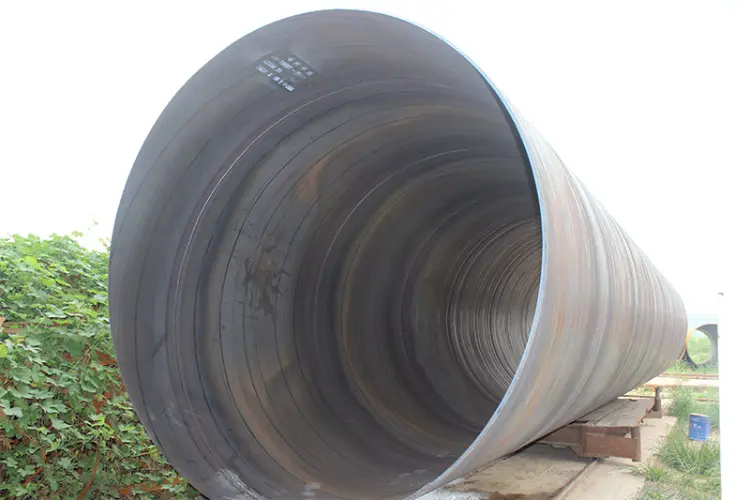
EN10025-6 S890Q SSAW Pipe Steel
EN10025-6 S890Q SSAW Pipe Steel: Full Data Sheet & International Equivalents
Complete technical profile of EN10025-6 S890Q quenched and tempered steel for spiral submerged arc welded pipes, including chemical composition, mechanical and thermal properties, international equivalents, and application guide.
Hot rolling, quenching and tempering, cold forming, cutting, welding (with preheat and interpass control)
- Phone : +8618037372205
- Email : [email protected]
- WhatsApp: Contact via Whtsapp
- WeChat: +8618037372205
EN10025-6 S890Q SSAW Pipe Steel Introduction
EN10025-6 S890Q is a low-alloy, quenched and tempered structural steel with a guaranteed minimum yield strength of 890 MPa, primarily used in welded heavy-duty constructions. It exhibits excellent strength, good weldability with proper precautions, and reliable low-temperature toughness. The grade is supplied in the quenched and tempered condition and is widely adopted for spiral submerged arc welded (SSAW) pipes serving oil & gas transmission, offshore structures, and heavy machinery. Its balanced chemistry allows for high load-bearing capacity while maintaining fabrication flexibility through controlled heat input welding processes.
EN10025-6 S890Q SSAW Pipe Steel Chemical Composition according to EN 10025-6:2019
Ladle analysis limits for grade S890Q. Aluminum total (Altot) must be at least 0.020% for fine grain practice. The steel may contain small amounts of other alloying elements like Nb, V, Ti, and B to ensure through-hardening and strength. Maximum carbon equivalent (CEV) is typically agreed upon at the time of enquiry and order.
| Element | Standard Value (max, unless range) | Remarks |
|---|---|---|
| Carbon (C) | 0.20% | Maximum |
| Silicon (Si) | 0.80% | Maximum |
| Manganese (Mn) | 1.70% | Maximum |
| Phosphorus (P) | 0.020% | Maximum |
| Sulfur (S) | 0.010% | Maximum |
| Chromium (Cr) | 1.50% | Maximum |
| Nickel (Ni) | 2.0% | Maximum |
| Molybdenum (Mo) | 0.70% | Maximum |
| Copper (Cu) | 0.50% | Maximum |
| Vanadium (V) | 0.12% | Maximum |
| Niobium (Nb) | 0.06% | Maximum |
| Titanium (Ti) | 0.05% | Maximum |
| Aluminum (Altot) | 0.020% min | Total aluminum, minimum required |
| Nitrogen (N) | 0.015% | Maximum |
| Boron (B) | 0.005% | Maximum |
EN10025-6 S890Q SSAW Pipe Steel Thermal and Electrical Physical Properties
These values are typical for quenched and tempered low-alloy steels similar to S890Q at room temperature, unless otherwise noted. They are not specified in EN 10025-6, but are derived from steel engineering handbooks and can be used for design calculations. Density, modulus of elasticity, and thermal expansion are relatively insensitive to the exact grade within this strength class.
| Property | Typical Value | Unit | Test Condition / Remarks |
|---|---|---|---|
| Density (ρ) | 7850 | kg/m³ | At 20°C |
| Modulus of Elasticity (E) | 210 | GPa | At 20°C |
| Shear Modulus (G) | 80 | GPa | Estimated from E and ν |
| Poisson's Ratio (ν) | 0.3 | – | Within elastic range |
| Thermal Expansion Coefficient (α) | 12 × 10⁻⁶ | K⁻¹ | Between 20°C and 100°C |
| Thermal Conductivity (λ) | 30 | W/(m⋅K) | At 20°C (typical for Q&T steel) |
| Specific Heat Capacity (cp) | 460 | J/(kg⋅K) | At 20°C to 100°C |
| Electrical Resistivity (ρe) | 0.25 | µΩ⋅m | At 20°C |
EN10025-6 S890Q SSAW Pipe Steel Mechanical Properties per EN 10025-6
Properties are valid for quenched and tempered condition, tested on transverse specimens unless otherwise noted. Yield strength (ReH) and tensile strength (Rm) depend on product thickness. Elongation (A) uses proportional gauge length Lo=5.65√So. Charpy impact energy (KV) is for longitudinal V-notch specimens at -20°C.
| Property Item | Standard Required Value | Unit | Test Condition / Thickness Range |
|---|---|---|---|
| Yield Strength (ReH) | ≥890 | MPa | t ≤ 50 mm |
| Yield Strength (ReH) | ≥830 | MPa | 50 < t ≤ 100 mm |
| Tensile Strength (Rm) | 940 - 1100 | MPa | t ≤ 50 mm |
| Tensile Strength (Rm) | 880 - 1100 | MPa | 50 < t ≤ 100 mm |
| Elongation after fracture (A) | ≥12 | % | t ≤ 50 mm, longitudinal |
| Elongation after fracture (A) | ≥11 | % | 50 < t ≤ 100 mm, longitudinal |
| Bend test (mandrel diameter) | 3t (no cracks) | – | t ≤ 100 mm, 180° bend |
| Charpy impact energy (KV) | ≥27 (longitudinal) | J | at -20°C, t ≤ 100 mm |
EN10025-6 S890Q SSAW Pipe Steel International Fully Equivalent Standards and Replaceable Grades
| Country/Region | Standard | Grade | Remarks |
|---|---|---|---|
| China | GB/T 16270-2009 | Q890D / Q890E | Same strength level, similar chemistry; Q890E for lower temperature impact requirements |
| International (ISO) | ISO 4950-2:1995 | S890Q | Direct ISO equivalent; standard withdrawn but widely referenced |
| Europe | EN 10025-6:2019 | S890QL | Enhanced low-temperature impact version (L) of S890Q, fully interchangeable for thickness ≤100 mm |
EN10025-6 S890Q SSAW Pipe Steel Application Introduction
S890Q is specifically designed for high-strength welded structures where weight savings and high load-bearing capacity are critical. As an SSAW pipe material, it is ideal for long-distance large-diameter pipelines and demanding structural applications. Preheating and post-weld heat treatment may be required depending on thickness and welding procedure to avoid cold cracking. Typical applications include:
Product Applications: Spiral submerged arc welded (SSAW) pipes, Longitudinal welded pipes (LSAW), Seamless pipes (where available), Welded structural profiles and box columns, Flanges, fittings, and connectors for high-pressure piping
Processed into products: Pipeline segments for sour service and sweet gas, Pipe connectors, tees, elbows, and reducers, Offshore platform braces and nodes, Crane booms, lattice structures, and telescopic arms, Tunnel boring machine components
Application industries: Oil & gas pipeline transmission (onshore & offshore), Offshore engineering (jackets, risers, topsides), Heavy machinery and mining equipment, Crane and boom manufacturing, Pressure vessels and storage tanks, Structural hollow sections for bridges and high-rise buildings
EN10025-6 S890Q SSAW Pipe Steel Similar Grade Recommendations with Comparable Performance
| Country/Region | Standard / Brand | Grade | Remarks |
|---|---|---|---|
| Europe | EN 10025-6 | S960Q | Higher yield strength (960 MPa) alternative; requires more careful welding due to higher carbon equivalent |
| USA | ASTM A514/A514M | Grade Q | Quenched and tempered steel with 690 MPa yield, lower strength but commonly used in similar applications; not a direct substitute for 890 MPa design |
| Sweden | SSAB | WELDOX 900 / STRENX 900 | Proprietary grades with guaranteed minimum 890 MPa yield, often used in SSAW pipes; similar weldability and toughness |
| Germany | Dillinger Hütte | DI-HARD 900 / ALFORM 900M | Thermo-mechanically rolled or Q&T grades with 890 MPa yield; designed for heavy plates and welded pipes |
Notes:
S890Q SSAW pipe manufacturing: The spiral welding process involves forming a hot-rolled coil into a helical shape and welding continuously with submerged arc. The heat-affected zone (HAZ) properties should be evaluated according to EN 10225 or project specifications. Welding consumables: Use low-hydrogen electrodes/wires matching the base material strength (e.g., AWS A5.28 ER100S-G or equivalent) and control heat input between 1.5–3.5 kJ/mm. Ordering options: Specify carbon equivalent (CEV) limits, ultrasonic testing per EN 10246-17, and Charpy impact temperatures lower than -20°C if required (e.g., -40°C variants are available as S890QL).
- Share



