
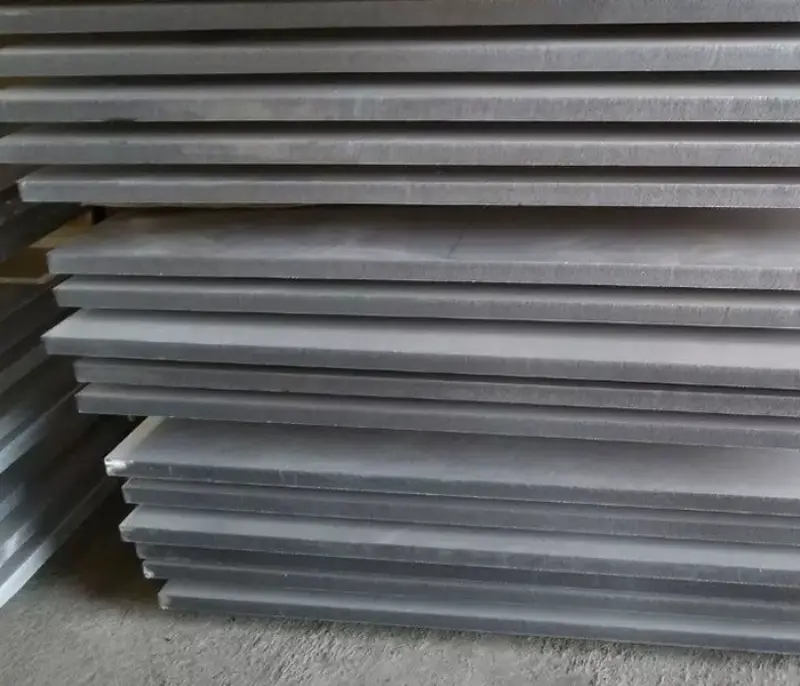
EN 10025-6 S690QL
EN 10025-6 S690QL SSAW Pipe: High-Strength Quenched and Tempered Steel for Demanding Applications
Detailed material data for S690QL structural steel according to EN 10025-6, used in SSAW pipes. Includes chemical composition, mechanical properties, thermal and electrical physical properties, and international equivalents.
Welding (SAW, SMAW, GMAW), bending, cold forming, hot forming, machining
- Phone : +8618037372205
- Email : [email protected]
- WhatsApp: Contact via Whtsapp
- WeChat: +8618037372205
EN 10025-6 S690QL Introduction
S690QL is a high-strength quenched and tempered structural steel specified in EN 10025-6, designed for heavy-duty applications where high yield strength, excellent toughness at low temperatures, and good weldability are required. The 'Q' indicates quenching and tempering, and 'L' stands for low-temperature impact properties (minimum 27 J at -40 °C). When formed into SSAW (spiral submerged arc welded) pipes, S690QL provides a combination of strength, fatigue resistance, and dimensional accuracy, making it suitable for demanding environments such as offshore structures, pressure piping, and large-scale civil engineering projects. Its fine-grain microstructure and controlled alloying elements ensure reliable performance under static and dynamic loads.
EN 10025-6 S690QL Chemical Composition
The chemical composition of S690QL steel is tightly controlled to achieve high strength and low-temperature toughness. Typical limits according to EN 10025-6:2019 are shown below. Microalloying elements such as Nb, Ti, and V are added for grain refinement and precipitation strengthening. Maximum values are listed unless a range is given.
| Chemical Element | Standard Value | Remarks |
|---|---|---|
| C | ≤0.20 | Carbon |
| Si | ≤0.80 | Silicon |
| Mn | ≤1.70 | Manganese |
| P | ≤0.020 | Phosphorus |
| S | ≤0.010 | Sulfur |
| Cu | ≤0.50 | Copper |
| Cr | ≤1.50 | Chromium |
| Ni | ≤2.0 | Nickel |
| Mo | ≤0.70 | Molybdenum |
| Nb | ≤0.06 | Niobium |
| Ti | ≤0.05 | Titanium |
| V | ≤0.12 | Vanadium |
| B | ≤0.005 | Boron |
EN 10025-6 S690QL Thermal and Electrical Physical Properties
The following physical properties are typical for quenched and tempered low-alloy structural steels like S690QL. These values are not part of the mandatory standard requirements but are commonly used for design and calculation purposes. Density, elastic modulus, and thermal expansion are particularly relevant for engineering analysis.
| Property | Standard Requirement Value | Unit | Test Condition |
|---|---|---|---|
| Density (ρ) | ~7850 | kg/m³ | At room temperature |
| Elastic modulus (E) | ~210 | GPa | 20 °C, static tensile test |
| Shear modulus (G) | ~81 | GPa | Estimated from E and ν |
| Poisson's ratio (ν) | ~0.3 | Elastic range | |
| Thermal expansion coefficient (α) | ~12.0×10⁻⁶ | 1/K | Between 20 °C and 100 °C |
| Thermal conductivity (λ) | ~45 | W/(m·K) | At 20 °C |
| Specific heat capacity | ~460 | J/(kg·K) | At room temperature |
| Electrical resistivity (ρ_e) | ~0.23×10⁻⁶ | Ω·m | At 20 °C |
EN 10025-6 S690QL Mechanical Properties
Mechanical properties of S690QL are guaranteed after quenching and tempering. The values below comply with EN 10025-6:2019 for flat products. The test specimen orientation is longitudinal unless otherwise noted. Depending on the thickness range, yield strength, tensile strength, elongation, and impact energy may vary. Bending test requirements are also included for quality assurance.
| Property | Standard Requirement | Unit | Test Condition |
|---|---|---|---|
| Yield strength (ReH) | ≥690 | MPa | Thickness ≤ 50 mm |
| Yield strength (ReH) | ≥650 | MPa | 50 < thickness ≤ 100 mm |
| Yield strength (ReH) | ≥630 | MPa | 100 < thickness ≤ 150 mm |
| Tensile strength (Rm) | 770 - 940 | MPa | Thickness ≤ 50 mm |
| Tensile strength (Rm) | 760 - 930 | MPa | 50 < thickness ≤ 100 mm |
| Tensile strength (Rm) | 710 - 900 | MPa | 100 < thickness ≤ 150 mm |
| Elongation (A) | ≥14 | % | Longitudinal, L₀=5.65√S₀, t ≤ 50 mm |
| Elongation (A) | ≥14 | % | Longitudinal, 50 < t ≤ 100 mm |
| Elongation (A) | ≥14 | % | Longitudinal, 100 < t ≤ 150 mm |
| Impact energy (KV) | ≥27 | J | -40 °C, longitudinal, t ≤ 50 mm |
| Impact energy (KV) | ≥27 | J | -40 °C, 50 < t ≤ 100 mm |
| Impact energy (KV) | ≥27 | J | -40 °C, 100 < t ≤ 150 mm |
| Bend test (d = bend diameter, a = thickness) | d = 3a | Bend angle 180°, t ≤ 16 mm | |
| Bend test | d = 4a | 16 < t ≤ 50 mm |
EN 10025-6 S690QL Exact Equivalent Material Standards and Substitute Grades
| Country / Region | Standard | Grade | Remarks |
|---|---|---|---|
| European Union | EN 10025-6:2019 | S690QL | Original specification |
| International | ISO 4950-2 | S690QL | Equivalent high-strength flat products |
| United Kingdom | BS EN 10025-6 | S690QL | British adoption |
| Germany | DIN EN 10025-6 | S690QL | German adoption |
| France | NF EN 10025-6 | S690QL | French adoption |
EN 10025-6 S690QL Application Introduction
S690QL SSAW pipes are engineered for high-pressure and high-load scenarios where weight savings and structural integrity are critical. The quenched and tempered condition provides an optimum balance of strength, ductility, and resistance to brittle fracture at sub-zero temperatures. Typical application sectors include:
Product Applications: Spiral submerged arc welded (SSAW) pipes, Longitudinally welded (LSAW) pipes, Tubular piles for deep foundations, Penstocks and hydraulic penstock pipes, Structural pipe for bridges and stadiums
Processed into products: Pipe spools and bends, Flanges and connectors, Reinforcement rings and stiffeners, Nozzles and branch outlets, Pipeline end terminations (PLETs), Submarine risers and flowlines
Application industries: Oil & Gas (onshore and offshore), Civil Engineering and Construction, Offshore and Marine Engineering, Heavy Machinery and Mining Equipment, Pressure Vessel and Boiler Manufacturing
EN 10025-6 S690QL Similar / Alternative Material Recommendations
| Country / Region | Standard | Grade | Remarks |
|---|---|---|---|
| European Union | EN 10025-6 | S690Q | Higher temperature impact (0 °C instead of -40 °C) |
| European Union | EN 10025-6 | S690QL1 | Even lower temperature impact (-60 °C) |
| China | GB/T 16270 | Q690E | Similar strength and low-temperature toughness |
| USA | ASTM A514 / A514M | Grade S (or modified) | Comparable yield strength, different chemistry; verify suitability |
| Japan | JIS G 3128 | SHY685 | High-strength steel, but slightly lower tensile requirements |
Notes:
- S690QL is a fine grain steel; welding must follow approved procedures with suitable low-hydrogen consumables and preheating to avoid cold cracking.
- Post-weld heat treatment (PWHT) is generally not required for thicknesses up to 50 mm, but stress relieving may be considered depending on service conditions.
- For SSAW pipes, the forming and welding process shall not impair the base material properties. Additional testing on the weld seam and heat-affected zone is typically required.
- This steel is not intended for elevated temperature applications above approximately 400 °C without special consideration, as strength may degrade.
- Share



