
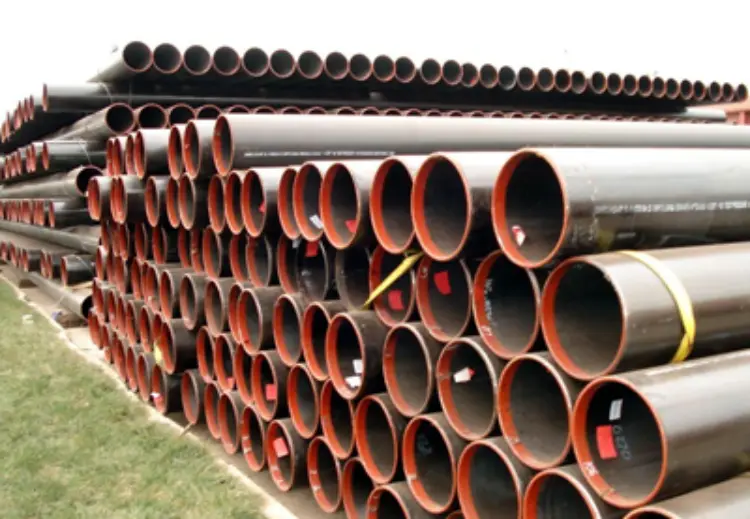
EN 10025-6 S690Q SSAW Pipe
EN 10025-6 S690Q SSAW Pipe: High-Strength Quenched & Tempered Structural Steel
Comprehensive material data for EN 10025-6 S690Q steel in SSAW pipe form. Includes chemical composition, mechanical and physical properties, equivalent standards, and application guidance for this high-yield-strength structural steel.
Welding (SMAW, GMAW, SAW), Cutting (Plasma, Laser, Abrasive Water Jet), Cold Forming (with caution), Hot Forming, Machining
- Phone : +8618037372205
- Email : [email protected]
- WhatsApp: Contact via Whtsapp
- WeChat: +8618037372205
EN 10025-6 S690Q SSAW Pipe Introduction
EN 10025-6 S690Q is a high-yield-strength structural steel grade delivered in the quenched and tempered condition. It is specified under the European standard EN 10025-6 for hot-rolled products of structural steels.
- Key Attributes: Minimum yield strength of 690 MPa, good toughness, and excellent weldability due to a low carbon equivalent value (CEV).
- Primary Use: Designed for heavily loaded structures where weight saving is critical.
- SSAW Pipe Form: When manufactured as Spiral Submerged Arc Welded (SSAW) pipe, it is exceptionally suited for large-diameter, high-pressure pipelines, offshore structures, and foundation piling.
EN 10025-6 S690Q SSAW Pipe Chemical Composition
The ladle analysis limits for S690Q steel according to EN 10025-6. The steel features a fine-grain structure achieved through microalloying elements like niobium (Nb), vanadium (V), and titanium (Ti), ensuring high strength and toughness. The controlled low carbon equivalent value (CEV) is critical for guaranteeing good weldability without cold cracking. For long products, the maximum values for C, Mn, P, and S may differ slightly from flat products.
| Element | Standard Value (max. %) | Remarks |
|---|---|---|
| Carbon (C) | 0.20 | Max. for flat products ≤ 50mm thick |
| Silicon (Si) | 0.80 | Max. |
| Manganese (Mn) | 1.70 | Max. for flat products |
| Phosphorus (P) | 0.020 | Max. for specified quality |
| Sulfur (S) | 0.010 | Max. for specified quality |
| Aluminum (Al) | 0.015 (min.) | Total aluminum, unless N-binding elements are present |
| Niobium (Nb) | 0.06 | Max. |
| Vanadium (V) | 0.12 | Max. |
| Titanium (Ti) | 0.05 | Max. |
| Chromium (Cr) | 1.50 | Max. for flat products |
| Nickel (Ni) | 2.0 | Max. |
| Molybdenum (Mo) | 0.70 | Max. |
| Copper (Cu) | 0.50 | Max. |
| Boron (B) | 0.005 | Max. |
| Nitrogen (N) | 0.015 | Max. |
| Carbon Equivalent (CEV) | 0.62 / 0.65 | Typ. max. for ≤ 50mm / 50-100mm thickness |
EN 10025-6 S690Q SSAW Pipe Thermal and Electrical Physical Properties
These reference values characterize the physical behavior of S690Q steel under various thermal and electrical conditions. They are crucial for engineering calculations involving thermal expansion, heat transfer, and structural dynamics. Properties like density, elastic modulus, and thermal conductivity are generally consistent for this class of low-alloy, quenched and tempered steel and vary slightly with temperature.
| Property | Typical Value | Unit | Test Condition / Temperature |
|---|---|---|---|
| Density (ρ) | 7800 | kg/m³ | At 20°C |
| Modulus of Elasticity (E) | 210 | GPa | At 20°C |
| Modulus of Elasticity (E) | 200 | GPa | At 200°C |
| Shear Modulus (G) | 81 | GPa | At 20°C |
| Poisson's Ratio (ν) | 0.3 | — | At 20°C |
| Thermal Expansion Coefficient (α) | 11.7 | 10⁻⁶/K | 20 to 100°C |
| Thermal Expansion Coefficient (α) | 12.8 | 10⁻⁶/K | 20 to 300°C |
| Thermal Conductivity (λ) | 41 | W/(m·K) | At 20°C |
| Thermal Conductivity (λ) | 38 | W/(m·K) | At 300°C |
| Specific Heat Capacity | 460 | J/(kg·K) | At 20°C |
| Electrical Resistivity (ρ_e) | 0.22 | μΩ·m | At 20°C |
EN 10025-6 S690Q SSAW Pipe Mechanical Properties
Tensile properties and impact energy requirements for EN 10025-6 S690Q in the quenched and tempered (+Q) condition. These values are specified for flat and long products at ambient temperature. Key note: The minimum yield strength decreases with increasing product thickness. Impact toughness is verified with longitudinal Charpy V-notch specimens at a test temperature of -20°C, guaranteeing good resistance to brittle fracture.
| Property | Specified Value | Unit | Test Condition / Thickness (mm) |
|---|---|---|---|
| Yield Strength (ReH) | 690 (min.) | MPa | Nominal thickness ≤ 50mm |
| Yield Strength (ReH) | 650 (min.) | MPa | Nominal thickness 50mm < t ≤ 100mm |
| Yield Strength (ReH) | 630 (min.) | MPa | Nominal thickness 100mm < t ≤ 150mm |
| Tensile Strength (Rm) | 770 to 940 | MPa | Nominal thickness ≤ 50mm |
| Tensile Strength (Rm) | 760 to 930 | MPa | Nominal thickness 50mm < t ≤ 100mm |
| Tensile Strength (Rm) | 710 to 900 | MPa | Nominal thickness 100mm < t ≤ 150mm |
| Elongation (A) | 14 (min.) | % | Gauge length L₀ = 5.65√S₀; nominal thickness ≤ 50mm |
| Elongation (A) | 14 (min.) | % | Gauge length L₀ = 5.65√S₀; nominal thickness 50mm < t ≤ 100mm |
| Elongation (A) | 14 (min.) | % | Gauge length L₀ = 5.65√S₀; nominal thickness 100mm < t ≤ 150mm |
| Impact Energy (KV₂) | 30 (min.) | J | Longitudinal, at T=-20°C, nominal thickness 10-150mm |
| Bend Test (Mandrel Diameter) | 3t | — | 180° bend, nominal thickness ≤ 50mm. t = specimen thickness. |
EN 10025-6 S690Q SSAW Pipe Full Equivalents and Replaceable Grade Recommendations
| Country/Region | Standard | Grade | Remarks |
|---|---|---|---|
| European Union | EN 10025-6 | S690Q (1.8931) | The original standard and grade number. |
| International | ISO 4950-2 | E690DD | Defined as high yield strength flat steel products, quenched and tempered. |
| China | GB/T 19597 | Q690D | Provides equivalent chemical and mechanical requirements for quenched & tempered high strength steel plate. |
EN 10025-6 S690Q SSAW Pipe Application Introduction
EN 10025-6 S690Q SSAW pipe is a premium engineering material for applications requiring maximum strength-to-weight ratio. Its high yield strength allows for significant reductions in wall thickness compared to lower-grade steels, leading to lighter structures, lower transport costs, and easier on-site handling. Its production in SSAW form allows for cost-effective manufacturing of very large diameter pipes from plate stock. Critical considerations for use include strict adherence to pre-heating and interpass temperature controls during welding, as well as careful cold-forming procedures to avoid cracking.
Product Applications: Large-diameter SSAW pipe for high-pressure gas transmission, Offshore wind turbine foundation monopiles, Telescopic crane booms, Jack-up rig legs and spudcans, Load-bearing beam and column assemblies in high-rise buildings
Processed into products: Welded pipe segments and fittings (elbows, reducers) for pipelines, Flanges and connectors for structural hollow sections, Cut and machined stiffeners and gusset plates, Cold-formed open sections (channels, angles) for lightweight structures, Pinned structural nodes and transition joints
Application industries: Civil and Structural Engineering (bridges, high-speed rail stations, large roof structures), Offshore Oil & Gas (topsides, jacket legs, conductors, flare booms), Renewable Energy (wind turbine monopiles, transition pieces for offshore wind), Heavy Machinery and Transport (crane booms, truck frames, trailer chassis), Water and Hydropower Engineering (penstocks, spiral cases, large-diameter water mains)
EN 10025-6 S690Q SSAW Pipe Similar/Comparable Material Recommendations
| Country/Region | Standard | Grade | Remarks |
|---|---|---|---|
| United States | ASTM A514 / A517 | Grade Q | A517 is for plates, A514 for structural shapes. Typical yield strength is 620-690 MPa (>100 ksi), but with different alloying concepts. Weldability characteristics require careful comparison of CEV. |
| Japan | JIS G 3128 | SHY 685 | High yield strength steel plate for welded structures. The '685' designation refers to a tensile strength grade, offering comparable strength levels. |
| Germany (DIN, superseded) | DIN EN 10137-2 | S690Q (1.8928) | This is a superseded standard. The grade is technically equivalent but has been replaced by EN 10025-6 for new designs. |
| China | GB/T 34560.X | Q690E | Structural steel with similar strength levels, but often specified with stricter impact toughness requirements at lower temperatures (-40°C) compared to the 'Q' (-20°C) designation. |
Notes:
Welding Imperative: For S690Q, the risk of hydrogen-induced cold cracking (HICC) is significant. It is mandatory to use low-hydrogen welding consumables and apply proper pre-heating temperatures, typically in the range of 50–175°C, depending on the plate thickness and combined heat input. Post-weld heat treatment (PWHT) is generally avoided as it can degrade the mechanical properties of the quenched and tempered microstructure. For SSAW pipe fabrication, the pipe mill must have a qualified welding procedure specification (WPS) that specifically addresses the unique metallurgy of the S690Q plate being formed and welded.
- Share



