
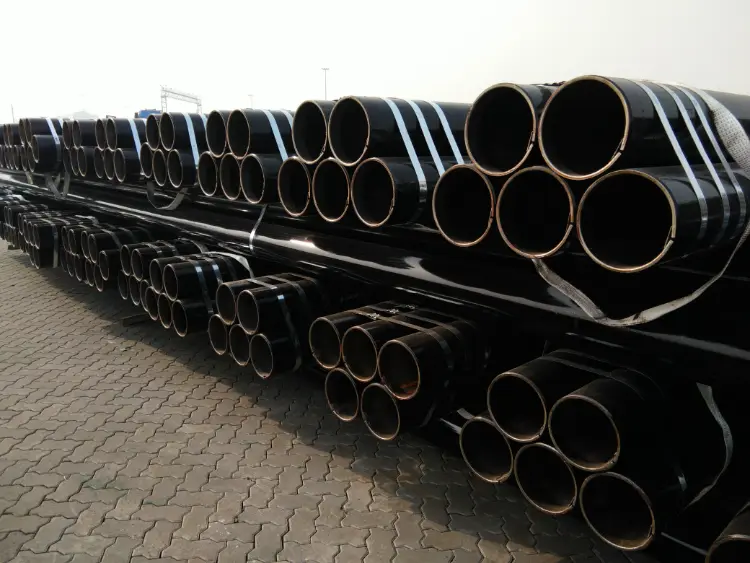
EN 10025-6 S620QL1 SSAW Pipe Steel
EN 10025-6 S620QL1 SSAW Pipe Steel - Quenched & Tempered High-Strength Structural Grade
Comprehensive technical data for S620QL1 steel according to EN 10025-6, including chemical composition, mechanical and physical properties, equivalent grades, and application guidance for spiral submerged arc welded (SSAW) pipes.
Welding (all common methods, including SAW for SSAW pipe), forming, cutting, machining, cold and hot bending
- Phone : +8618037372205
- Email : [email protected]
- WhatsApp: Contact via Whtsapp
- WeChat: +8618037372205
EN 10025-6 S620QL1 SSAW Pipe Steel Introduction
S620QL1 is a high-strength, quenched and tempered structural steel covered by EN 10025-6, designed for welded load-bearing structures. It provides a minimum yield strength of 620 MPa in thicknesses up to 50 mm and guarantees Charpy impact toughness of at least 27 J at -20 °C (designated by the L1 quality). The fine-grain microstructure ensures excellent weldability and good ductility. This grade is widely used in heavy machinery, crane booms, bridge construction, offshore structures, and particularly for the fabrication of spiral submerged arc welded (SSAW) pipes in oil and gas transmission and piling applications.
- Outstanding strength-to-weight ratio
- Reliable low-temperature toughness
- Controlled carbon equivalent for welding
- Consistent properties through heat treatment
EN 10025-6 S620QL1 SSAW Pipe Steel Chemical Composition
Ladle analysis according to EN 10025-6:2019, Table 3, heat analysis for S620QL1. Maximum values unless otherwise indicated. Elements not listed, such as Nb, V, Ti, Zr, B, are included if intentionally added or as residuals within standard limits. Carbon equivalent (CEV) is calculated according to the standard formula and typically restricted to a maximum of 0.52–0.58 depending on thickness; the exact limit is agreed upon at ordering.
- Low phosphorus and sulfur levels enhance cleanliness and toughness.
- Microalloying elements (Nb, V, Ti) refine grain size and increase strength.
- Nickel and chromium improve hardenability and toughness.
| Element | Standard Value (max %) | Remarks |
|---|---|---|
| Carbon (C) | 0.20 | Maximum |
| Silicon (Si) | 0.80 | Maximum |
| Manganese (Mn) | 1.70 | Maximum |
| Phosphorus (P) | 0.020 | Maximum for L1 quality |
| Sulfur (S) | 0.010 | Maximum for L1 quality |
| Nitrogen (N) | 0.015 | Maximum |
| Chromium (Cr) | 1.50 | Maximum |
| Copper (Cu) | 0.50 | Maximum |
| Molybdenum (Mo) | 0.70 | Maximum |
| Nickel (Ni) | 2.0 | Maximum |
| Niobium (Nb) | 0.06 | Maximum |
| Vanadium (V) | 0.12 | Maximum |
| Titanium (Ti) | 0.05 | Maximum |
| Zirconium (Zr) | 0.15 | Maximum |
| Boron (B) | 0.005 | Maximum |
| Aluminium (Al) total | 0.015 min. | Minimum when used as grain refiner; otherwise agreed |
EN 10025-6 S620QL1 SSAW Pipe Steel Thermal and Electrical Physical Properties
Physical properties are not mandatory in EN 10025-6 and are provided as typical reference values for S620QL1 at room temperature unless another temperature is noted. Actual values may vary slightly depending on exact chemical composition and heat treatment.
- Thermal conductivity decreases with increasing temperature.
- Thermal expansion coefficient is needed for welding and design calculations.
- Electrical resistivity is useful for corrosion protection design.
| Physical Property | Typical Value | Unit | Test Condition / Temperature |
|---|---|---|---|
| Density (ρ) | 7850 | kg/m³ | Room temperature |
| Elastic modulus (E) | 210 | GPa | Room temperature |
| Shear modulus (G) | 80 | GPa | Room temperature |
| Poisson's ratio (ν) | 0.30 | – | Room temperature |
| Thermal expansion coefficient (α) | 11.1 | 10⁻⁶/K | 20–100 °C |
| Thermal expansion coefficient (α) | 11.9 | 10⁻⁶/K | 20–200 °C |
| Thermal expansion coefficient (α) | 12.5 | 10⁻⁶/K | 20–300 °C |
| Thermal conductivity (λ) | 42 | W/(m·K) | 20 °C |
| Thermal conductivity (λ) | 38 | W/(m·K) | 200 °C |
| Specific heat capacity | 460 | J/(kg·K) | 20 °C |
| Electrical resistivity (ρ_e) | 0.20 | 10⁻⁶ Ω·m | Room temperature |
EN 10025-6 S620QL1 SSAW Pipe Steel Mechanical Properties
Mechanical properties according to EN 10025-6:2019, Table 5 for quenched and tempered condition. Values are for longitudinal test pieces unless noted. For thicknesses above 150 mm, properties are subject to agreement.
- Bending angle: 180°; no cracks shall occur.
- Charpy impact test temperatures: Q (20 °C), QL (-40 °C), QL1 (-20 °C).
- All joints and attachment welds should consider the softening effect in the heat-affected zone.
| Property | Standard Requirement Value | Unit | Test Condition |
|---|---|---|---|
| Yield strength (ReH) | 620 min. | MPa | Thickness ≤ 50 mm |
| Yield strength (ReH) | 580 min. | MPa | 50 mm < thickness ≤ 100 mm |
| Yield strength (ReH) | 550 min. | MPa | 100 mm < thickness ≤ 150 mm |
| Tensile strength (Rm) | 700 – 890 | MPa | Thickness ≤ 50 mm |
| Tensile strength (Rm) | 650 – 830 | MPa | 50 mm < thickness ≤ 100 mm |
| Tensile strength (Rm) | 620 – 800 | MPa | 100 mm < thickness ≤ 150 mm |
| Elongation (A5) | 14 min. | % | Longitudinal, gauge length 5.65√So, thickness ≤ 50 mm |
| Elongation (A5) | 14 min. | % | Longitudinal, 50–100 mm thickness |
| Elongation (A5) | 14 min. | % | Longitudinal, 100–150 mm thickness |
| Bend test (diameter) | 4t | – | Thickness ≤ 50 mm, 180° bend |
| Bend test (diameter) | 5t | – | 50–100 mm thickness, 180° bend |
| Bend test (diameter) | 6t | – | 100–150 mm thickness, 180° bend |
| Charpy impact (KV2) at -20°C | 27 min. (longitudinal) | J | Average of three full-size specimens |
| Charpy impact (KV2) at -20°C | 19 min. (transverse) | J | Average of three full-size specimens, if specified |
EN 10025-6 S620QL1 SSAW Pipe Steel Complete Equivalent Grades – Direct Substitute S620QL1
| Country / Region | Standard | Grade | Remarks |
|---|---|---|---|
| European Union | EN 10025-6 | S620QL1 | Original specification; quenched and tempered, impact at -20°C |
| Germany | DIN EN 10025-6 | S620QL1 | Identical technical delivery conditions |
| United Kingdom | BS EN 10025-6 | S620QL1 | Identical |
| France | NF EN 10025-6 | S620QL1 | Identical |
| Italy | UNI EN 10025-6 | S620QL1 | Identical |
| Spain | UNE EN 10025-6 | S620QL1 | Identical |
| Sweden | SS EN 10025-6 | S620QL1 | Identical |
| International (ISO) – historical | ISO 4950-2:1995 | S620QL1 | Superseded standard, same concept; check compatibility with current EN |
EN 10025-6 S620QL1 SSAW Pipe Steel Application Introduction
S620QL1 is an excellent choice for spiral submerged arc welded (SSAW) pipes used in demanding environments where high strength, toughness, and weldability are required. Its balanced chemistry and quenched-and-tempered condition allow for safe welding following established procedures.
- Preheat and interpass temperature control are essential to prevent cold cracking.
- Post-weld heat treatment may be needed for thick sections or high restraint.
- Commonly used in accordance with EN 10208-2 (steel pipes for pipelines) when ordered as pipe material.
Product Applications: Spiral submerged arc welded (SSAW) line pipes, Long-distance oil and gas pipelines, Water transmission mains and penstocks, Structural hollow sections and tubular piling, Heavy crane booms and lattice structures, Pressure vessels and storage tanks
Processed into products: SSAW pipe segments for onshore/offshore pipelines, Piling pipe for quay walls and bridge foundations, Tubular truss elements in long-span bridges, Reinforcement rings and flanges for large-diameter pipes, Rotary kiln shells and heavy machinery frames
Application industries: Oil and gas exploration and transmission, Water supply and sewage infrastructure, Offshore and marine structures, Bridge building and heavy civil engineering, Construction machinery and mobile cranes, Piling and foundation engineering
EN 10025-6 S620QL1 SSAW Pipe Steel Similar / Alternative Grades with Comparable Performance
| Country / Region | Standard | Grade | Remarks |
|---|---|---|---|
| European Union | EN 10025-6 | S620Q | Same strength, no guaranteed low-temperature toughness (impact test at +20°C) |
| European Union | EN 10025-6 | S620QL | Same strength, guaranteed toughness at -40°C (more demanding than L1) |
| United States | ASTM A514 / A517 | Grade Q | 690 MPa yield, quenched & tempered; higher strength but different chemistry and CEV; need engineering validation for replacement |
| Japan | JIS G 3106 | SM570 | 570 MPa class; slightly lower yield; may be used in some structural applications with design adjustment |
| China | GB/T 1591 | Q620D / Q620E | Chinese high-strength structural steel, impact temperatures -20°C / -40°C; similarity in strength but distinct production route |
Notes:
- Welding consumables must match the strength and toughness requirements; typically low-hydrogen electrodes of the 7018 class or equivalent for submerged arc welding.
- Carbon Equivalent (CEV) is usually ≤ 0.54 for thickness up to 50 mm, but the final limit is agreed between manufacturer and purchaser to ensure weldability.
- Ultrasonic testing of SSAW weld seams is mandatory for pressure applications per relevant standards (e.g., API 5L, EN 10208).
- For highly corrosive media, the use of HIC-resistant (hydrogen-induced cracking) testing may be required and should be specified at ordering.
- The material can be supplied with EN 10204 Type 3.1 or 3.2 inspection certificates.
- Share



