
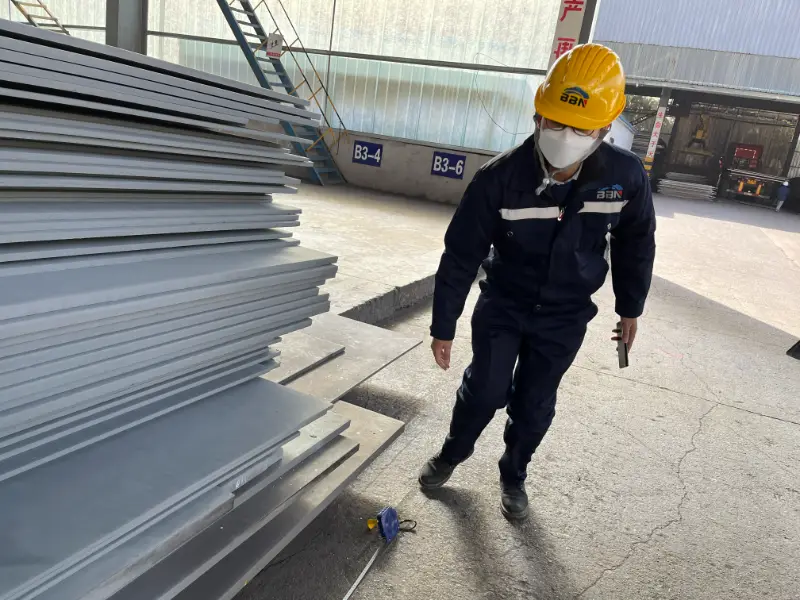
DIN 17102 WStE420
DIN 17102 WStE420 Hot Rolled Steel Coil – High-Strength Fine Grain Structural Steel
Comprehensive data on WStE420 steel according to DIN 17102: chemical composition, mechanical and physical properties, equivalent grades, applications, and processing guidelines for hot rolled coils.
Suitable for hot forming, cold forming, welding, bending, punching, and machining; can be used in as-rolled, normalized or thermomechanically rolled condition
- Phone : +8618037372205
- Email : [email protected]
- WhatsApp: Contact via Whtsapp
- WeChat: +8618037372205
DIN 17102 WStE420 Introduction
DIN 17102 WStE420 is a weldable fine grain structural steel delivered in the hot rolled condition. This grade is designed for dynamically loaded structures and offers a minimum yield strength of 420 MPa, combined with good toughness at sub-zero temperatures. The fine grain practice (normalized rolling or equivalent) ensures uniform mechanical properties and excellent weldability, making it suitable for heavy-duty applications.
- High yield and tensile strength for weight reduction
- Guaranteed impact energy at low temperatures
- Good formability for bending and profiling
- Wide range of delivery conditions (thermo-mechanically rolled, normalized)
WStE420 is now superseded by EN 10025-4 S420M, but remains widely referenced.
DIN 17102 WStE420 Chemical Composition
The chemical composition complies with DIN 17102 for grade WStE420. Elements are controlled to achieve fine grain structure and high strength while maintaining excellent weldability. Microalloying elements such as niobium, vanadium, and titanium are used for grain refinement and precipitation hardening. Sulphur and phosphorus are kept low to enhance toughness and welding performance.
| Chemical Element | Specified Value (max. or range in %) | Remarks |
|---|---|---|
| Carbon (C) | ≤ 0.20 | For thickness ≤ 16 mm; may be slightly adjusted for larger thickness |
| Silicon (Si) | ≤ 0.50 | Deoxidizer, improves strength |
| Manganese (Mn) | 1.00 – 1.70 | Promotes strength and toughness; exact range depends on thickness |
| Phosphorus (P) | ≤ 0.030 | Low for improved ductility and weldability |
| Sulphur (S) | ≤ 0.025 | Low to prevent hot cracking |
| Aluminium (Al) | ≥ 0.020 | Grain refinement; acid-soluble or total Al |
| Niobium (Nb) | ≤ 0.05 | Microalloy for grain refinement and precipitation strengthening |
| Vanadium (V) | ≤ 0.10 | Optional microalloy for strength |
| Titanium (Ti) | ≤ 0.05 | Optional, grain refinement and deoxidation |
| Nitrogen (N) | ≤ 0.020 | Typically controlled for consistent toughness; may be bound by Ti/Al |
| Chromium (Cr) | ≤ 0.30 | Residual element; not intentionally added |
| Copper (Cu) | ≤ 0.35 | Residual; may be present from scrap |
| Molybdenum (Mo) | ≤ 0.08 | Residual |
| Nickel (Ni) | ≤ 0.30 | Residual |
DIN 17102 WStE420 Thermal and Electrical Physical Properties
Physical properties are not part of the DIN 17102 standard but represent typical values for low-alloy fine grain structural steels at ambient temperature. These data can be used for engineering calculations such as thermal expansion, heat transfer, and load analysis.
| Property | Typical Value | Unit | Test Condition / Remarks |
|---|---|---|---|
| Density (ρ) | 7.85 | g/cm³ | At 20 °C |
| Modulus of elasticity (E) | 210 | GPa | At 20 °C, dynamic or static |
| Shear modulus (G) | ~81 | GPa | At 20 °C |
| Poisson's ratio (ν) | ~0.30 | – | Elastic range |
| Thermal expansion coefficient (α) | 11.5 | ×10⁻⁶ K⁻¹ | 20 – 100 °C |
| Thermal expansion coefficient (α) | 12.0 | ×10⁻⁶ K⁻¹ | 20 – 200 °C |
| Thermal expansion coefficient (α) | 12.9 | ×10⁻⁶ K⁻¹ | 20 – 400 °C |
| Thermal conductivity (λ) | 48 – 52 | W/(m·K) | At 20 °C |
| Specific heat capacity (cp) | 460 – 480 | J/(kg·K) | At 20 °C |
| Electrical resistivity (ρ_e) | 0.16 – 0.22 | ×10⁻⁶ Ω·m | At 20 °C |
DIN 17102 WStE420 Mechanical Properties
Mechanical properties are guaranteed by the manufacturer according to DIN 17102 with testing at ambient temperature unless otherwise noted. Values refer to the transverse direction for plates and wide flats; longitudinal testing may be agreed. Properties depend on product thickness and delivery condition (+N or +M). The impact energy requirement is usually specified for a test temperature of -20°C or lower for this grade.
| Property | Requirement (Typical/Guaranteed) | Unit | Test Condition / Remarks |
|---|---|---|---|
| Minimum Yield Strength (ReH) | ≥ 420 | MPa | Thickness ≤ 16 mm; for thickness 16–35 mm: ≥ 380 MPa; for 35–50 mm: ≥ 360 MPa; transverse specimens |
| Tensile Strength (Rm) | 520 – 680 | MPa | Thickness ≤ 16 mm; remains in a similar range for thicker products (e.g., 500–650 MPa) |
| Elongation after fracture (A) | ≥ 19 | % | Gauge length L₀ = 5.65√S₀; transverse, thickness ≤ 16 mm; ≥ 18 % for 16–35 mm |
| Bend test (mandrel diameter) | No cracks | – | Bend angle 180°; mandrel diameter = 2t for thickness ≤ 16 mm; 3t for 16–35 mm |
| Impact energy (KV, V-notch) | ≥ 27 | J | At -20 °C, longitudinal; higher temperatures or alternative values may be agreed (e.g., 27 J at -30 °C for some supply conditions) |
| Impact energy (KV, V-notch) | ≥ 40 | J | At -20 °C, transverse; minimum average of three tests, single value ≥ 28 J |
DIN 17102 WStE420 Direct Equivalent Materials – Identical or Directly Superseded Grades
| Country / Region | Standard | Grade | Remarks |
|---|---|---|---|
| Germany | DIN 17102 | WStE420 | Original standard (withdrawn); basis of comparison |
| Europe | EN 10113-2 | S420M | Thermomechanically rolled weldable fine grain structural steels; directly replaces WStE420 |
| Europe | EN 10025-4 | S420M | Hot rolled products of structural steels – Part 4; current standard for TMCP fine grain steel |
| International | ISO 4950-2 | E420C | High yield strength flat steel products – normalized or controlled rolled; near-identical chemical and mechanical requirements |
| Great Britain | BS 7613 (withdrawn) | 420M | Former British equivalent, now covered by EN 10025-4 |
DIN 17102 WStE420 Application Introduction
WStE420 (and its modern equivalent S420M) is engineered for welded structures subjected to high static and dynamic loads. The combination of high yield strength, good toughness, and excellent weldability makes it ideal for weight- and cost-optimized designs. It is widely used where fatigue resistance is critical and where construction codes require guaranteed low-temperature impact properties.
- Avoid prolonged exposure to temperatures above 400°C to prevent loss of mechanical properties
- Preheating for welding may be necessary depending on thickness and hydrogen control
- Can be cold-formed with generous bend radii, normally ≥ 2t
Product Applications: Welded bridge girders and box sections, Mobile crane booms and outriggers, Offshore platform components and wind turbine towers, Heavy-duty vehicle chassis and dump truck bodies, Excavator arms and buckets, Industrial flooring and grating, Penstocks and hydraulic gates
Processed into products: Webs and flanges of welded I-beams, Load-bearing brackets and stiffeners, End plates and gusset plates, Chords and diagonals in truss structures, Machinery frames and base plates, Cold-formed hat sections and purlins, Formed pipe and tubular sections for structural use
Application industries: Bridge construction, Heavy machinery and earthmoving equipment, Crane and lifting equipment, Shipbuilding and offshore structures, Transportation (railway wagons, truck frames), Steel construction for high-rise buildings and stadiums, Pressure vessels and storage tanks (subject to additional certification)
DIN 17102 WStE420 Similar or Nearly Equivalent Alternatives
| Country / Region | Standard | Grade | Remarks |
|---|---|---|---|
| United States | ASTM A572 | Grade 60 [415] (Type 1 or 2) | Similar yield strength level (415 MPa min); C-Mn-Si base, may not guarantee fine grain practice or low-temperature toughness as strictly as WStE420; verify toughness requirements. |
| China | GB/T 1591 | Q420C | Yield strength ≥ 420 MPa; contains microalloying elements; impact tested at 0 °C; comparable when impact test temperature is adjusted. |
| Japan | JIS G3106 | SM570 | Higher yield strength (~460 MPa) and tensile strength; often used as a stronger substitute, but may require adaptation of welding procedures. |
| Europe | EN 10025-3 | S420N | Normalized fine grain structural steel; similar mechanical properties but different delivery condition (+N) compared to WStE420 (+M option). Suitable for heavy plates. |
Notes:
Important processing notes:
- This grade is typically supplied in the thermomechanically rolled (+M) condition; heat treatment above 580°C may reduce strength.
- For welding, low hydrogen consumables are recommended; heat input and interpass temperature should be controlled to preserve the fine grain structure.
- When used as a substitute for older WStE420, the current EN 10025-4 S420M should be referenced in new designs.
- Third-party inspection and testing to EN 10204 are usually required for critical applications.
- Share



