
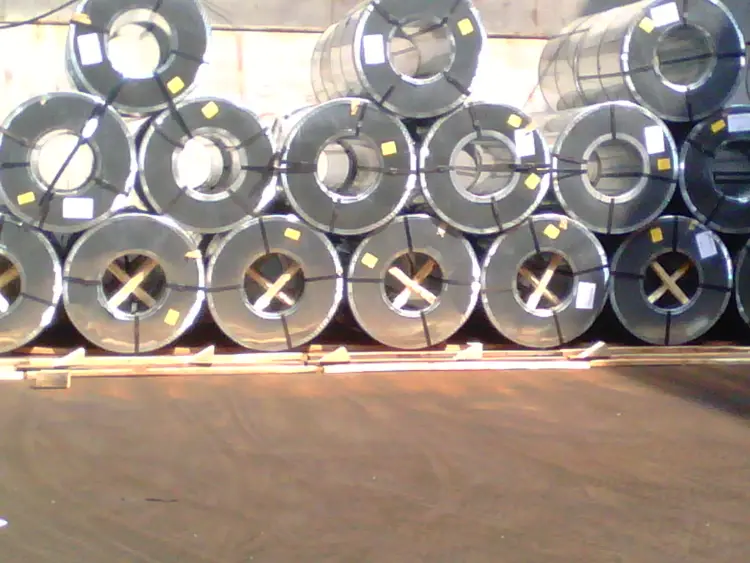
DIN 17102 TStE420 Hot Rolled Steel Coil
DIN 17102 TStE420 Hot Rolled Steel Coil: Fine-Grain Structural Steel Grade
Comprehensive data on TStE420 steel according to DIN 17102: chemical composition, mechanical and physical properties, international equivalents, and typical applications in welding construction and pressure vessels.
Normalizing rolling, normalizing, welding, cold forming, hot forming, machining
- Phone : +8618037372205
- Email : [email protected]
- WhatsApp: Contact via Whtsapp
- WeChat: +8618037372205
DIN 17102 TStE420 Hot Rolled Steel Coil Introduction
TStE420 is a weldable fine-grain structural steel grade specified in the withdrawn German standard DIN 17102. It is supplied in the normalizing-rolled or normalized condition and displays a minimum yield strength of 420 MPa for thicknesses up to 16 mm. The fine-grain practice with addition of aluminum and microalloying elements (Nb, V, Ti) grants excellent toughness at low temperatures and good weldability. This steel is suited for highly stressed welded structures such as bridges, cranes, and pressure vessels. Today it is fully replaced by EN 10025-3 S420N, although TStE420 stock or specifications may still be encountered in legacy projects.
DIN 17102 TStE420 Hot Rolled Steel Coil Chemical Composition
The chemical requirements comply with DIN 17102 Table 1 for TStE420. The steel is fully killed and contains grain-refining elements such as aluminum, niobium, vanadium, and titanium. Values are maximum unless a range is given.
| Element | Value (%) | Remarks |
|---|---|---|
| C | ≤0.20 | |
| Si | ≤0.60 | |
| Mn | 1.00 – 1.70 | |
| P | ≤0.030 | |
| S | ≤0.025 | |
| Al (total) | ≥0.020 | grain refining |
| Nb | ≤0.05 | |
| V | ≤0.12 | |
| Ti | ≤0.05 | |
| Ni | ≤0.80 | residual element |
| Cr | ≤0.30 | residual element |
| Mo | ≤0.10 | residual element |
| Cu | ≤0.55 | residual element |
| N | ≤0.020 | normally bound by Al/Ti |
DIN 17102 TStE420 Hot Rolled Steel Coil Thermal and Electrical Physical Properties
Physical properties are typical for fine-grain structural steel and valid for room temperature unless otherwise noted. They provide essential data for design calculations (thermal expansion, conductivity, etc.).
| Property | Typical Value | Unit | Condition / Temperature |
|---|---|---|---|
| Density (ρ) | 7.85 | kg/dm³ | room temperature |
| Modulus of elasticity (E) | 210 | GPa | 20 °C |
| Shear modulus (G) | 81 | GPa | 20 °C |
| Poisson's ratio (ν) | 0.30 | elastic range | |
| Thermal expansion coefficient (α) | 11.7 | 10⁻⁶/K | 20 – 100 °C |
| Thermal expansion coefficient (α) | 12.5 | 10⁻⁶/K | 20 – 200 °C |
| Thermal expansion coefficient (α) | 13.5 | 10⁻⁶/K | 20 – 400 °C |
| Thermal conductivity (λ) | 42 | W/(m·K) | 20 °C |
| Specific heat capacity (cp) | 460 | J/(kg·K) | 20 °C |
| Electrical resistivity (ρ_e) | 0.25 | µΩ·m | 20 °C |
DIN 17102 TStE420 Hot Rolled Steel Coil Mechanical Properties
Mechanical properties according to DIN 17102 for normalized/normalizing rolled condition (+N), measured at ambient temperature. Impact energy tested on Charpy-V longitudinal specimens. Values depend on product thickness.
| Property | Required Value | Unit | Test Condition |
|---|---|---|---|
| Yield strength ReH | ≥420 | MPa | thickness ≤ 16 mm |
| Yield strength ReH | ≥400 | MPa | thickness >16 mm ≤ 40 mm |
| Yield strength ReH | ≥380 | MPa | thickness >40 mm ≤ 63 mm |
| Yield strength ReH | ≥360 | MPa | thickness >63 mm ≤ 80 mm |
| Tensile strength Rm | 520 – 680 | MPa | thickness ≤ 40 mm |
| Tensile strength Rm | 500 – 660 | MPa | thickness >40 mm ≤ 80 mm |
| Elongation A (L0=5.65√S0) | ≥19 | % | longitudinal, thickness ≤ 40 mm |
| Elongation A | ≥18 | % | thickness >40 mm ≤ 63 mm |
| Elongation A | ≥17 | % | thickness >63 mm ≤ 80 mm |
| Impact energy KV | ≥27 | J | -20 °C, longitudinal, min. average |
| Bend test (mandrel dia.) | 3t (a ≤ 16 mm) | bend angle 180°, t = thickness | |
| Bend test (mandrel dia.) | 4t (a > 16 mm) | thickness >16 mm |
DIN 17102 TStE420 Hot Rolled Steel Coil Fully Equivalent Material Standards and Replaceable Grades
| Country / Region | Standard | Grade | Remarks |
|---|---|---|---|
| Europe | EN 10025-3 | S420N | Direct replacement; normalized delivery condition |
| International | ISO 4950-2 | E420 | High yield strength flat products – quenched and tempered or normalized; partially equivalent |
| France | NFA 36-201 | E420 | Historical French equivalent |
| United Kingdom | BS 4360 | Grade 50DD | Former BS standard, close but not identical |
DIN 17102 TStE420 Hot Rolled Steel Coil Application Introduction
TStE420 is used in welded constructions requiring high strength and good impact toughness at low temperatures. Thanks to its fine-grain structure and controlled carbon equivalent, it exhibits excellent weldability with conventional methods. Typical fields of application include:
- Civil engineering and bridge building
- Pressure vessels and storage tanks (under PD 5500 or EN 13445 rules)
- Heavy lifting equipment (crane booms, frames)
- Offshore and shipbuilding (jack-up legs, deck stiffeners)
- Wind energy towers and transition pieces
- Transport equipment (rail car bodies, heavy-duty trailers)
Product Applications: Welded bridge girders and deck plates, Pressure vessel shells and heads, Welded crane booms, outriggers, and chassis, Jack-up rig legs and spudcans, Wind turbine tower sections and flanges, Hydraulic press frames and cylinders
Processed into products: Longitudinal and transverse stiffeners, High-strength welded beams and columns, Crane runway girders, Rotary kiln shells, Automotive chassis components for heavy trucks, Heavy-duty forklift mast sections, Lifting and spreader beams
Application industries: Construction & civil engineering, Heavy machinery & crane manufacturing, Pressure vessel & boiler fabrication, Offshore & marine engineering, Wind energy, Railway and transport engineering
DIN 17102 TStE420 Hot Rolled Steel Coil Similar / Comparable Alternative Grades
| Country / Region | Standard | Grade | Remarks |
|---|---|---|---|
| China | GB/T 1591 | Q420C | Yield ≥420 MPa, impact at 0 °C; not fully equivalent due to different impact test temperature |
| Japan | JIS G3106 | SM520B / SM520C | Weldable structural steel; SM520C has better toughness; yield 365 MPa, lower than TStE420 |
| USA | ASTM A572 | Grade 60 | Yield 415 MPa (60 ksi); as-rolled, not normalized; toughness not guaranteed at low temperature |
| USA | ASTM A633 | Grade D | Normalized high-strength low-alloy steel; yield ~345 MPa; higher toughness but lower strength |
| Europe | EN 10025-3 | S420ML | Thermomechanical rolled (M) with low-temperature impact (L); strength similar, different route |
Notes:
- DIN 17102 was officially withdrawn and superseded by EN 10025-3. For new projects, grade S420N must be specified.
- Thicker plates (>80 mm) may require special procedures to guarantee notch toughness; through-thickness properties (Z-grade) should be agreed upon if necessary.
- Welding: low-hydrogen processes (SMAW, SAW, GMAW) are recommended; preheat is generally not required for moderate thicknesses, but should be checked according to the carbon equivalent (CEV) and plate thickness.
- Cold forming: minimum bending radii according to EN 1993-1-8 or supplier data; hot forming should be followed by normalizing if mechanical properties need to be fully restored.
- Physical data are reference values and may vary slightly depending on exact composition and temperature.
- Share



