
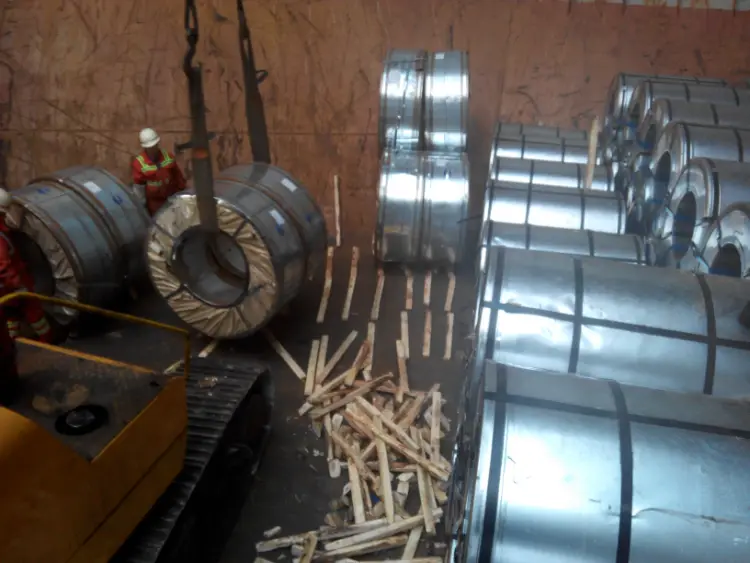
DIN 17102 EStE420 Hot Rolled Coil
DIN 17102 EStE420 Hot Rolled Coil - Fine‑Grain Structural Steel for High‑Strength Welded Applications
Detailed material data for EStE420 fine‑grain structural steel according to DIN 17102, including chemical composition, mechanical properties, thermal and electrical physical performance, international equivalents, and application guidance.
Cold forming, bending, welding, shearing, punching, laser/plasma cutting
- Phone : +8618037372205
- Email : [email protected]
- WhatsApp: Contact via Whtsapp
- WeChat: +8618037372205
DIN 17102 EStE420 Hot Rolled Coil Introduction
DIN 17102 EStE420 is a weldable fine‑grain structural steel supplied as hot‑rolled coil. It belongs to the group of high‑strength low‑alloy (HSLA) steels with a minimum yield strength of 420 MPa in the as‑rolled or normalized condition. The fine‑grain microstructure is achieved through controlled microalloying with elements such as niobium, vanadium, and titanium, which also allows good toughness at low temperatures.
Key features include:
- High strength combined with excellent weldability
- Good cold‑forming capability
- Uniform mechanical properties across the coil width
- Often supplied in thermomechanically rolled or normalized condition
DIN 17102 EStE420 Hot Rolled Coil Chemical Composition
The values below are the maximum limits unless a range or minimum is stated. The steel is fully killed and contains fine‑grain forming elements such as Al, Nb, V, and Ti. A controlled carbon equivalent (CEV) is often guaranteed to ensure weldability.
| Element | Standard Value | Remarks |
|---|---|---|
| C | ≤0.22 | |
| Si | ≤0.50 | |
| Mn | ≤1.70 | |
| P | ≤0.040 | |
| S | ≤0.040 | |
| Al (total) | ≥0.015 | Minimum for fine‑grain treatment |
| Nb | ≤0.05 | Microalloying element |
| V | ≤0.12 | Microalloying element |
| Ti | ≤0.08 | Microalloying element |
| N | ≤0.020 | Free nitrogen may be bound by Ti/Al |
| Cr | ≤0.30 | Residual (if applicable) |
| Ni | ≤0.30 | Residual (if applicable) |
| Mo | ≤0.10 | Residual (if applicable) |
| Cu | ≤0.20 | Residual (if applicable) |
DIN 17102 EStE420 Hot Rolled Coil Thermal and Electrical Physical Properties
The data below are typical for fine‑grain structural steels and are valid for approximately 20°C unless otherwise stated. Variations may occur depending on exact composition and processing route.
| Property | Typical Value | Unit | Test Condition / Remarks |
|---|---|---|---|
| Density (ρ) | 7850 | kg/m³ | 20°C |
| Modulus of elasticity (E) | 210 | GPa | 20°C, static load |
| Shear modulus (G) | 81 | GPa | Calculated from E and ν |
| Poisson's ratio (ν) | 0.30 | — | Elastic range |
| Thermal expansion coefficient (α) | 12.0 | 10⁻⁶/K | 20–100°C, mean value |
| Thermal conductivity (λ) | 45 | W/(m·K) | 20°C |
| Specific heat capacity (cp) | 460 | J/(kg·K) | 20°C |
| Electrical resistivity (ρe) | 0.22 | µΩ·m | 20°C |
DIN 17102 EStE420 Hot Rolled Coil Mechanical Properties
The mechanical properties are valid for product thickness ≤ 16 mm in the as‑delivered condition (thermomechanically rolled or normalized). For larger thicknesses the yield and tensile strength values may be slightly reduced. Impact energy is measured on longitudinal Charpy V‑notch specimens.
| Property | Required Value | Unit | Test Condition |
|---|---|---|---|
| Yield strength (ReH) | ≥420 | MPa | Thickness ≤16 mm, transverse |
| Tensile strength (Rm) | 520 – 670 | MPa | Thickness ≤16 mm, transverse |
| Elongation after fracture (A) | ≥19 | % | Gauge length L₀ = 5.65√S₀ (A5), transverse |
| Bend test | 180° bend, no cracks | — | Mandrel diameter 2a (a = specimen thickness) |
| Impact energy (KV) at -20°C | ≥27 (≥40 by agreement) | J | Longitudinal, Charpy V‑notch |
DIN 17102 EStE420 Hot Rolled Coil Identical Material Standards and Substitutable Grades
| Country/Region | Standard | Grade | Remarks |
|---|---|---|---|
| Europe | EN 10149‑2 | S420MC (1.0980) | Direct successor; thermomechanically rolled cold‑formable high‑strength steel |
| Germany | DIN 17102 | EStE420 | Original designation |
| United Kingdom | BS EN 10149‑2 | S420MC | Same as EN |
| International | ISO 630‑3 | H420KD | Approximate equivalent; fine‑grain structural steel |
DIN 17102 EStE420 Hot Rolled Coil Application Introduction
EStE420 is used where a combination of high strength, good weldability, and moderate cold‑formability is required. It can replace conventional structural steels to reduce weight or increase load‑carrying capacity without major design changes.
Product Applications: Truck chassis rails and cross members, Crane telescopic booms and outrigger beams, Structural profiles for high‑rise buildings (as part of composite structures), Welded beams and columns, Agricultural and forestry machinery frames
Processed into products: Longitudinal frame members, Cross members and brackets, Boom segments and reinforcements, Welded fabrications subject to fatigue loads, Bending‑intensive parts (e.g., hinge plates, spring seats)
Application industries: Automotive and transport (chassis, frames, wheels), Construction machinery (crane booms, lifting equipment), Mechanical engineering (welded machine frames, presses), Pressure vessel and tank manufacturing (where code permits), Shipbuilding (secondary structures)
DIN 17102 EStE420 Hot Rolled Coil Materials with Similar Performance
| Country/Region | Standard | Grade | Remarks |
|---|---|---|---|
| Europe | EN 10149‑2 | S355MC | Lower minimum yield strength (355 MPa), otherwise similar weldability and formability |
| Europe | EN 10149‑2 | S460MC | Higher strength grade from the same family |
| Europe | EN 10025‑4 | S420M | Hot‑rolled fine‑grain structural steel, thermomechanically rolled, slightly different chemistry |
| Europe | EN 10025‑3 | S420N / S420NL | Normalized fine‑grain steel, often used when impact toughness at low temperature is critical |
| USA | ASTM A1018 / A1018M | HSLAS Grade 60 (420) | HSLA steel with minimum yield strength 420 MPa, similar application range |
Notes:
Special requirements: EStE420 may be ordered with restricted carbon equivalent (CEV) to improve weldability, e.g., CEV ≤ 0.39 for thickness ≤ 16 mm. Improved impact toughness at -40°C or -50°C can be agreed at the time of order. The steel is usually supplied with a surface finish suitable for immediate painting. Normalising rolling or thermomechanical rolling is selected according to the final thickness and required toughness class. For full compliance with modern pressure equipment directives (PED), the EN 10025‑4 S420M grade is often preferred because of its guaranteed 0°C, -20°C or -40°C impact values.
- Share



