
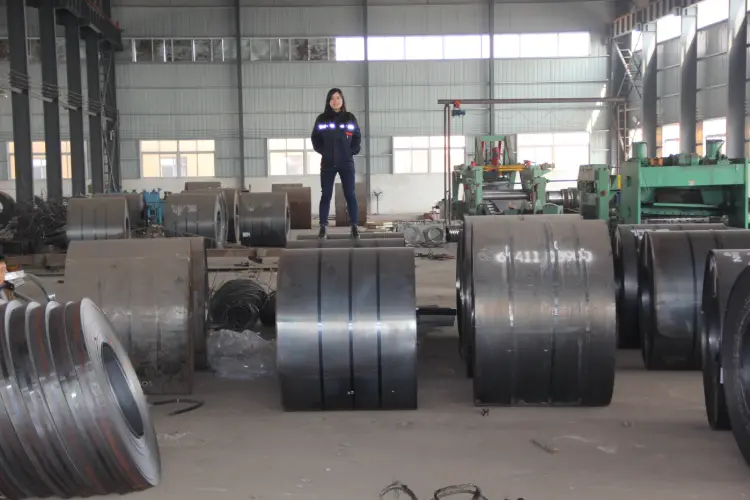
DIN 17102 StE420 Hot Rolled Steel Coil
DIN 17102 StE420 Hot Rolled Steel Coil: Premium Fine-Grain High-Strength Structural Steel
Complete technical profile of StE420 steel according to DIN 17102: chemical composition, mechanical and physical properties, international equivalents, and applications for heavy engineering.
Gas cutting, plasma cutting, flame cutting, shearing, cold bending (r ≥ 2t), hot forming, common welding processes (SMAW, GMAW, SAW), machining
- Phone : +8618037372205
- Email : [email protected]
- WhatsApp: Contact via Whtsapp
- WeChat: +8618037372205
DIN 17102 StE420 Hot Rolled Steel Coil Introduction
DIN 17102 StE420 is a weldable, normalized fine-grain structural steel with a minimum yield strength of 420 MPa. Developed for heavy plate and coil applications, it offers an excellent balance of high strength, superior toughness, and reliable weldability. The fine-grained microstructure is achieved through controlled normalizing or normalizing rolling and the addition of grain-refining elements such as aluminum, niobium, vanadium, and titanium. Typical delivery condition is normalized, ensuring uniform properties and good formability even at sub-zero temperatures.
This grade is widely specified in steel construction, bridge building, offshore installations, crane manufacturing, and pressure vessel engineering. With strict control of carbon equivalent (CEV) and sulphur/phosphorus levels, StE420 exhibits low susceptibility to hot cracking and excellent through-thickness properties. It can be cold formed within limits and is readily processed by all common cutting and welding methods.
International equivalent material is EN 10025-3 S420N (or S420NL for improved low-temperature toughness). Although DIN 17102 has been officially withdrawn, StE420 remains in use and is fully comparable to current European standards. This datasheet provides all critical information for material selection, quality assurance, and engineering design.
DIN 17102 StE420 Hot Rolled Steel Coil Chemical Composition
The following table lists the chemical requirements for StE420 according to DIN 17102. Values are in weight percent and are maxima unless a range is given.
Microalloying elements such as Nb, V, and Ti may be added singly or in combination to refine grain size. The sum of Nb+V+Ti is typically ≤ 0.22%.
| Chemical Element | Standard Value | Remarks |
|---|---|---|
| Carbon (C) | ≤ 0.20 | For thickness ≤ 16 mm; increased to 0.22 for t > 16 mm |
| Silicon (Si) | 0.10 – 0.60 | Or ≤ 0.60 if only max. specified |
| Manganese (Mn) | 1.00 – 1.70 | Higher Mn improves strength and toughness |
| Phosphorus (P) | ≤ 0.030 | Maximum; lower for +N option |
| Sulfur (S) | ≤ 0.030 | Maximum; lower for improved through-thickness properties |
| Nitrogen (N) | ≤ 0.025 | Total nitrogen content |
| Aluminum (Al) | ≥ 0.020 | Total aluminium, for grain refining; metallic Al may be specified |
| Niobium (Nb) | ≤ 0.05 | Microalloying, grain refinement |
| Vanadium (V) | ≤ 0.12 | Microalloying, precipitation strengthening |
| Titanium (Ti) | ≤ 0.05 | Microalloying, grain refinement and deoxidation |
| Copper (Cu) | ≤ 0.20 | Residual element, may be higher if agreed |
| Nickel (Ni) | ≤ 0.30 | Residual; may be added to improve toughness |
| Chromium (Cr) | ≤ 0.30 | Residual; may be added for hardenability |
| Molybdenum (Mo) | ≤ 0.10 | Residual; maximum 0.10% |
| CEV (typical) | ≤ ~0.47 | Carbon equivalent value for weldability, calculated per formula |
DIN 17102 StE420 Hot Rolled Steel Coil Thermal and Electrical Physical Properties
Physical properties are indicative and based on typical structural steels. They are suitable for design calculations. Variations may occur depending on exact composition and heat treatment.
| Property | Standard Required Value | Unit | Test Condition |
|---|---|---|---|
| Density (ρ) | 7850 | kg/m³ | Ambient temperature |
| Young Modulus (E) | 210 | GPa | Ambient temperature |
| Shear Modulus (G) | 81 | GPa | Calculated from E and ν |
| Poisson Ratio (ν) | 0.3 | – | Elastic range |
| Coefficient of thermal expansion (α) | 11.5 × 10⁻⁶ | K⁻¹ | 20 – 100°C |
| Coefficient of thermal expansion (α) | 12.0 × 10⁻⁶ | K⁻¹ | 20 – 200°C |
| Coefficient of thermal expansion (α) | 12.5 × 10⁻⁶ | K⁻¹ | 20 – 300°C |
| Thermal conductivity (λ) | 50 | W/(m·K) | At 20°C |
| Specific heat capacity (cp) | 460 | J/(kg·K) | At 20°C |
| Electrical resistivity (ρe) | 0.23 | μΩ·m | Ambient temperature |
DIN 17102 StE420 Hot Rolled Steel Coil Mechanical Properties
Mechanical properties depend on product thickness and test direction. Tensile testing is performed on transverse specimens. Impact energy values are minimal guaranteed averages of three Charpy-V tests. The steel exhibits a distinct yield point and good ductility in its normalized condition.
| Property | Standard Required Value | Unit | Test Condition |
|---|---|---|---|
| Yield Strength (ReH) | 420 | MPa | Thickness ≤ 16 mm |
| Yield Strength (ReH) | 400 | MPa | 16 mm < thickness ≤ 35 mm |
| Yield Strength (ReH) | 380 | MPa | 35 mm < thickness ≤ 50 mm |
| Yield Strength (ReH) | 360 | MPa | 50 mm < thickness ≤ 70 mm |
| Tensile Strength (Rm) | 520 – 680 | MPa | All thicknesses |
| Elongation after fracture (A) | 19 | % | Thickness ≤ 16 mm, L0 = 5.65√S0 |
| Elongation after fracture (A) | 18 | % | 16 mm < thickness ≤ 35 mm |
| Elongation after fracture (A) | 17 | % | 35 mm < thickness ≤ 50 mm |
| Elongation after fracture (A) | 16 | % | 50 mm < thickness ≤ 70 mm |
| Impact energy (KV, Charpy-V) | 40 | J | at -20°C, thickness ≤ 50 mm, longitudinal |
| Impact energy (KV, Charpy-V) | 27 | J | at -20°C, thickness ≤ 50 mm, transverse |
| Bend test (c = center diameter, a = thickness) | c ≤ 3a (180°) | – | Mandrel diameter up to 3 times thickness, no cracks |
DIN 17102 StE420 Hot Rolled Steel Coil Fully Equivalent Material Standards & Substitutable Grades
| Country/Region | Standard | Grade | Remarks |
|---|---|---|---|
| European Union | EN 10025-3 (2004) | S420N | Direct replacement, normalized fine-grain steel |
| European Union | EN 10025-3 (2004) | S420NL | Improved low‑temperature toughness variant |
| Germany | DIN 17102 (withdrawn) | StE420 | Original designation, fully equivalent to S420N |
| United Kingdom | BS EN 10025-3 | S420N | British adoption of European standard |
| France | NF EN 10025-3 | S420N | French standard, identical to EN 10025-3 |
| Italy | UNI EN 10025-3 | S420N | Italian adoption |
DIN 17102 StE420 Hot Rolled Steel Coil Application Introduction
DIN 17102 StE420 is designed for demanding structural applications where high load-bearing capacity, toughness at low temperatures, and reliable welding performance are critical. It is delivered in normalized condition and finds use across heavy industry sectors. The material can be cut, welded, and cold formed (within specified bending radii), and it is suitable for galvanizing and coating. Typical engineering employs include crane booms and lattice towers, offshore platform legs, pressure vessel shells, and heavy vehicle chassis.
Product Applications: Welded H‑beams and I‑beams, Box columns and tubular sections, Crane booms and lattice masts, Bridge girders and arch ribs, Offshore platform legs and braces, Pressure vessel shells (non‑cryogenic), Heavy‑duty vehicle frames and excavator booms, Mining dump truck bodies
Processed into products: Gusset plates and stiffeners, Crane rail beams and trolley frames, Offshore platform nodes (jacket structures), Base plates and anchor boxes, Welded pipe fittings for high‑stress lines, Boom sections and telescopic arms, Heavy‑duty gearbox housings and support structures
Application industries: Civil engineering and infrastructure, Bridge construction, Heavy machinery and lifting equipment, Shipbuilding and marine structures, Offshore oil & gas, Mining and material handling, Energy (wind turbine towers, power plant structures)
DIN 17102 StE420 Hot Rolled Steel Coil Similar & Alternative Material Recommendations
| Country/Region | Standard | Grade | Remarks |
|---|---|---|---|
| United States | ASTM A572/A572M | Grade 60 [415] | Similar yield strength (415 MPa), Mn up to 1.35%, different toughness concept |
| United States | ASTM A633/A633M | Grade E | Normalized high-strength low-alloy steel, minimum yield 415 MPa, good low-temperature toughness |
| Japan | JIS G 3106 | SM490YA/B | SM490 has min. 325‑365 MPa yield, lower strength; not a direct match but used in similar welded structures |
| China | GB/T 1591 | Q420D | High strength low alloy structural steel, minimum yield 420 MPa, normalized condition available |
| International | API RP 2A | API 2H Grade 50 | Offshore structural steel, minimum yield 345‑414 MPa, enhanced toughness, alternative for offshore use |
Notes:
Important notes for processing:
• StE420 is typically supplied as normalized or normalizing-rolled; verify heat treatment condition before welding or forming.
• For thicknesses above 50 mm, consult the standard for adjusted mechanical values and potential through-thickness property testing.
• The carbon equivalent (CEV) should be calculated and reported to ensure weldability; preheating may be required depending on thickness and CEV.
• This data is compiled from official DIN 17102 regulations and should be used in conjunction with the latest material test certificates.
- Share



