
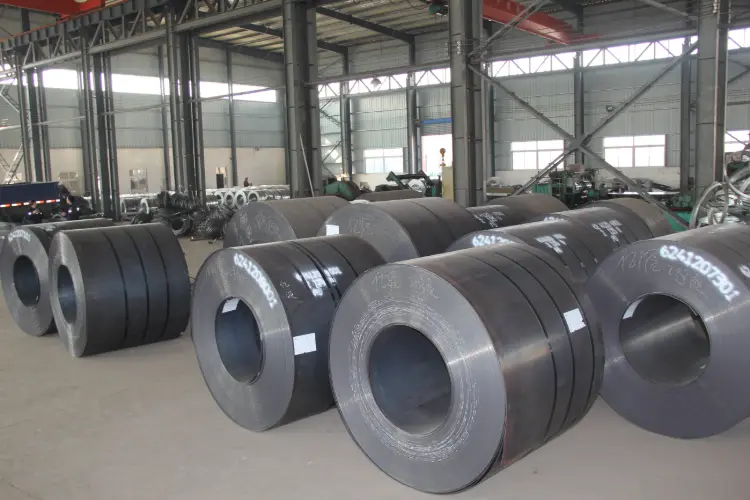
DIN 17102 WStE380 Hot Rolled Steel Coil
DIN 17102 WStE380 Hot Rolled Steel Coil: Full Data Sheet & Equivalents
Complete properties of DIN 17102 WStE380 hot rolled steel: chemical composition, yield strength ≥380 MPa, impact toughness at -20°C, thermal conductivity, and EN 10025-3 S380N cross-reference.
Hot rolling; can be further processed by cold bending, flame cutting, welding, drilling, milling, and painting
- Phone : +8618037372205
- Email : [email protected]
- WhatsApp: Contact via Whtsapp
- WeChat: +8618037372205
DIN 17102 WStE380 Hot Rolled Steel Coil Introduction
WStE380 under DIN 17102 is a hot rolled weldable fine grain normalized structural steel with a minimum yield strength of 380 MPa. It is produced as fully killed steel with a fine austenitic grain size obtained by controlled additions of aluminum and/or microalloying elements (Nb, V, Ti). The material offers excellent combination of strength, toughness, and weldability suitable for heavily loaded welded structures. Original standard has been superseded by EN 10025-3 grades S380N and S380NL, but WStE380 remains widely specified in legacy projects.
- Key features: Normalized delivery condition, guaranteed Charpy V-notch impact energy at -20°C, good cold formability and machinability.
- Typical applications: Welded structures in civil engineering, heavy machinery, bridges, offshore components, and vehicle frames.
DIN 17102 WStE380 Hot Rolled Steel Coil Chemical Composition
The composition guarantees a fine grain structure and adequate weldability. For WStE380 the sum of microalloying elements Nb, V and Ti is normally ≤ 0.22%. Aluminum acts as a grain refiner and nitrogen fixer.
- Values in accordance with DIN 17102 and equivalent EN 10025-3 S380N requirements.
- Optional additions of Cr, Ni, Cu and Mo may be present by agreement; limits shown are maximum unless otherwise noted.
| Element | Specification (wt%) | Remarks |
|---|---|---|
| Carbon (C) | ≤ 0.20 | Max value for fine grain steel |
| Silicon (Si) | ≤ 0.50 | Deoxidation element |
| Manganese (Mn) | 1.00 - 1.70 | Strength and toughness contributor |
| Phosphorus (P) | ≤ 0.030 | Controlled for improved notch toughness |
| Sulfur (S) | ≤ 0.025 | Controlled to avoid hot shortness |
| Aluminium (Al total) | ≥ 0.020 | Minimum for grain refinement; acid-soluble Al may be specified |
| Niobium (Nb) | ≤ 0.05 | Grain refiner; may be partly replaced by other microalloying elements |
| Vanadium (V) | ≤ 0.12 | Precipitation hardening and grain refinement |
| Titanium (Ti) | ≤ 0.20 | Used for nitrogen fixation and grain size control |
| Nitrogen (N) | ≤ 0.015 | Typical limit for fine grain steels |
| Nickel (Ni) | ≤ 0.30 | Residual/specified addition, improves toughness |
| Chromium (Cr) | ≤ 0.30 | May be added for increased hardenability |
| Copper (Cu) | ≤ 0.55 | Weathering resistance; can be specified |
| Molybdenum (Mo) | ≤ 0.10 | Usually residual; optional for high temperature properties |
DIN 17102 WStE380 Hot Rolled Steel Coil Thermal & Electrical Physical Properties
Physical constants are typical for low-alloy normalized structural steels. Values in the table are representative for density, elastic modulus, thermal expansion, thermal conductivity, specific heat capacity, and electrical resistivity. Actual properties may vary slightly with chemical composition and heat treatment.
- The coefficient of thermal expansion increases with temperature; data are given for common temperature ranges.
- Thermal conductivity decreases as temperature rises; values shown are mean values for the relevant temperature span.
| Property | Value | Unit | Test Condition |
|---|---|---|---|
| Density (ρ) | 7850 | kg/m³ | At 20°C |
| Elastic modulus (E) | 210 | GPa | At 20°C, tensile modulus |
| Shear modulus (G) | 81 | GPa | At 20°C, approximate |
| Poisson's ratio (ν) | 0.3 | - | Within elastic range |
| Thermal expansion coefficient (α) | 12.0 × 10⁻⁶ | K⁻¹ | 20 - 100°C |
| Thermal expansion coefficient (α) | 12.5 × 10⁻⁶ | K⁻¹ | 20 - 200°C |
| Thermal expansion coefficient (α) | 13.0 × 10⁻⁶ | K⁻¹ | 20 - 300°C |
| Thermal conductivity (λ) | 50 | W/(m·K) | At 20°C |
| Thermal conductivity (λ) | 48 | W/(m·K) | At 100°C |
| Specific heat capacity (c) | 460 | J/(kg·K) | At 20°C - 100°C |
| Electrical resistivity (ρ_e) | 0.22 × 10⁻⁶ | Ω·m | At 20°C |
DIN 17102 WStE380 Hot Rolled Steel Coil Mechanical Properties
Properties depend on product thickness and test direction. Values below follow DIN 17102 and are valid for flat products tested in the transverse direction unless otherwise stated. Impact energy is given for full-size Charpy V-notch specimens at -20°C as a key requirement for WStE380.
- For plate thicknesses ≤ 16 mm, the mandrel diameter for bend test is typically 2t.
- Higher thicknesses may require longer soaking times and stricter process control to achieve uniform properties.
| Property | Value | Unit | Test Condition / Remarks |
|---|---|---|---|
| Yield strength ReH | ≥ 380 | MPa | Thickness t ≤ 16 mm, transverse |
| Yield strength ReH | ≥ 360 | MPa | Thickness 16 < t ≤ 35 mm, transverse |
| Yield strength ReH | ≥ 340 | MPa | Thickness 35 < t ≤ 50 mm, transverse |
| Tensile strength Rm | 560 - 730 | MPa | All thicknesses, transverse |
| Elongation A (L0=5.65√S0) | ≥ 20 | % | Thickness t ≤ 16 mm, transverse |
| Elongation A (L0=5.65√S0) | ≥ 19 | % | Thickness 16 < t ≤ 35 mm, transverse |
| Bend test | No cracks, mandrel diameter 2t | - | Bend to 180°; t = specimen thickness, t ≤ 16 mm |
| Bend test | No cracks, mandrel diameter 3t | - | Thickness 16 < t ≤ 35 mm |
| Charpy-V impact energy KV (longitudinal) | ≥ 27 | J | At -20°C, average of 3 specimens, min. single 20 J |
| Charpy-V impact energy KV (transverse) | ≥ 16 | J | At -20°C, for comparison only, when required |
DIN 17102 WStE380 Hot Rolled Steel Coil Direct Equivalent Material Standards & Designations
| Country/Region | Standard | Designation/Grade | Remarks |
|---|---|---|---|
| Germany | DIN 17102 | WStE380 | Original specification, now obsolete; normalized fine grain steel |
| Europe | EN 10025-3:2019 | S380N (1.8911) | Direct successor; -20°C impact energy guaranteed |
| Europe | EN 10025-3:2019 | S380NL (1.8912) | Low-temperature variant; Charpy tests at -50°C |
| Italy | UNI 7732 | Fe E 380 | Equivalent normalized steel, superseded by EN standard |
| France | NF A 35-501 | E 380 | Former French designation, now replaced |
| Spain | UNE 36080 | AE380 | Former Spanish fine grain structural steel standard |
DIN 17102 WStE380 Hot Rolled Steel Coil Application Introduction
WStE380 and its modern equivalent S380N are designed for welded constructions subject to moderate to high loading where reliable toughness is essential. Its good weldability, even in thick sections, together with guaranteed impact properties at sub-zero temperatures, makes it a preferred choice in structural engineering, heavy machinery, and offshore environments. The normalized microstructure ensures consistent properties across the entire cross‑section.
Product Applications: Welded bridge girders and box sections, Press-brake formed profiles and crane booms, Heavy‑duty trailer chassis and tipper bodies, Offshore jack‑up leg chords and rack components, Wind tower shell courses and door frames, Excavator arms and buckets, Building columns and truss elements, High‑strength hollow structural sections (cold‑formed or hot‑finished)
Processed into products: Longitudinal and transverse beams in bridges, Welded diaphragms, gusset plates, and stiffeners, Boom segments, luffing frames, and outriggers, Bogie frames for railway wagons, Offshore platform braces and joint cans, Tower flanges and bolted connections, Plow frames and soil‑engaging tools (with appropriate wear protection), Forklift masts and industrial lift components
Application industries: Civil engineering and infrastructure (bridges, stadia, high‑rise buildings), Heavy machinery and mining equipment, Crane and lifting equipment manufacturing, Shipbuilding and offshore platforms (deck structures, legs), Rail vehicle and trailer frames, Wind energy (turbine tower sections, internal platforms), Pressure vessel fabrication (limited, depending on code/application), Agricultural and earthmoving machinery
DIN 17102 WStE380 Hot Rolled Steel Coil Similar or Alternative Materials
| Country/Region | Standard | Designation/Grade | Comparison Notes |
|---|---|---|---|
| Europe | EN 10025-3 | S355N / S355NL | Lower yield strength (355 MPa), similar toughness and weldability; widely available |
| USA | ASTM A572/A572M | Grade 55 [380] | Similar yield (380 MPa) but not necessarily fine grain treated; typical for structural shapes, toughness may differ |
| USA | ASTM A633/A633M | Grade C | Normalized, fine grain, yield 345 MPa; good toughness at -40°C, seismic applications |
| Japan | JIS G 3106 | SM490B / SM490YB | Yield 355-365 MPa, welded structures; lacks guaranteed -20°C impact by default, QLT variant needed for toughness |
| China | GB/T 1591 | Q345E / Q390C | Q390C yield approx. 390 MPa with Charpy at 0°C; Q345E offers -40°C impact but lower strength |
| International | ISO 4950/3 | E 380 - C | High yield strength structural steel; comparable to WStE380 in normalized condition |
Notes:
Welding recommendations: Use low‑hydrogen welding processes (MMA, MAG, SAW) with appropriate pre‑heat and interpass temperatures according to the carbon equivalent (typically CEV ≤ 0.45). Post‑weld heat treatment is generally not required for thicknesses below 30 mm when adequate pre‑heat is applied.
Formability: Cold bending radii should be at least 2t for transverse bending; stricter radii may require a bend test qualification. Flame cutting of thicker plates (≥ 40 mm) should be performed with pre‑heating to avoid hardening cracks.
Surface protection: The material accepts standard painting systems and hot‑dip galvanizing. For long‑term weathering resistance, a copper‑bearing modification (similar to S380J0W) can be agreed, but this is not part of the base WStE380 specification.
Certification: Material can be supplied with EN 10204 inspection certificates 3.1 or 3.2, including Charpy V‑notch tests at -20°C (mandatory) and optionally -40°C when S380NL quality is required.
- Share



