
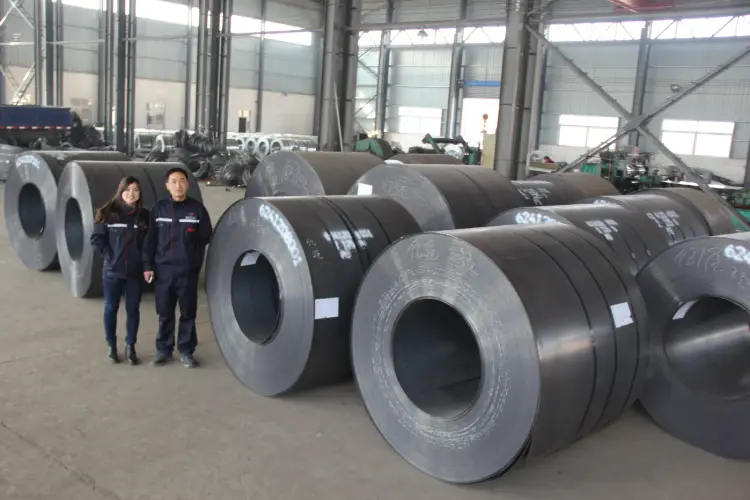
DIN 17102 TStE380 Hot Rolled Steel Coil
DIN 17102 TStE380 Hot Rolled Steel Coil - Chemical, Mechanical & Physical Data
Complete material data sheet for TStE380 hot rolled steel per DIN 17102. Includes chemical composition, tensile and impact properties, thermal constants, equivalent grades (EN 10025-3 S355N), and application guidance for bridges, offshore and heavy welded structures.
Cutting, welding (all common methods), cold forming, machining, hot forming (followed by normalizing if necessary)
- Phone : +8618037372205
- Email : [email protected]
- WhatsApp: Contact via Whtsapp
- WeChat: +8618037372205
DIN 17102 TStE380 Hot Rolled Steel Coil Introduction
TStE380 is a hot-rolled weldable fine-grain structural steel originally specified in DIN 17102 (now superseded by EN 10025-3). It is supplied in the normalized or normalized-rolled condition and offers a minimum yield strength of 380 MPa for thicknesses up to 16 mm.
Key characteristics:
- Excellent weldability due to low carbon equivalent and fine-grain practice
- Good notch toughness down to -20°C (tested with Charpy V-notch ≥ 40 J)
- Improved resistance to brittle fracture, suitable for dynamic loading
- Typical applications include welded bridges, crane structures, offshore platforms, pressure vessels, and heavy machinery
The material is designed for demanding welded fabrications where reliable through-thickness properties and toughness at low temperatures are required.
DIN 17102 TStE380 Hot Rolled Steel Coil Chemical Composition
The ladle analysis limits according to DIN 17102 for TStE380. Additional microalloying elements (Nb, V, Ti) are used singly or in combination to achieve the required fine grain size and strength. Carbon equivalent (CEV) is typically ≤ 0.45% for good weldability.
| Element | Standard Value (max or range) | Remarks |
|---|---|---|
| C | ≤ 0.20 % | Carbon – influences strength and weldability |
| Si | ≤ 0.50 % | Silicon – deoxidiser |
| Mn | 1.00 – 1.60 % | Manganese – strength and hardenability |
| P | ≤ 0.035 % | Phosphorus – kept low for toughness |
| S | ≤ 0.030 % | Sulphur – controlled for cleanliness |
| Al (total) | ≥ 0.020 % | Aluminium – grain refining, deoxidation |
| Nb | ≤ 0.05 % | Niobium – grain refinement (optional) |
| V | ≤ 0.10 % | Vanadium – precipitation strengthening (optional) |
| Ti | ≤ 0.05 % | Titanium – grain refinement (optional) |
| Ni | ≤ 0.30 % | Nickel – residual max, improves toughness |
| Cr | ≤ 0.30 % | Chromium – residual max |
| Cu | ≤ 0.30 % | Copper – residual max |
| Mo | ≤ 0.08 % | Molybdenum – residual max |
| N | ≤ 0.020 % | Nitrogen – controlled to avoid strain ageing |
| CEV (typical) | ≤ 0.45 % | Carbon equivalent per IIW formula |
DIN 17102 TStE380 Hot Rolled Steel Coil Thermal and Electrical Physical Properties
Typical physical constants for TStE380 / S355N type structural steels at room temperature and elevated temperatures. Exact values may vary slightly with specific heat treatment and composition.
| Property | Typical Value | Unit | Test Condition / Temperature |
|---|---|---|---|
| Density (ρ) | 7.85 | g/cm³ | 20°C |
| Modulus of Elasticity (E) | 210 | GPa | 20°C |
| Shear Modulus (G) | ≈ 81 | GPa | 20°C |
| Poisson's Ratio (ν) | 0.3 | – | Room temp. |
| Coefficient of Thermal Expansion (α) | 11.1 | 10⁻⁶/K | 20 – 100°C |
| Coefficient of Thermal Expansion (α) | 12.1 | 10⁻⁶/K | 100 – 200°C |
| Coefficient of Thermal Expansion (α) | 12.9 | 10⁻⁶/K | 200 – 300°C |
| Thermal Conductivity (λ) | ≈ 50 | W/(m·K) | 20°C |
| Specific Heat Capacity (cp) | ≈ 460 | J/(kg·K) | 20°C |
| Electrical Resistivity (ρe) | ≈ 0.20 | μΩ·m | 20°C |
DIN 17102 TStE380 Hot Rolled Steel Coil Mechanical Properties
Tensile and impact properties at room temperature (or -20°C for impact) as required by DIN 17102. Values apply to transverse specimens from normalized/normalized-rolled coil and plate. Impact energy is guaranteed for longitudinal Charpy-V specimens at a specified test temperature.
| Property | Standard Requirement | Unit | Test/Thickness Condition |
|---|---|---|---|
| Yield Strength (ReH) | ≥ 380 | MPa | Thickness ≤ 16 mm |
| Yield Strength (ReH) | ≥ 355 | MPa | Thickness > 16 mm ≤ 40 mm |
| Yield Strength (ReH) | ≥ 325 | MPa | Thickness > 40 mm ≤ 63 mm |
| Yield Strength (ReH) | ≥ 315 | MPa | Thickness > 63 mm ≤ 80 mm |
| Tensile Strength (Rm) | 500 – 650 | MPa | Thickness ≤ 16 mm |
| Tensile Strength (Rm) | 480 – 630 | MPa | Thickness > 16 mm ≤ 40 mm |
| Tensile Strength (Rm) | 470 – 620 | MPa | Thickness > 40 mm ≤ 63 mm |
| Tensile Strength (Rm) | 460 – 610 | MPa | Thickness > 63 mm ≤ 80 mm |
| Elongation (A5) | ≥ 20 | % | Lo=5.65√S₀, transverse, all thicknesses |
| Impact Energy (KV, longitudinal) | ≥ 40 | J | At -20°C, 10x10 mm Charpy-V |
| Bend Test (180°) | No cracks or fissures | – | Mandrel dia = 3a (a = specimen thickness), up to 50 mm |
DIN 17102 TStE380 Hot Rolled Steel Coil Exact Equivalent Material Standards & Replaceable Grades
| Country / Region | Standard & Grade | Original Grade | Remarks |
|---|---|---|---|
| European Union | EN 10025-3: S355N (nearest standard; yield 355 MPa) | DIN 17102 TStE380 | Not a direct match in modern standards. Some mills offer S380N+ according to EN 10025-3 as a special agreement. S355N provides lower yield strength; check design implications. |
| European Union | EN 10025-3: S355NL | DIN 17102 TStE380 | Low-temperature variant with guaranteed impact at -50°C; other properties similar to S355N. |
| International | ISO 4950-2: E355 | DIN 17102 TStE380 | Former ISO equivalent for 355 MPa yield class; mechanical values align when thickness ≤ 16 mm (ReH ≥ 355 MPa). |
DIN 17102 TStE380 Hot Rolled Steel Coil Application Introduction
TStE380 is suited for highly stressed welded structures where reliability and resistance to brittle fracture are essential. It is typically delivered in normalized condition to guarantee uniform fine-grain microstructure.
Processing tips:
- Preheating is usually not required for moderate thicknesses, but for thicker sections (>30 mm) and high restraints, a preheat of 100–150°C is recommended.
- All common arc welding processes can be used; low-hydrogen consumables are preferred to avoid cold cracking.
- Cold forming up to moderate strains is feasible; if heavy deformation is performed, a subsequent stress-relief or normalizing treatment may be necessary.
- Machinability is typical for a normalized fine-grain steel (comparable to S355).
Product Applications: Welded bridge girders and box sections, Offshore platform substructure nodes and braces, Wind turbine tubular towers and transition pieces, Heavy-duty crane booms and frames, Pressure vessel shells (where approved by code), Mining dump truck frames and booms, Hydraulic cylinder bodies and thick-walled pipes
Processed into products: Longitudinal and transverse stiffeners, Flange plates for welded beams, End plates and splice connections, Pinned structural joints, Welded fabrications requiring through-thickness toughness (with Z-quality option if specified), Machined components like pin bosses, brackets and anchor blocks, Cold-formed profiles and sections up to moderate radii
Application industries: Civil engineering and bridge construction, Offshore and marine engineering (deck structures, jack-up legs), Wind energy (tower sections, foundations), Crane and heavy lifting equipment, Pressure vessel and storage tank (moderate temperature), Mining and earth-moving machinery, Shipbuilding (secondary structures)
DIN 17102 TStE380 Hot Rolled Steel Coil Similar / Non-Exact Substitute Grades
| Country / Region | Standard & Grade | Alternative Grade | Remarks |
|---|---|---|---|
| European Union | EN 10025-3 S420N | TStE380 | Higher yield (420 MPa) and tensile strength; may be substituted for weight reduction if design allows higher strength and slightly lower elongation. |
| United States | ASTM A572 Gr 50 (Type 1 & 2) | TStE380 | Yield 345 MPa, tensile 450 MPa min; lower strength but often used interchangeably after re-calculation for static applications. Notch toughness varies with grade. |
| United States | ASTM A709 Gr 50 / Gr 50W | TStE380 | For bridge structural steel; similar strength level to A572 Gr 50, with improved atmospheric corrosion resistance (50W). |
| United Kingdom (obsolete) | BS 4360 Gr 50D / 50EE | TStE380 | Former British standard with 355 MPa yield and guaranteed impact at -20°C (50D) or -40°C (50EE); close match for many thickness ranges. |
| China | GB/T 1591 Q355NE | TStE380 | Yield 355 MPa, impact at -40°C; normalized delivery condition; similar in weldability and toughness. |
Notes:
DIN 17102 was officially withdrawn and replaced by the EN 10025 series. The designation TStE380 today is usually ordered and supplied as S355N or S420N according to EN 10025-3, often with a supplementary requirement for minimum yield of 380 MPa (agreed between purchaser and mill). When specifying TStE380, it is advisable to reference the EN grade with a note on the required yield strength.
Fabrication note: To maintain fine-grain properties, hot forming above 650°C should be followed by normalizing. For welded structures, post-weld heat treatment (PWHT) is generally not mandatory, but for pressure vessel applications or thick sections, a stress-relief at 530–580°C may be applied.
- Share



