
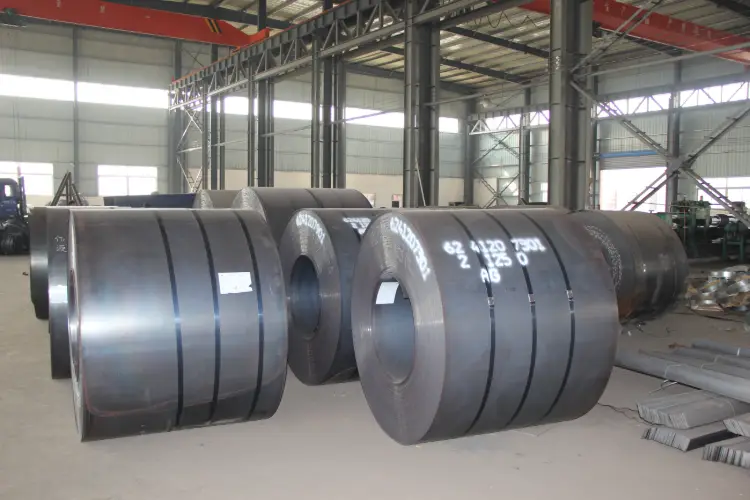
DIN 17102 StE380 Hot Rolled Steel Coil
DIN 17102 StE380 Hot Rolled Steel Coil - Fine-Grain Structural Steel
Detailed material properties and equivalents for StE380 according to DIN 17102. Includes chemical composition, mechanical and physical properties, international equivalents, and application guidance for hot rolled fine-grain structural steel.
Cold forming, bending, flanging, welding, machining, cutting
- Phone : +8618037372205
- Email : [email protected]
- WhatsApp: Contact via Whtsapp
- WeChat: +8618037372205
DIN 17102 StE380 Hot Rolled Steel Coil Introduction
DIN 17102 StE380 is a German standard fine-grain structural steel supplied as hot rolled coil, plate, and sections. It is designed for cold forming and welding, with a minimum yield strength of 380 MPa for thicknesses up to 16 mm. The steel is microalloyed with elements such as niobium, vanadium, or titanium to achieve fine grain size and enhanced notch toughness.
- Excellent weldability with low carbon equivalent
- Good cold formability for bending and profiling
- Guaranteed impact energy at -20°C
- Normalized or as-rolled delivery condition
Typical applications include welded load-bearing structures, vehicle frames, crane booms, and earthmoving equipment.
DIN 17102 StE380 Hot Rolled Steel Coil Chemical Composition
Ladle analysis according to DIN 17102 for StE380. The steel is fully killed and fine-grain treated. The grain refinement is achieved by additions of aluminium, niobium, vanadium and/or titanium. The sum of Nb+V+Ti typically does not exceed 0.22%. Carbon equivalent (CEV) is controlled for good weldability.
| Chemical Element | Standard Value (%) | Remarks |
|---|---|---|
| Carbon (C) | ≤ 0.20 | Ladle analysis |
| Silicon (Si) | ≤ 0.50 | Ladle analysis |
| Manganese (Mn) | 0.90 – 1.65 | Ladle analysis |
| Phosphorus (P) | ≤ 0.030 | Ladle analysis |
| Sulfur (S) | ≤ 0.025 | Ladle analysis |
| Aluminium (Altotal) | ≥ 0.020 | Grain refining element |
| Niobium (Nb) | ≤ 0.05 | Optional, as grain refiner |
| Vanadium (V) | ≤ 0.10 | Optional, as grain refiner |
| Titanium (Ti) | ≤ 0.05 | Optional, as grain refiner |
| Nitrogen (N) | ≤ 0.015 | Typically controlled for fine-grain stability |
| Copper (Cu) | ≤ 0.55 | Residual, higher amounts may affect hot shortness |
| Chromium (Cr) | ≤ 0.30 | Residual element |
| Nickel (Ni) | ≤ 0.30 | Residual element |
| Molybdenum (Mo) | ≤ 0.10 | Residual element |
DIN 17102 StE380 Hot Rolled Steel Coil Thermal and Electrical Physical Properties
Typical physical properties for fine-grain structural steels similar to StE380. These values are valid at room temperature (20°C) unless otherwise noted. They are provided for design calculations and numerical simulations.
| Property | Typical Value | Unit | Test Condition / Temperature |
|---|---|---|---|
| Density (ρ) | 7.85 | g/cm³ | 20°C |
| Modulus of elasticity (E) | 210 | GPa | 20°C |
| Shear modulus (G) | 81 | GPa | 20°C |
| Poisson's ratio (ν) | 0.3 | – | 20°C |
| Thermal expansion coefficient (α) | 11.5 × 10⁻⁶ | K⁻¹ | 20°C – 100°C |
| Thermal expansion coefficient (α) | 12.0 × 10⁻⁶ | K⁻¹ | 20°C – 200°C |
| Thermal expansion coefficient (α) | 12.8 × 10⁻⁶ | K⁻¹ | 20°C – 400°C |
| Thermal conductivity (λ) | 50 | W/(m·K) | 20°C |
| Thermal conductivity (λ) | 45 | W/(m·K) | 200°C |
| Specific heat capacity (c) | 460 | J/(kg·K) | 20°C |
| Electrical resistivity (ρe) | 0.20 – 0.25 | Ω·mm²/m | 20°C |
DIN 17102 StE380 Hot Rolled Steel Coil Mechanical Properties
Mechanical properties for StE380 in the delivery condition (as-rolled or normalized). Values are specified for longitudinal test pieces. The impact energy is determined on Charpy-V specimens at -20°C. Properties depend on product thickness and test direction.
| Property | Standard Required Value | Unit | Test Condition |
|---|---|---|---|
| Yield strength (ReH) | ≥ 380 | MPa | Thickness ≤ 16 mm |
| Yield strength (ReH) | ≥ 370 | MPa | Thickness > 16 mm ≤ 35 mm |
| Yield strength (ReH) | ≥ 360 | MPa | Thickness > 35 mm ≤ 50 mm |
| Yield strength (ReH) | ≥ 350 | MPa | Thickness > 50 mm ≤ 80 mm |
| Tensile strength (Rm) | 510 – 680 | MPa | Thickness ≤ 50 mm |
| Tensile strength (Rm) | 490 – 660 | MPa | Thickness > 50 mm ≤ 80 mm |
| Elongation after fracture (A) | ≥ 19 | % | Longitudinal, gauge length 5.65√S₀ |
| Elongation after fracture (A) | ≥ 17 | % | Transverse, gauge length 5.65√S₀ |
| Impact energy (KV2) | ≥ 27 | J | Longitudinal, -20°C |
| Impact energy (KV2) | ≥ 27 | J | Transverse, -20°C |
| Bend test (mandrel diameter) | No cracking | – | Bend angle 180°, mandrel diameter = 2×t (t ≤ 16 mm) |
DIN 17102 StE380 Hot Rolled Steel Coil Directly Equivalent Material Standards and Substitutable Grades
| Country/Region | Standard | Grade | Remarks |
|---|---|---|---|
| Germany / EU | DIN 17102 | StE380 | Original standard; still used in some specifications |
| EU | EN 10113-2 (withdrawn) | S380N | Former European equivalent, directly aligned with StE380 |
| International | ISO 4952 | FeE380 | Corresponding ISO grade for fine-grain structural steel |
| United Kingdom | BS 4360 (withdrawn) | 50D | Close match in terms of yield and toughness, though not fully identical |
| Japan | JIS G 3106 | SM490B/C | Comparable weldable structural steel with similar carbon equivalent and toughness |
| China | GB/T 1591 | Q390C/D | Fine-grain structural steel with minimum yield 390 MPa, similar application |
| USA | ASTM A572/A572M | Grade 55 (380) | Slightly lower minimum yield; can be used with design adjustment |
| Russia | GOST 27772 | S390 | Steel for welded structures, comparable strength level |
DIN 17102 StE380 Hot Rolled Steel Coil Application Introduction
StE380 is a versatile fine-grain structural steel used primarily in welded constructions that require good cold formability and guaranteed impact toughness at subzero temperatures. The material is easily cut, bent, and welded using conventional methods. Typical applications span heavy machinery, bridges, building frames, and transport equipment. Preheating before welding is generally not required for moderate plate thicknesses, but low-hydrogen welding procedures are recommended. The fine-grain structure ensures uniform mechanical properties and resistance to brittle fracture. The steel can be supplied with improved atmospheric corrosion resistance through copper additions upon agreement.
Product Applications: Welded bridge girders and structural beams, Crane booms and jib sections, Heavy-duty vehicle chassis and trailer frames, Earthmoving equipment buckets and arms, Storage tanks and pressure vessels (limited to moderate pressure), Transmission towers and lattice masts, Rolled profiles for welded built-up sections
Processed into products: Flanges and webs of welded plate girders, Cold-formed channel and angle sections, Stiffeners and gusset plates, Welded tubular sections and closed profiles, Booms, arms, and linkages for excavators, Frame rails and crossmembers for trucks, Piling and sheet piling accessories, Base plates for machinery and equipment
Application industries: Heavy machinery and equipment manufacturing, Bridge and structural engineering, Automotive and transportation (truck frames, trailers), Crane and lifting equipment, Earthmoving and mining machinery, Offshore and shipbuilding (limited to structural parts), Steel construction and industrial buildings
DIN 17102 StE380 Hot Rolled Steel Coil Similar / Near-Equivalent Material Recommendations
| Country/Region | Standard | Grade | Remarks |
|---|---|---|---|
| EU | EN 10025-3 | S355N / S355NL | Lower yield (min 355 MPa) but similar fine-grain and low-temperature toughness; widely available and current standard. |
| EU | EN 10025-3 | S420N / S420NL | Higher yield (min 420 MPa) with better strength-to-weight ratio; suitable for upgrading StE380 applications. |
| EU | EN 10025-4 | S355M / S355ML | Thermomechanical rolled variant with very good weldability; yield close to StE380 for thin gauges. |
| USA | ASTM A572/A572M | Grade 55 (380) | Minimum yield 380 MPa, however the chemistry and toughness requirements differ; verify suitability for cold forming. |
| USA | ASTM A709/A709M | Grade 50T / 50W | Weathering steel with similar strength; compositional differences require corrosion assessment. |
| Japan | JIS G 3106 | SM490YA/YB | Higher yield point steel (≥ 365 MPa) with good weldability; likely acceptable for StE380 replacement. |
| China | GB/T 1591 | Q420C/D | Higher strength fine-grain steel (min 420 MPa); may be substituted if design allows for increased strength. |
| International | ISO 4952 | FeE420 | Grade with higher strength; alternative when upgrading is feasible. |
Notes:
Weldability: Carbon equivalent (CEV) typically between 0.35% and 0.42%. Preheating is recommended when plate thickness exceeds 30 mm or ambient temperature is below 5°C. Use low-hydrogen consumables for shielded metal arc welding (SMAW) or gas metal arc welding (GMAW). Cold forming: Minimum bending radius should be 1.5–2.5×t for transverse bends; larger radii may be required for thick plates. Stress relief heat treatment (580–620°C) can be applied after severe forming. Surface condition: Hot rolled surface with mill scale; pickled and oiled surface available for direct painting or galvanizing. Hot-dip galvanizing is possible with typical bath temperatures 445–460°C. Testing: Standard EN 10160 ultrasonic testing can be agreed for internal soundness. Charpy impact transition curves may be provided upon request.
- Share



