
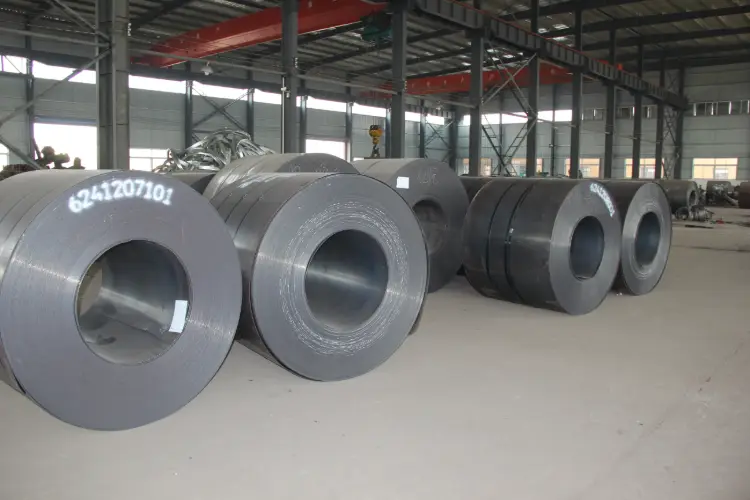
DIN 17102 EStE355 Hot Rolled Steel Coil
DIN 17102 EStE355 Hot Rolled Steel Coil - Fine‑Grain Structural Steel for Superior Cold Formability
Technical data and equivalent grades for the German structural steel EStE355 according to DIN 17102 (replaced by EN 10149‑2 S355MC). Includes chemistry, mechanical, physical properties, and application guidance.
Thermomechanical rolling, cold forming, stamping, bending, welding, cutting
- Phone : +8618037372205
- Email : [email protected]
- WhatsApp: Contact via Whtsapp
- WeChat: +8618037372205
DIN 17102 EStE355 Hot Rolled Steel Coil Introduction
EStE355 (material number 1.0978) is a thermomechanically rolled fine‑grain structural steel specified in DIN 17102 for hot‑rolled strip and sheet intended for cold forming. It belongs to the weldable fine‑grain steels with a minimum yield strength of 355 MPa in the delivery condition.
Key characteristics:
- Excellent cold formability, e.g., roll forming, bending, deep drawing.
- Good weldability due to low carbon content and low carbon equivalent.
- Fine‑grain microstructure achieved by thermomechanical rolling.
- Uniform mechanical properties across the coil thickness.
This grade is the predecessor of the current European standard EN 10149‑2 S355MC and is widely used in automotive and structural applications where cold forming and welding are essential.
DIN 17102 EStE355 Hot Rolled Steel Coil Chemical composition
The ladle analysis according to DIN 17102 for grade EStE355. The steel is aluminium‑killed, fine‑grain treated with microalloying elements (Nb, Ti, V) to ensure grain refinement and improved formability. The sum of Nb+Ti+V is restricted to ≤ 0.22% to avoid excessive precipitation hardening and maintain good ductility. Nitrogen is limited to prevent strain‑aging.
| Element | Standard Value | Note |
|---|---|---|
| C | ≤ 0.10 | max. |
| Si | ≤ 0.50 | max. |
| Mn | ≤ 1.40 | max. |
| P | ≤ 0.025 | max. |
| S | ≤ 0.020 | max. |
| Al (total) | ≥ 0.015 | min. |
| Nb | ≤ 0.09 | max. |
| Ti | ≤ 0.15 | max. |
| V | ≤ 0.10 | max. |
| N | ≤ 0.015 | max. |
| Nb+Ti+V | ≤ 0.22 | sum constraint |
DIN 17102 EStE355 Hot Rolled Steel Coil Thermal and electrical physical properties
The following data represent typical values for low‑alloy fine‑grain structural steels at room temperature (20 °C) unless otherwise indicated. These values are not part of the material standard but are derived from published general data for similar steel grades and can be used for engineering calculations.
| Property | Typical Value | Unit | Test Condition / Remarks |
|---|---|---|---|
| Density ρ | 7.85 | g/cm³ | 20 °C |
| Modulus of elasticity E | 210 | GPa | 20 °C |
| Shear modulus G | 81 | GPa | 20 °C, calculated from E and ν |
| Poisson's ratio ν | 0.30 | — | in elastic range |
| Thermal expansion coefficient α | 11.5 | 10⁻⁶/K | 20 – 100 °C |
| Thermal expansion coefficient α | 12.2 | 10⁻⁶/K | 20 – 200 °C |
| Thermal conductivity λ | 50 | W/(m·K) | 20 °C |
| Specific heat capacity c | 460 | J/(kg·K) | 20 °C |
| Electrical resistivity ρe | 0.17 | μΩ·m | 20 °C |
DIN 17102 EStE355 Hot Rolled Steel Coil Mechanical properties
Minimum yield strength ReH, tensile strength Rm, and elongation A (longitudinal, Lo = 5.65√So) as required by DIN 17102 / EN 10149‑2 for EStE355 in thermomechanically rolled condition. The bend test is a 180° cold bend with the specified mandrel diameter. Impact energy (Charpy‑V) is usually agreed upon at ordering; typical guarantee values for fine‑grain steels are included where applicable.
| Property | Standard Requirement | Unit | Test Condition |
|---|---|---|---|
| Yield strength ReH | ≥ 355 | MPa | Thickness ≤ 16 mm |
| Yield strength ReH | ≥ 345 | MPa | 16 < Thickness ≤ 40 mm |
| Yield strength ReH | ≥ 335 | MPa | 40 < Thickness ≤ 63 mm |
| Yield strength ReH | ≥ 325 | MPa | 63 < Thickness ≤ 100 mm |
| Tensile strength Rm | 430 – 550 | MPa | Thickness ≤ 16 mm |
| Tensile strength Rm | 410 – 530 | MPa | 16 < Thickness ≤ 40 mm |
| Tensile strength Rm | 400 – 520 | MPa | 40 < Thickness ≤ 63 mm |
| Tensile strength Rm | 380 – 500 | MPa | 63 < Thickness ≤ 100 mm |
| Elongation A (L=5.65√So) | ≥ 24 | % | Longitudinal, thickness ≤ 16 mm |
| Elongation A (L=5.65√So) | ≥ 23 | % | Longitudinal, 16 < t ≤ 40 mm |
| Elongation A (L=5.65√So) | ≥ 22 | % | Longitudinal, 40 < t ≤ 63 mm |
| Elongation A (L=5.65√So) | ≥ 21 | % | Longitudinal, 63 < t ≤ 100 mm |
| Bend test (180°) | Mandrel 0.5 t | — | Thickness ≤ 16 mm; no cracking |
| Bend test (180°) | Mandrel 1.0 t | — | Thickness > 16 mm; no cracking |
| Impact energy KV | ≥ 27 (typical) | J | At -20 °C, upon agreement |
DIN 17102 EStE355 Hot Rolled Steel Coil Exact equivalent material standards / substitute grades
| Country/Region | Standard | Grade | Remarks |
|---|---|---|---|
| Germany | DIN 17102 | EStE355 | Original standard (withdrawn) |
| European Union | EN 10149‑2:1996 | S355MC | Direct successor; identical chemical and mechanical requirements |
| International | ISO 6930‑1:2019 | S355MC | Adopted from EN 10149‑2 |
DIN 17102 EStE355 Hot Rolled Steel Coil Application Introduction
EStE355 / S355MC is designed for applications where high cold formability is required together with a minimum yield strength of 355 MPa. Its low carbon content and microalloyed fine‑grain structure ensure excellent suitability for welding, bending, roll forming, and moderate deep drawing. The steel is delivered as‑rolled (M) or skin‑passed, and is widely used in the automotive and mechanical engineering sectors.
Product Applications: Hot‑rolled coils and sheets, Slit strip for tube and pipe manufacturing, Cold‑formed open profiles (C, U, Z sections), Welded structural hollow sections, Stamped and bent components
Processed into products: Chassis frames and cross members, Wheels and wheel rims, Longitudinal beams, Suspension arms and brackets, Bumper reinforcements, Agricultural plow frames and mower decks, Support structures for solar panels, Light‑duty crane booms, Storage racking uprights and beams
Application industries: Automotive, Agricultural machinery, Construction & civil engineering (light‑gauge sections), Conveyor & material handling equipment, Railway wagon manufacturing, General engineering
DIN 17102 EStE355 Hot Rolled Steel Coil Similar / comparable materials
| Country/Region | Standard | Grade | Remarks |
|---|---|---|---|
| China | GB/T 1591‑2018 | Q355D | Low‑alloy high‑strength structural steel; similar strength but not optimised for cold forming; impact test at -20 °C guaranteed. |
| Japan | JIS G 3134 | SPFH590 | Hot‑rolled high‑strength steel sheet for automobile structural uses; yield strength approx. 400 MPa (exact level depends on heat treatment). |
| USA | ASTM A1011 / A1011M | HSLAS Grade 50 Class 1 | High‑strength low‑alloy hot‑rolled sheet; yield 345 MPa min, higher carbon and manganese allowed; cold formability slightly lower. |
| Italy | UNI EN 10149‑2 | S355MC | Identical to EN standard; listed for regional reference. |
Notes:
- Weldability: EStE355 exhibits excellent weldability; no pre‑heat normally required for thicknesses up to 40 mm. Carbon equivalent typically < 0.35.
- Surface finish: May be supplied as pickled and oiled (PO) or with a thin oxide layer (as‑rolled). Skin‑passing improves surface quality and material flatness.
- Tolerances: In accordance with DIN 1016 or EN 10051 for hot‑rolled strip and sheet.
- Inspection certificates: EN 10204 type 2.2 or 3.1 are available upon request.
- Share



