
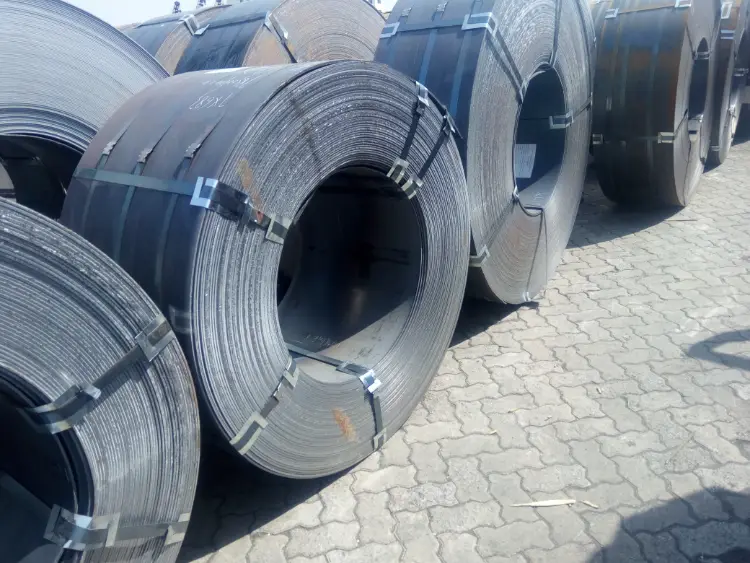
DIN 17102 TStE500 Hot Rolled Steel Coil
DIN 17102 TStE500 Hot Rolled Steel Coil : Properties, Equivalents & Applications
Complete data sheet for DIN 17102 TStE500 fine grain structural steel: chemical composition, mechanical & thermal properties, international equivalents and welding guidelines.
Hot forming, cold forming (limited), welding, cutting, bending
- Phone : +8618037372205
- Email : [email protected]
- WhatsApp: Contact via Whtsapp
- WeChat: +8618037372205
DIN 17102 TStE500 Hot Rolled Steel Coil Introduction
DIN 17102 TStE500 is a hot rolled, weldable fine grain structural steel supplied in the normalized or normalized rolled condition. It was originally defined under the now-withdrawn German standard DIN 17102 : 1980 (Schweißgeeignete Feinkornbaustähle im normalgeglühten Zustand) and is functionally equivalent to the current European grade EN 10025-3 S500NL. The 'T' prefix designates enhanced low‑temperature notch toughness with guaranteed transverse impact energy of 27 J at –50 °C. With a minimum yield strength of 500 MPa for thicknesses ≤ 16 mm, TStE500 offers high load‑bearing capacity combined with good weldability and formability. Its fine‑grain microstructure is achieved by microalloying with niobium, vanadium and/or titanium, which ensures uniform mechanical properties throughout the thickness. The steel is typically delivered as hot rolled coils, plates or wide flats and is widely employed in welded constructions subjected to severe static and dynamic loads, such as crane booms, heavy machinery frames, pressure vessels and offshore structures. Compared with standard structural steels, TStE500 permits weight savings without sacrificing safety, making it an economical choice for lightweight design in demanding environments.
DIN 17102 TStE500 Hot Rolled Steel Coil Chemical composition
The chemistry of TStE500 is tightly controlled to guarantee a fine grain structure, high strength and excellent low‑temperature toughness. Carbon is kept low to ensure weldability without excessive preheating. Microalloying elements (Nb, V, Ti) are added for grain refinement and precipitation strengthening. Phosphorus and sulfur are restricted to very low levels to maintain ductility and notch impact properties. The typical limits according to DIN 17102 are shown below.
| Element | Standard value (max, unless range) | Remarks |
|---|---|---|
| C | ≤ 0.20 | Ladle analysis |
| Si | 0.10 – 0.60 | Silicon range |
| Mn | 0.90 – 1.70 | Manganese |
| P | ≤ 0.025 | Phosphorus max |
| S | ≤ 0.020 | Sulfur max |
| N | ≤ 0.020 | Nitrogen max |
| Al (total) | ≥ 0.020 | Grain size control |
| Nb | ≤ 0.05 | Optional grain refiner |
| V | ≤ 0.12 | Optional strengthening |
| Ti | ≤ 0.03 | Optional microalloying |
| Cr | ≤ 0.30 | Residual element |
| Ni | ≤ 0.30 | Residual element |
| Cu | ≤ 0.30 | Residual element |
| Mo | ≤ 0.10 | Residual element |
| Nb+V+Ti | ≤ 0.22 | Combined microalloy sum |
DIN 17102 TStE500 Hot Rolled Steel Coil Thermal and electrical physical properties
The following physical properties are typical for fine grain structural steels of similar composition. They are not part of the DIN 17102 standard but are useful for thermal and structural design calculations. Values may vary slightly depending on actual chemistry and heat treatment.
| Property | Typical value | Unit | Temperature / condition |
|---|---|---|---|
| Density (ρ) | 7850 | kg/m³ | at 20 °C |
| Elastic modulus (E) | 210 | GPa | at 20 °C |
| Shear modulus (G) | 81 | GPa | at 20 °C |
| Poisson's ratio (ν) | 0.3 | — | at 20 °C |
| Thermal expansion (α) | 11.1 | 10⁻⁶/K | 20 – 100 °C |
| Thermal expansion (α) | 12.1 | 10⁻⁶/K | 20 – 200 °C |
| Thermal expansion (α) | 12.9 | 10⁻⁶/K | 20 – 300 °C |
| Thermal conductivity (λ) | 42 | W/(m·K) | at 20 °C |
| Thermal conductivity (λ) | 40 | W/(m·K) | at 200 °C |
| Specific heat capacity (c) | 460 | J/(kg·K) | at 20 °C |
| Electrical resistivity (ρ_e) | 0.22 – 0.28 | µΩ·m | at 20 °C |
DIN 17102 TStE500 Hot Rolled Steel Coil Mechanical properties
The mechanical properties of TStE500 are guaranteed in the normalized/ normalized rolled delivery condition. Yield and tensile strength depend on product thickness. The steel exhibits a good combination of strength and ductility, with guaranteed impact energy at −50 °C (transverse) for thicknesses above 10 mm. The data below originate from DIN 17102 and its successor standards.
| Property | Standard requirement | Unit | Test condition |
|---|---|---|---|
| Yield strength (ReH) | ≥ 500 | MPa | thickness t ≤ 16 mm |
| Yield strength (ReH) | ≥ 490 | MPa | 16 < t ≤ 35 mm |
| Yield strength (ReH) | ≥ 470 | MPa | 35 < t ≤ 50 mm |
| Yield strength (ReH) | ≥ 440 | MPa | 50 < t ≤ 70 mm |
| Tensile strength (Rm) | 610 – 770 | MPa | t ≤ 70 mm |
| Elongation (A, L₀=5d₀) | ≥ 17 | % | t ≤ 40 mm, transverse |
| Elongation (A, L₀=5d₀) | ≥ 16 | % | 40 < t ≤ 63 mm, transverse |
| Elongation (A, L₀=5d₀) | ≥ 15 | % | 63 < t ≤ 70 mm, transverse |
| Charpy V‑notch (KV₂) | ≥ 27 | J | at −50 °C, transverse, t > 10 mm |
DIN 17102 TStE500 Hot Rolled Steel Coil Exact equivalent standards & replaceable grades
| Country/Region | Standard | Grade | Remarks |
|---|---|---|---|
| Europe | EN 10025-3:2019 | S500NL | Direct successor; identical requirements for normalized fine grain steel with guaranteed impact at −50 °C |
| Europe (obsolete) | EN 10113-3:1993 | S500NL | Former European equivalent before consolidation into EN 10025 |
| Germany | DIN 17102:1980 | TStE500 | Original national designation |
DIN 17102 TStE500 Hot Rolled Steel Coil Application Introduction
Thanks to its high strength and excellent toughness at low temperatures, TStE500 (and its successor S500NL) is the material of choice for dynamically loaded, welded constructions where weight savings, safety and durability are critical. It is easily weldable with standard procedures, provided appropriate preheating and interpass temperatures are observed.
Product Applications: Hot rolled quenched & tempered plates (normalized) for welded structures, Coils for cold forming of high‑strength profiles, Welded hollow sections and beams, Crane booms and lattice sections, Penstocks and pressure pipes, Heavy‑duty vehicle chassis frames, Support structures for offshore wind farms
Processed into products: Main boom sections of mobile cranes, Chassis beams for mining dump trucks, Welded plate girders for long‑span bridges, Pressure vessel shells and dished heads, Jack‑up leg chords and rack plates, Turret bases and yaw rings in wind turbines, Excavator booms and stick arms, Cutting‑edge supports in dredgers
Application industries: Heavy machinery and earth‑moving equipment, Mobile and tower cranes, Pressure vessel and boiler fabrication, Offshore and marine engineering (jack‑up rigs, platform structures), Steel bridge construction, Mining and tunnelling equipment, Wind energy (tubular steel towers, transition pieces), Industrial steel fabrication and structural steelwork
DIN 17102 TStE500 Hot Rolled Steel Coil Similar / comparable grades
| Country/Region | Standard | Grade | Remarks |
|---|---|---|---|
| Europe | EN 10025-3 | S500N | Same strength level but impact energy verified only at −20 °C (less tough than TStE500) |
| Europe | EN 10149-2 | S500MC | Thermomechanically rolled steel with 500 MPa yield; higher elongation but not normalized; suited for cold forming |
| USA | ASTM A709/A709M | Grade 70W (485 MPa) | High‑performance structural steel for bridges; slightly lower yield strength |
| Japan | JIS G3106 | SM570 | Rolled steel for welded structure with min ReH 460 MPa; often used for similar applications but lower strength |
| China | GB/T 1591 | Q500D | Low‑alloy high‑strength structural steel; impact at −20 °C; chemical limits differ |
Notes:
- The standard DIN 17102 has been officially replaced by EN 10025-3; TStE500 is technically identical to S500NL. For new projects, EN 10025-3 S500NL shall be specified.
- Welding requires low‑hydrogen electrodes or processes. Preheat (typically 100–150 °C) and interpass temperature control are necessary for thicknesses above 20 mm to avoid cold cracking.
- Post‑weld heat treatment (PWHT) is not mandatory for this grade if adequate preheating is applied; however, stress relieving at 550–600 °C may be used for thick components.
- The steel is not intended for hot‑dip galvanising at temperatures above 450 °C without prior agreement, as microalloying elements can cause liquid metal embrittlement.
- Cold forming with small bending radii should be followed by a stress‑relief anneal if the elongation limit is approached.
- Share



