
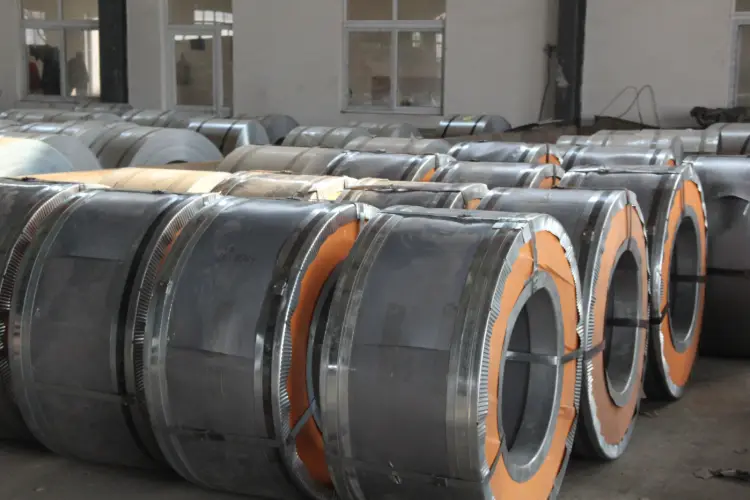
DIN 17102 EStE285 Hot Rolled Steel Coil
DIN 17102 EStE285 Hot Rolled Steel Coil: Detailed Material Data and Equivalents
Comprehensive analysis of DIN 17102 EStE285 hot rolled steel coil: chemical composition, mechanical and thermal properties, international equivalents, and application guide.
Hot rolling, normalizing, stress relief annealing, welding, bending, forming
- Phone : +8618037372205
- Email : [email protected]
- WhatsApp: Contact via Whtsapp
- WeChat: +8618037372205
DIN 17102 EStE285 Hot Rolled Steel Coil Introduction
DIN 17102 EStE285 is a hot-rolled fine-grain structural steel produced according to the now-withdrawn German standard DIN 17102. It is designed for welded structures requiring reliable toughness at low temperatures and good formability. The designation EStE285 indicates a weldable (E) special-quality (St) fine-grain (E) steel with a minimum yield strength of 285 MPa.
Key features:
- Fine-grain microstructure achieved by controlled additions of Al, Nb, V, or Ti
- Guaranteed Charpy-V impact energy of 27 J at -20°C
- Supplied as hot-rolled coil, sheet, or plate; normalization may be agreed upon delivery
- Good weldability and cold forming properties
- Typical applications include bridges, cranes, offshore structures, and pressure vessels
The grade is directly superseded in Europe by EN 10149-2 S315MC, which offers comparable mechanical performance with updated quality requirements.
DIN 17102 EStE285 Hot Rolled Steel Coil Chemical Composition
The chemical composition of EStE285 is tailored to ensure a fine grain structure and good weldability. The steel is fully killed and contains grain-refining elements such as aluminium and microalloying additions (Nb, V, Ti). Residual elements Cr, Ni, Cu are limited to maintain toughness and avoid hot shortness. Nitrogen is restricted to prevent strain ageing.
| Element | Content (wt%) | Remarks |
|---|---|---|
| C | ≤ 0.18 | |
| Si | ≤ 0.50 | |
| Mn | 0.90 – 1.65 | |
| P | ≤ 0.030 | |
| S | ≤ 0.025 | |
| Al (total) | ≥ 0.020 | Minimum for fine grain practice |
| Nb | ≤ 0.05 | Grain refiner (optional) |
| V | ≤ 0.10 | Grain refiner (optional) |
| Ti | ≤ 0.03 | Grain refiner (optional) |
| N | ≤ 0.012 | |
| Cr | ≤ 0.30 | Residual element |
| Ni | ≤ 0.30 | Residual element |
| Cu | ≤ 0.25 | Residual element |
DIN 17102 EStE285 Hot Rolled Steel Coil Thermal and Electrical Physical Properties
These physical properties are representative for low-carbon fine-grain structural steels at room temperature unless otherwise indicated. They can vary slightly depending on exact composition and processing.
| Property | Typical Value | Unit | Test Condition |
|---|---|---|---|
| Density (ρ) | 7.85 | g/cm³ | 20°C |
| Modulus of elasticity (E) | 210 | GPa | 20°C |
| Shear modulus (G) | 81 | GPa | Calculated from E and ν |
| Poisson's ratio (ν) | 0.3 | – | |
| Thermal expansion coefficient (α) | 12.0 | 10⁻⁶/K | 20–100°C |
| Thermal conductivity (λ) | 52 | W/(m·K) | 20°C |
| Specific heat capacity (cp) | 460 | J/(kg·K) | 20°C |
| Electrical resistivity (ρe) | 0.15 – 0.20 | Ω·mm²/m | 20°C, typical for mild steel |
DIN 17102 EStE285 Hot Rolled Steel Coil Mechanical Properties
The indicated values are minimum requirements according to DIN 17102 unless stated otherwise. Yield and tensile strength are thickness-dependent. Elongation is measured on a proportional gauge length (A5 for thickness ≥ 3 mm). Impact energy is guaranteed at -20°C in the longitudinal direction. Bending properties ensure good formability.
| Property | Value | Unit | Test Condition |
|---|---|---|---|
| Yield strength (ReH) | ≥ 285 | MPa | t ≤ 16 mm |
| Yield strength (ReH) | ≥ 275 | MPa | 16 < t ≤ 35 mm |
| Yield strength (ReH) | ≥ 265 | MPa | 35 < t ≤ 50 mm |
| Yield strength (ReH) | ≥ 255 | MPa | 50 < t ≤ 70 mm |
| Tensile strength (Rm) | 420 – 550 | MPa | All thicknesses |
| Elongation (A5) | ≥ 24 | % | t ≥ 3 mm, longitudinal |
| Bend test (180° bend) | 2a | – | t ≤ 16 mm |
| Bend test (180° bend) | 3a | – | t > 16 mm |
| Charpy impact energy (KV) | ≥ 27 | J | -20°C, longitudinal, standard V-notch |
DIN 17102 EStE285 Hot Rolled Steel Coil Fully Equivalent Material Standards and Replacement Grades
| Country / Region | Standard | Grade | Remarks |
|---|---|---|---|
| Germany | DIN 17102 (withdrawn) | EStE285 | Original specification |
| Europe | EN 10149-2 | S315MC | Direct successor, hot-rolled high yield strength steel for cold forming |
| International | ISO 6930-2 | S315MC | Identical to EN 10149-2 S315MC |
DIN 17102 EStE285 Hot Rolled Steel Coil Application Introduction
EStE285 steel is engineered for welded load-bearing structures that require guaranteed toughness at sub-zero temperatures. Its fine grain size provides a combination of strength, ductility, and weldability suitable for moderate forming and severe service conditions.
Product Applications: Steel frameworks for high-rise buildings, Bridge girders and deck plates, Crane booms and chassis, Offshore platform modules and structural nodes, Process vessels and storage tanks, Heavy-duty vehicle chassis
Processed into products: Beams, columns, and truss members, Welded stiffeners and gusset plates, Flanges for pipe connections, Load-bearing brackets and supports, Reinforcing ribs in machine frames, Crane rail support beams
Application industries: Construction and civil engineering, Bridge building and infrastructure, Crane and heavy lifting equipment, Offshore and marine engineering, Pressure vessel and storage tank manufacturing, Earthmoving and mining machinery
DIN 17102 EStE285 Hot Rolled Steel Coil Similar / Alternative Materials with Close Performance
| Country / Region | Standard | Grade | Remarks |
|---|---|---|---|
| USA | ASTM A572/A572M | Grade 42 [290] | Yield 290 MPa, weldable, not explicit fine-grain but similar strength range |
| China | GB/T 1591 | Q345D | Higher yield (345 MPa), fine-grain, good low-temperature toughness |
| Europe | EN 10025-3 | S275N | Yield 275 MPa, normalised fine-grain steel, alternative for lower strength demand |
| Japan | JIS G 3106 | SM490B | Higher strength (yield 325 MPa), weldable structural fine-grain steel |
Notes:
- When welding, the carbon equivalent (CEV) should be evaluated; preheating is typically not required for thicknesses below 30 mm when using low-hydrogen processes.
- Hot-dip galvanizing can be applied without risk of liquid metal embrittlement if the silicon content is controlled (= 0.05–0.15%).
- The steel is fully killed and can be supplied with a certificate according to EN 10204 3.1 or 3.2.
- For fatigue-critical designs, improved surface finish and stricter inspection may be required beyond standard product specifications.
- Share



