
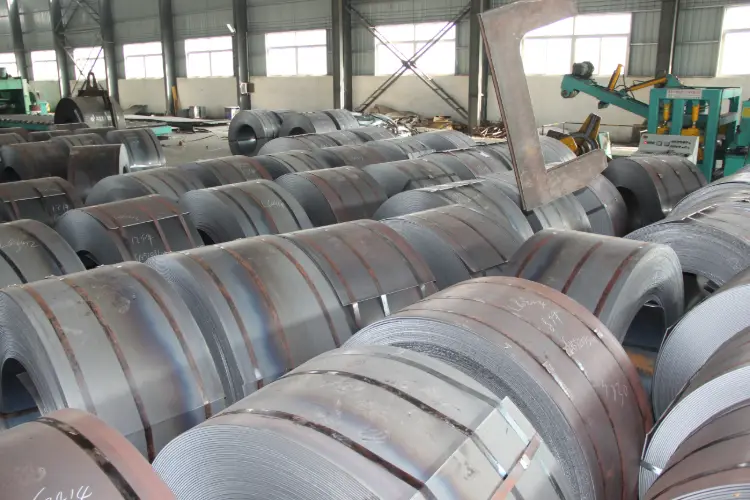
DIN 17102 TStE285 Hot Rolled Steel Coil
DIN 17102 TStE285 Hot Rolled Steel Coil: Fine-grained Structural Steel for Welded Constructions
Comprehensive data sheet for TStE285 steel under DIN 17102, including chemical composition, mechanical and thermo-electrical properties, equivalent grades, and application guide for welded structures.
Welding, hot forging, cold forming (limited), normalizing, stress relieving
- Phone : +8618037372205
- Email : [email protected]
- WhatsApp: Contact via Whtsapp
- WeChat: +8618037372205
DIN 17102 TStE285 Hot Rolled Steel Coil Introduction
TStE285 is a fine-grained structural steel supplied according to the historical German standard DIN 17102. It is produced in hot rolled coils and designed for welded, highly stressed components where normalizing rolling or normalizing treatment refines the microstructure, ensuring excellent toughness and weldability. The grade offers a minimum yield strength of 285 MPa (for thickness ≤16 mm) and belongs to the category of normalized fine-grain steels. Its balanced alloy design, with controlled additions of aluminum and microalloying elements, provides high resistance to brittle fracture and good cold-forming characteristics. Typical applications include bridges, crane structures, pressure vessels, and offshore engineering, where safety and structural integrity are paramount. Although DIN 17102 has been superseded by European standards, TStE285 remains widely referenced and can be effectively replaced by modern EN 10025-3 grades with equivalent or slightly adjusted strength levels.
DIN 17102 TStE285 Hot Rolled Steel Coil Chemical Composition
The chemical composition of TStE285 conforms to DIN 17102. It features a controlled carbon content to preserve weldability, a manganese range ensuring strength, and microalloying additions (Nb, V, Ti) for grain refinement. The steel is fully killed and typically aluminum treated.
- All values are max unless a range is indicated.
- For product thicknesses >100 mm, slightly higher carbon equivalent may be permitted on agreement.
| Element | Specified Value (%) | Remarks |
|---|---|---|
| C | ≤0.18 | Ladle analysis |
| Si | ≤0.50 | |
| Mn | 0.90 – 1.65 | |
| P | ≤0.030 | |
| S | ≤0.025 | For improved formability ≤0.020 available |
| Al (total) | ≥0.020 | Grain refining element; metallic Al |
| Nb | ≤0.05 | Optional microalloy |
| V | ≤0.10 | Optional microalloy |
| Ti | ≤0.05 | Optional microalloy |
| Ni | ≤0.30 | Residual; not intentionally added |
| Cr | ≤0.30 | Residual; not intentionally added |
| Cu | ≤0.20 | Residual |
| Mo | ≤0.08 | Residual |
| N | ≤0.012 | For Al addition, nitrogen binding ensures grain refinement |
DIN 17102 TStE285 Hot Rolled Steel Coil Thermal and Electrical Physical Properties
Physical properties of TStE285 are typical for fine-grained structural steels. Values are influenced by temperature and microstructure. Thermal expansion, conductivity, and specific heat capacity are essential for design in fire-resistant and thermally loaded structures.
- Room temperature values unless noted.
- Elastic moduli are valid for static loading.
| Property | Value | Unit | Test Condition |
|---|---|---|---|
| Density (ρ) | 7.85 | g/cm³ | 20°C |
| Elastic modulus (E) | 205 – 210 | GPa | 20°C, longitudinal |
| Shear modulus (G) | ≈81 | GPa | 20°C |
| Poisson's ratio (ν) | 0.29 – 0.30 | – | 20°C |
| Thermal expansion coefficient (α) | 11.5 × 10⁻⁶ | K⁻¹ | 20 – 100°C |
| Thermal expansion coefficient (α) | 12.5 × 10⁻⁶ | K⁻¹ | 20 – 200°C |
| Thermal expansion coefficient (α) | 13.5 × 10⁻⁶ | K⁻¹ | 20 – 300°C |
| Thermal conductivity (λ) | 48 – 52 | W/(m·K) | 20°C |
| Specific heat capacity (cp) | 460 – 510 | J/(kg·K) | 20°C |
| Electrical resistivity (ρ_e) | 0.20 – 0.25 × 10⁻⁶ | Ω·m | 20°C |
DIN 17102 TStE285 Hot Rolled Steel Coil Mechanical Properties
Mechanical properties of TStE285 are valid for normalized or normalizing-rolled condition. The yield and tensile strengths decrease with increasing thickness. Minimum impact energy is guaranteed at specified temperatures.
- Transverse test pieces unless otherwise agreed.
- Bending test: mandrel diameter ≤ 2.5 × thickness (180° bend).
| Property | Specified Value | Unit | Test Condition |
|---|---|---|---|
| Yield strength (ReH) | ≥285 | MPa | Thickness ≤ 16 mm |
| Yield strength (ReH) | ≥275 | MPa | 16 < t ≤ 40 mm |
| Yield strength (ReH) | ≥265 | MPa | 40 < t ≤ 63 mm |
| Yield strength (ReH) | ≥255 | MPa | 63 < t ≤ 80 mm |
| Yield strength (ReH) | ≥245 | MPa | 80 < t ≤ 100 mm |
| Yield strength (ReH) | ≥235 | MPa | 100 < t ≤ 150 mm |
| Tensile strength (Rm) | 430 – 580 | MPa | t ≤ 100 mm |
| Tensile strength (Rm) | 400 – 550 | MPa | 100 < t ≤ 150 mm |
| Elongation (A5, L0=5.65√S0) | ≥22 | % | t ≤ 63 mm, longitudinal |
| Elongation (A5, L0=5.65√S0) | ≥20 | % | 63 < t ≤ 100 mm, longitudinal |
| Impact energy (KV) | ≥40 J at -20°C | J | Transverse, 10×10 mm V-notch; grade TStE285 |
| Impact energy (KV) | ≥27 J at -50°C | J | Available as TStE285 low-temperature variant (S-T) on agreement |
| Bend test | No cracks: mandrel diameter 2.5×t | – | 180° bend, t = product thickness |
DIN 17102 TStE285 Hot Rolled Steel Coil Equivalent Standards and Substitutable Grades
| Country/Region | Standard | Grade | Remarks |
|---|---|---|---|
| Europe | EN 10025-3:2019 | S275N | Yield strength 275 MPa min. for t≤16 mm; similar composition; slightly lower strength than TStE285 |
| Europe | EN 10025-3:2019 | S275NL | Low-temperature variant; KV≥27 J at -50°C |
| Germany | DIN EN 10025-3 | S275N | Direct successor of DIN 17102 TStE285 |
| Japan | JIS G3106 | SM490A | Higher tensile strength (490–610 MPa); not identical but often substituted in welded structures |
| USA | ASTM A572 / A572M | Grade 42 | Minimum yield 290 MPa (42 ksi) for t≤150 mm; comparable strength, but different chemistry |
DIN 17102 TStE285 Hot Rolled Steel Coil Application Introduction
TStE285 hot rolled coils and plates are employed wherever reliable welded structures subject to medium-high loading are required. The fine-grained microstructure provides superior toughness even at low temperatures, making it suitable for safety-critical applications.
- Typical design codes such as EN 1993 (Eurocode 3) or DIN 18800 can be applied.
- Proper preheating and interpass temperature control during welding are recommended for thicker sections.
Product Applications: Hot rolled coils and cut sheets, Welded H-beams, box girders, Cold-formed hollow sections (within forming limits), Fabricated crane booms and jibs, Tubular segments for wind towers, Offshore module structural components
Processed into products: Longitudinal and transverse bridge beams, Crane runway girders, Offshore jacket brace members, Wind turbine tower shells (rolled plates), Pressure vessel shells, Heavy machinery frames and base plates
Application industries: Bridge construction (road and railway bridges), Crane and lifting equipment manufacturing, Offshore platforms and shipbuilding (non-marine hull structures), Wind energy (tower and foundation sections), Pressure vessels and storage tanks (under moderate pressure and temperature), Heavy machinery and hydraulic steel structures, Building frames and hall constructions
DIN 17102 TStE285 Hot Rolled Steel Coil Similar/Alternative Materials with Close Properties
| Country/Region | Standard | Grade | Remarks |
|---|---|---|---|
| Europe | EN 10025-3 | S355N | Higher yield strength (355 MPa); can replace TStE285 where greater load capacity is needed |
| Europe | EN 10025-2 | S275JR | Non-grain-refined; lower toughness; suitable only for non-critical applications |
| Germany | DIN 17102 | WStE285 | Weathering variant with improved atmospheric corrosion resistance |
| Russia | GOST 19281 | 09G2S | Similar strength and weldability; commonly used in structural works |
| China | GB/T 1591 | Q345B | Minimum yield 345 MPa; widely available; slightly higher strength |
Notes:
- Welding: TStE285 has excellent weldability with all common arc welding processes (SMAW, GMAW, SAW). Preheating to 100–150°C is advisable for thicknesses >30 mm. The carbon equivalent (CEV) typically ranges between 0.35 and 0.43.
- Forming: The steel can be cold-formed with a minimum bending radius of 2.5×t (transverse). Hot forming may be performed at 900–1100°C with subsequent normalizing if heavy deformation occurs.
- For structural components designed for low ambient temperatures, the low-temperature variant TStE285 with guaranteed impact energy at -50°C can be supplied upon agreement (designated as TStE285 T).
- DIN 17102 has been officially replaced by the EN 10025 series. Users should refer to DIN EN 10025-3 S275N for new designs, but TStE285 remains available from some suppliers as a non-standard grade until stock exhaustion.
- Share



