
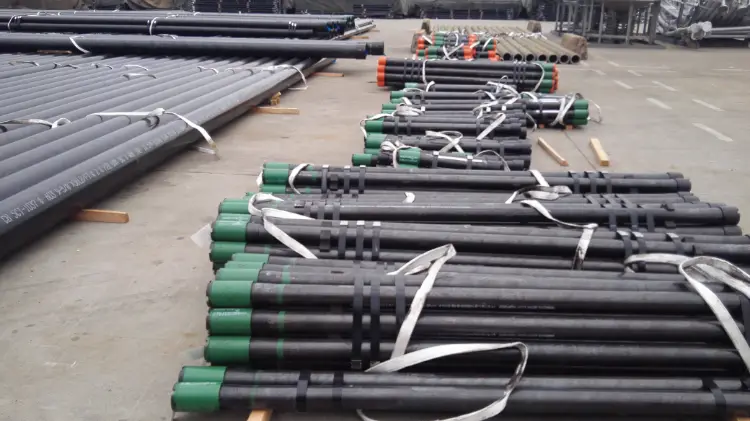
DIN 17100 St52-3 Steel for SSAW Pipes
DIN 17100 St52-3 Steel for SSAW Pipes - Properties, Equivalents & Applications
Comprehensive material data for DIN 17100 St52-3 steel used in SSAW pipes. Includes chemical composition, mechanical and thermal properties, international equivalents, and application guidelines.
Hot rolling, normalizing (optional), SAW pipe forming and welding
- Phone : +8618037372205
- Email : [email protected]
- WhatsApp: Contact via Whtsapp
- WeChat: +8618037372205
DIN 17100 St52-3 Steel for SSAW Pipes Introduction
DIN 17100 St52-3 is a weldable low-carbon structural steel grade with a minimum yield strength of 355 MPa for thicknesses up to 16 mm. It belongs to the group of general structural steels and is commonly supplied in a normalized or as-rolled condition. The steel offers good weldability, excellent strength and toughness, and is widely used in welded constructions such as spiral submerged arc welded (SSAW) pipes for oil, gas, and water transmission. Its fine-grain practice and controlled composition ensure reliable performance in plate and strip form for pipe manufacturing.
Typical delivery conditions for SSAW pipes include hot-rolled coil or plate, with optional impact testing at temperatures down to -20 °C when specified as St52-3 N or corresponding modern grade S355J2+N.
DIN 17100 St52-3 Steel for SSAW Pipes Chemical Composition
The chemistry of St52-3 according to DIN 17100 reflects a low-carbon, manganese-silicon base with controlled phosphorus and sulfur for good weldability and toughness. Microalloying elements like aluminum are used for deoxidation; when specified for fine-grain practice, aluminium content is at least 0.020 %. For SSAW pipe applications, carbon equivalent (CEV) is often limited to ensure field weldability.
| Element | Standard Value (max, % unless range given) | Remarks |
|---|---|---|
| Carbon (C) | ≤ 0.22 | Ladle analysis; for thickness > 16 mm, C max may be increased to 0.24% |
| Silicon (Si) | ≤ 0.55 | Essential deoxidizer |
| Manganese (Mn) | ≤ 1.60 | Improves strength and toughness |
| Phosphorus (P) | ≤ 0.045 | For general grades; ≤ 0.035 for quality J2 (impact tested) |
| Sulfur (S) | ≤ 0.045 | ≤ 0.035 for quality J2 |
| Aluminium (Al)total | ≥ 0.020 | Required for fine-grain practice when not substituted by other grain refiners |
| Nitrogen (N) | ≤ 0.012 | If sufficient Al is present |
| Copper (Cu) | ≤ 0.60 | If specified for atmospheric corrosion resistance (optional) |
DIN 17100 St52-3 Steel for SSAW Pipes Thermal and Electrical Physical Properties
Physical properties are based on generic low-alloy structural steel data, applicable to St52-3. They are influenced by composition and microstructure; values shown are representative for room temperature unless otherwise noted. These properties assist in engineering design involving heat transfer, thermal expansion, and electrical conductivity.
| Property | Typical Value | Unit | Test Conditions / Remarks |
|---|---|---|---|
| Density (ρ) | 7850 | kg/m³ | At 20 °C |
| Modulus of elasticity (E) | 210 | GPa | At 20 °C |
| Shear modulus (G) | 81 | GPa | Calculated from E and ν |
| Poisson's ratio (ν) | 0.3 | – | At 20 °C |
| Thermal expansion coefficient (α) | 12.0 × 10⁻⁶ | K⁻¹ | 20 – 100 °C |
| Thermal expansion coefficient (α) | 13.5 × 10⁻⁶ | K⁻¹ | 20 – 300 °C |
| Thermal conductivity (λ) | 50 | W/(m·K) | At 20 °C |
| Thermal conductivity (λ) | 45 | W/(m·K) | At 300 °C |
| Specific heat capacity (cp) | 460 | J/(kg·K) | At 20 – 100 °C |
| Electrical resistivity (ρₑ) | 0.15 – 0.20 | μΩ·m | At 20 °C |
DIN 17100 St52-3 Steel for SSAW Pipes Mechanical Properties
Mechanical properties of St52-3 at room temperature, derived from DIN 17100 for normalized or as-rolled condition. Values depend on product thickness. For SSAW pipes, the pipe body properties generally meet the requirements of the original plate or strip. Charpy impact values are guaranteed when ordering with quality suffices like "J2" (27 J at -20 °C).
| Property | Standard Requirement Value | Unit | Test Conditions / Remarks |
|---|---|---|---|
| Yield strength (ReH) | ≥ 355 | MPa | Nominal thickness ≤ 16 mm, transverse specimens |
| Yield strength (ReH) | ≥ 345 | MPa | 16 mm < thickness ≤ 40 mm |
| Yield strength (ReH) | ≥ 335 | MPa | 40 mm < thickness ≤ 63 mm |
| Tensile strength (Rm) | 490 – 630 | MPa | thickness ≤ 100 mm |
| Elongation after fracture (A) | ≥ 22 | % | Lo = 5.65√So; thickness ≤ 40 mm, transverse |
| Elongation after fracture (A) | ≥ 21 | % | 40 mm < thickness ≤ 63 mm, transverse |
| Bend test (mandrel diameter) | 3a | – | For thickness ≤ 16 mm; a = specimen thickness |
| Bend test (mandrel diameter) | 4a | – | 16 mm < thickness ≤ 40 mm |
| Impact energy (KV) – optional | ≥ 27 | J | At -20 °C; for St52-3 J2 quality, longitudinal |
| Impact energy (KV) – optional | ≥ 27 | J | At 0 °C; for St52-3 J0 quality |
DIN 17100 St52-3 Steel for SSAW Pipes Full Equivalent Material Standards and Substitutable Grades
| Country/Region | Standard | Grade | Remarks |
|---|---|---|---|
| EU | EN 10025-2:2004 | S355J2 (+N) | Direct replacement; normalized rolled or normalized; impact 27J at -20°C |
| China | GB/T 1591-2018 | Q355D | Equivalent to S355J2; fine-grain structural steel |
| USA | ASTM A572/A572M | Grade 50 [345] | Common structural steel; verify Charpy requirements for pipe |
| Japan | JIS G3106 | SM490B / SM490C | Welded structural steel; SM490C guarantees 47J at 0°C |
| Russia | GOST 19281 | 17G1S | Manganese-silicon low-alloy steel; similar strength class |
DIN 17100 St52-3 Steel for SSAW Pipes Application Introduction
St52-3 in SSAW pipe form combines high strength with excellent workability. Its good weldability and low temperature toughness make it suitable for a wide range of infrastructure projects. The material is predominantly used in oil, gas, and water transmission pipelines as well as in structural hollow sections.
Product Applications: Spiral Submerged Arc Welded (SSAW) pipes, Longitudinal Submerged Arc Welded (LSAW) pipes, Structural hollow sections (CHS, RHS), Tubular piles and pilings, Pressure vessel shells and boilers (with additional certifications)
Processed into products: Pipe segments for pipeline construction, Flanges and fittings welded to pipe ends, Tubular bridge piers and columns, Foundation piles and sheet pile connectors, Penstock liners in hydroelectric plants, Dredging and conveyance piping components
Application industries: Oil & Gas (onshore/offshore pipelines), Water & Sewage Transmission, Civil Engineering & Construction, Shipbuilding & Marine Structures, Power Generation (cooling water pipes, penstocks), Machinery & Heavy Equipment
DIN 17100 St52-3 Steel for SSAW Pipes Similar / Closely Related Alternative Materials
| Country/Region | Standard | Grade | Remarks |
|---|---|---|---|
| EU | EN 10025-2 | S355JR (+N) | Slightly less tough (impact at +20°C); may replace St52-3 in non-critical applications |
| EU | EN 10025-2 | S355K2 (+N) | Higher toughness (impact 40J at -20°C); over-qualified but fully compatible |
| EU – obsolete | DIN 17100 | St52-3 N | Normalized variant; exact match to historical specification |
| USA | ASTM A709/A709M | Grade 50 | Bridged structural steel: similar strength but different impact categories |
| India | IS 2062 | E350 B / C | High-strength microalloyed steel; similar 350 MPa yield class |
Notes:
- The data provided for St52-3 corresponds to DIN 17100 which has been superseded by EN 10025-2. For new designs, the equivalent grade S355J2+N should be specified.
- When ordering SSAW pipes, supplementary requirements such as carbon equivalent (CEV), Charpy V-notch at specified temperatures, and non-destructive testing (UT/RT) shall be clearly stated.
- For hydrogen service or sour environments, special limits on hardness and chemistry may apply and the user should consult relevant service standards (e.g., NACE MR0175).
- Typical delivery conditions for SSAW pipes: hot-rolled coil or plate, edges trimmed, welded with matching filler metal, mechanically or hydraulically tested according to API 5L or client specifications.
- Share



