
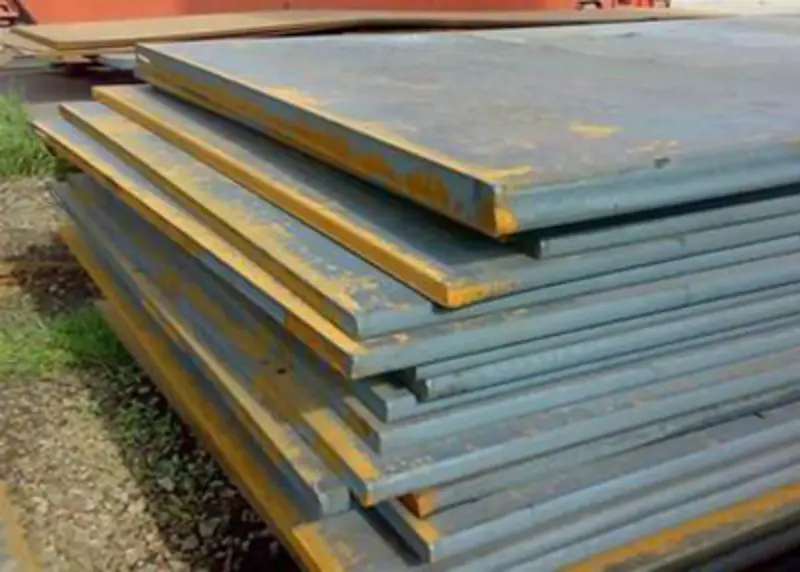
CCS Grade DQ51 Shipbuilding Steel Plate
CCS Grade DQ51 Shipbuilding Steel Plate - High-Strength Quenched & Tempered Marine Steel
Full material data for CCS DQ51 shipbuilding steel: chemical composition, mechanical and physical properties, international equivalents, and applications in shipbuilding and offshore engineering.
Hot rolling, quenching and tempering, cutting, cold forming, welding
- Phone : +8618037372205
- Email : [email protected]
- WhatsApp: Contact via Whtsapp
- WeChat: +8618037372205
CCS Grade DQ51 Shipbuilding Steel Plate Introduction
CCS Grade DQ51 is a high-strength quenched and tempered steel plate specifically developed for shipbuilding and marine structures certified by the China Classification Society (CCS). It belongs to the D-quality level with a minimum yield strength of 510 MPa, combining excellent strength, good low-temperature toughness, and satisfactory weldability.
- Designed for critical structural members in hulls and offshore platforms
- Manufactured via quenching and tempering to achieve a fine-grained bainitic/martensitic microstructure
- Offers reliable impact toughness at -20°C for safe service in cold waters
- Meets the requirements of IACS UR W11, ensuring global recognition and interchangeability across major classification societies
Typical applications include deck plates, bottom structures, bulkheads, and high-stress components in large container ships, tankers, and FPSOs.
CCS Grade DQ51 Shipbuilding Steel Plate Chemical Composition
The chemical composition of CCS DQ51 steel is strictly controlled to ensure high strength and toughness. Typical limits per CCS Rules for Materials and Welding are listed below. Carbon equivalent (CEV) is usually limited to ≤0.43% to guarantee good weldability. All values are maximum unless a range is given.
| Chemical Element | Standard Value (Wt. %) | Remarks |
|---|---|---|
| C | ≤0.20 | Ladle analysis |
| Si | ≤0.55 | Ladle analysis |
| Mn | 0.90 – 1.70 | Ladle analysis |
| P | ≤0.025 | Ladle analysis |
| S | ≤0.025 | Ladle analysis |
| Cr | ≤0.30 | Ladle analysis |
| Ni | ≤0.40 | Ladle analysis |
| Mo | ≤0.08 | Ladle analysis |
| Cu | ≤0.35 | Ladle analysis |
| Nb | ≤0.05 | Ladle analysis |
| V | ≤0.10 | Ladle analysis |
| Ti | ≤0.02 | Ladle analysis |
| Alt (total Al) | ≥0.015 | Ladle analysis, for grain refinement |
| N | ≤0.012 | Ladle analysis (optional requirement) |
| CEV | ≤0.43 (typical) | Carbon equivalent, usually specified for weldability |
CCS Grade DQ51 Shipbuilding Steel Plate Thermal and Electrical Physical Properties
The physical properties provided below are typical for high-strength low-alloy quenched and tempered steels and are not mandatory requirements of the CCS standard. They serve as approximate design references. Properties may vary slightly depending on the actual chemical composition and heat treatment condition.
| Performance Item | Typical Value | Unit | Condition / Temperature |
|---|---|---|---|
| Density (ρ) | 7.85 | g/cm³ | Room temperature |
| Elastic modulus (E) | 205 | GPa | Room temperature |
| Shear modulus (G) | 80 | GPa | Room temperature |
| Poisson's ratio (ν) | 0.30 | Room temperature | |
| Thermal expansion coefficient (α) | 12.0 × 10⁻⁶ | /K | 20°C to 100°C |
| Thermal conductivity (λ) | 45 | W/(m·K) | At 20°C |
| Specific heat capacity | 460 | J/(kg·K) | At 20°C |
| Electrical resistivity (ρ_e) | 0.20 × 10⁻⁶ | Ω·m | At 20°C |
CCS Grade DQ51 Shipbuilding Steel Plate Mechanical Properties
Mechanical properties of CCS DQ51 are determined by tensile and impact tests on specimens taken from the steel plate. Requirements vary with thickness. Tests are performed at room temperature for tensile properties and at -20°C for Charpy V-notch impact energy. The bending test confirms no cracking. Values below are minimum unless stated otherwise.
| Performance Item | Required Value | Unit | Test Condition |
|---|---|---|---|
| Yield Strength (ReH) | ≥510 | MPa | Thickness ≤ 50 mm, transverse direction |
| Yield Strength (ReH) | ≥500 | MPa | 50 mm < Thickness ≤ 100 mm, transverse direction |
| Tensile Strength (Rm) | 610 – 770 | MPa | Thickness ≤ 100 mm, transverse direction |
| Elongation (A) | ≥16 | % | Gauge length 5.65√So, thickness ≤ 50 mm |
| Elongation (A) | ≥15 | % | 50 mm < Thickness ≤ 100 mm |
| Charpy V-notch impact energy (KV) | ≥27 (average) | J | Longitudinal, -20°C |
| Charpy V-notch impact energy (KV) | ≥20 (single) | J | Longitudinal, -20°C |
| Charpy V-notch impact energy (KV) | ≥27 (average) | J | Transverse, -20°C (when specified) |
| Bend test (180°) | d = 3a | a = specimen thickness; no cracks; thickness ≤ 50 mm | |
| Bend test (180°) | d = 4a | 50 mm < Thickness ≤ 100 mm |
CCS Grade DQ51 Shipbuilding Steel Plate Exact Equivalent Materials & Substitutable Grades
CCS DQ51 is fully recognized by other IACS classification societies under the same grade designation. The following table lists equivalent grades that can normally be substituted without re-approval, provided the material certificate states compliance with IACS UR W11.
| Country/Area | Standard/Society | Grade | Remarks |
|---|---|---|---|
| China | CCS | DQ51 | Original grade; quenched and tempered, YS 510 MPa |
| USA | ABS | DQ51 | Equivalent to CCS DQ51 per IACS UR W11 |
| France | BV | DQ51 | Equivalent to CCS DQ51 per IACS UR W11 |
| Norway/Germany | DNV | DQ51 | Equivalent to CCS DQ51 per IACS UR W11 |
| UK | LR | DQ51 | Equivalent to CCS DQ51 per IACS UR W11 |
| Japan | NK | DQ51 | Equivalent to CCS DQ51 per IACS UR W11 |
| Italy | RINA | DQ51 | Equivalent to CCS DQ51 per IACS UR W11 |
| Russia | RS | DQ51 | Equivalent to CCS DQ51 per IACS UR W11 |
CCS Grade DQ51 Shipbuilding Steel Plate Application Introduction
CCS DQ51 steel is primarily employed in the shipbuilding and offshore industry due to its balanced high strength and toughness. Key sectors include:
- Commercial shipbuilding (container ships, bulk carriers, tankers)
- Naval and defense vessels
- Offshore oil and gas platforms (jackets, topsides, FPSO modules)
- Marine and coastal engineering structures (wind turbine foundations, bridges)
It is suitable for heavy welded constructions exposed to low ambient temperatures and dynamic loads.
Product Applications: Hull plates (decks, bottoms, sides), Longitudinal and transversal frames, Bulkheads and web frames, Offshore platform decks and modules, Lifting appliances and crane pedestals
Processed into products: Main deck and bottom shell plates, Hatch coaming and container supports, Shear strakes and bilge strakes, Tower and foundation elements for wind turbines, Reinforcement pads and stiffeners, Bracket and node connections in truss structures
Application industries: Shipbuilding, Offshore engineering, Marine structures, Bridge construction, Pressure vessel and boiler manufacturing (when approved)
CCS Grade DQ51 Shipbuilding Steel Plate Similar / Substitute Materials with Comparable Performance
When CCS DQ51 is not available, the following high-strength structural steels may be considered as alternatives, provided proper engineering assessment and classification society approval are obtained. Their strengths and properties are close but not identical; adjustments in design or welding may be required.
| Country/Area | Standard | Grade | Remarks |
|---|---|---|---|
| China | GB/T 1591 | Q550D | High-strength low-alloy structural steel, YS 550 MPa, good low-temperature toughness; may need additional approval for marine use |
| EU | EN 10025-6 | S550Q | Quenched and tempered structural steel, YS 550 MPa, similar strength level; requires project-specific qualification |
| International | IACS UR W11 | AH550 / DH550 / EH550 | Slightly higher grade (550 MPa YS), could be used if strength margin is acceptable |
| Japan | JIS G 3128 | SHY685 | High-strength quenched and tempered steel for welded structures; substantially higher YS, verify formability and toughness |
| USA | ASTM A514 | Grade B or F | Quenched and tempered alloy steel plate, YS 690 MPa; over-match in strength, needs careful weld procedure development |
Notes:
Delivery condition and processing: DQ51 is supplied in the quenched and tempered condition. Further hot forming should be avoided to maintain its mechanical properties; if hot forming is necessary, a new full heat treatment is recommended. Welding: Preheating is usually not required for moderate thicknesses, but controlled heat input and low-hydrogen consumables are mandatory. A post-weld heat treatment (PWHT) is not generally needed but may be applied for stress relief at temperatures below the tempering temperature. Certification: All plates come with CCS inspection certificates as per EN 10204 type 3.1 or 3.2, depending on the project specification.
- Share



