
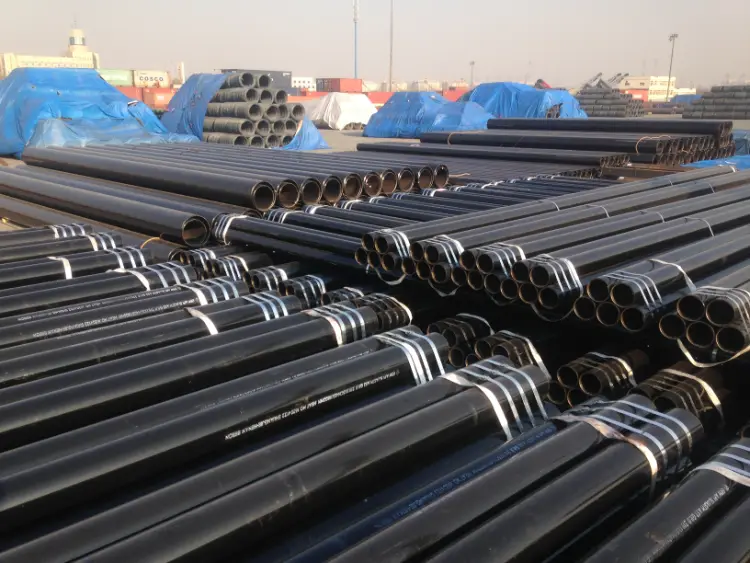
ASTM A53 Grade A ERW Pipe
ASTM A53 Grade A ERW Pipe - Chemical, Mechanical Properties & Equivalents
Comprehensive data on ASTM A53 Grade A ERW carbon steel pipe: chemical composition, tensile/yield strength, elongation, equivalent grades ISO 65, EN 10255, and typical applications in plumbing and construction.
Electric resistance welding (ERW), hot-dipped galvanizing, cutting, threading, bending, grooving
- Phone : +8618037372205
- Email : [email protected]
- WhatsApp: Contact via Whtsapp
- WeChat: +8618037372205
ASTM A53 Grade A ERW Pipe Introduction
ASTM A53 Grade A ERW pipe is a carbon steel pipe designed for mechanical and pressure applications, commonly used in low-pressure steam, water, gas, and air lines. Manufactured by electric resistance welding (ERW), it delivers consistent wall thickness and economical production. Grade A provides lower strength than Grade B but offers enhanced ductility and excellent weldability. It is supplied in black (non-coated) or hot-dipped galvanized finishes. Typical services include plumbing, fire protection, structural support, and fencing. The pipe meets ASTM A53/A53M requirements for chemical composition, tensile properties, and hydrostatic or nondestructive electric testing.
ASTM A53 Grade A ERW Pipe Chemical Composition
The table below lists the chemical element limits for ASTM A53 Grade A steel as specified in the standard. Copper may be added when copper-bearing steel is required; other elements represent residual limits from the steelmaking process. For ERW pipe, the base metal must conform to these heat analysis maxima.
| Element | Maximum % (Heat Analysis) | Remarks |
|---|---|---|
| Carbon (C) | 0.25 | The intentional addition of any element other than carbon and manganese is not permitted without purchaser approval. |
| Manganese (Mn) | 0.95 | Maximum limit for all product thicknesses. |
| Phosphorus (P) | 0.05 | Phosphorus is controlled to maintain weldability and toughness. |
| Sulfur (S) | 0.045 | Sulfur level is limited to avoid hot shortness during welding. |
| Copper (Cu) (when specified) | 0.40 | When copper steel is ordered, the minimum copper content shall be 0.20%. Otherwise, copper is a residual element. |
| Nickel (Ni) | 0.40 | Residual nickel maximum; not intentionally added. |
| Chromium (Cr) | 0.40 | Residual chromium maximum; not intentionally added. |
| Molybdenum (Mo) | 0.15 | Residual molybdenum maximum; not intentionally added. |
| Vanadium (V) | 0.08 | Residual vanadium maximum; not intentionally added. |
ASTM A53 Grade A ERW Pipe Physical Properties
ASTM A53/A53M does not specify physical constants such as density or thermal conductivity. The values below are typical for carbon steel in the as-welded condition and are provided for preliminary design guidance only. They are not mandatory requirements of the standard and may vary slightly depending on exact chemical composition and processing.
| Property | Typical Value | Unit | Conditions / Remarks |
|---|---|---|---|
| Density (ρ) | 7.85 | g/cm³ | Typical for low‑carbon steel at 20°C. |
| Elastic modulus (E) | 200 | GPa | Average for carbon steel at room temperature. |
| Shear modulus (G) | 77 | GPa | Calculated using ν = 0.30. |
| Poisson's ratio (ν) | 0.30 | – | Within elastic range. |
| Thermal expansion coefficient (α) | 12.0 – 13.0 | 10⁻⁶/K | Range for 0‑100°C; typical value 12.5 × 10⁻⁶/K. |
| Thermal conductivity (λ) | 50 – 60 | W/(m·K) | At 20°C; decreases with increasing temperature. |
| Specific heat capacity (cp) | 460 – 480 | J/(kg·K) | Approximate for carbon steel near room temperature. |
| Electrical resistivity (ρe) | 0.14 – 0.18 | μΩ·m | At 20°C. |
ASTM A53 Grade A ERW Pipe Mechanical Properties
ASTM A53 Grade A pipe must meet the following tensile requirements at room temperature. Elongation is calculated per the standard's formula as a function of cross-sectional area and tensile strength. No impact test is mandated for this grade. The listed yield strength uses the 0.5% extension-under-load method (or 0.2% offset method for referee testing).
| Property | Requirement | Unit | Test Condition |
|---|---|---|---|
| Tensile Strength, min | 330 | MPa | At room temperature; 48,000 psi minimum. |
| Yield Strength, min (0.5% EUL) | 205 | MPa | At room temperature; 30,000 psi minimum. Determined by 0.5% extension under load, or 0.2% offset for referee tests. |
| Elongation, min | Calculated per formula e = 625000 × A^0.2 / U^0.9. Typical minimum approximately 25% for standard wall thickness (e.g., NPS 6 Schedule 40). | % | Gauge length 2 in. (50 mm) on strip specimen; A = cross-sectional area in in.², U = specified minimum tensile strength in psi. The calculated e shall not be rounded to less than the nearest 0.5%. |
ASTM A53 Grade A ERW Pipe Directly Equivalent Material Standards and Substitutable Grades
| Country / Region | Standard | Grade / Designation | Remarks |
|---|---|---|---|
| International (ISO) | ISO 65 | Grade A | Similar mechanical and chemical requirements for carbon steel tubes suitable for screwing in ordinary service. Often interchangeable with ASTM A53 Grade A. |
| Europe | EN 10255 | S195T | Non-alloy steel tubes for welding and threading; technical delivery conditions align with A53 Grade A. S195T indicates minimum tensile strength of 195 MPa (similar Grade A intent). |
| Japan | JIS G3452 | SGP | Carbon steel pipes for ordinary piping. SGP covers a strength range comparable to ASTM A53 Grade A with lower specified minimum values but widely substituted. |
| China | GB/T 3091 | Q195 / Q215A | Welded steel pipes for low-pressure service. Q195 is a mild steel grade with properties close to A53 Grade A. Q215A may also be used depending on wall thickness. |
ASTM A53 Grade A ERW Pipe Application Introduction
ASTM A53 Grade A ERW pipe is widely used where moderate strength, good ductility, and ease of welding are required. It is cost‑effective for low‑pressure fluid conveyance and light structural duties. Black pipe is suitable for indoor or non‑corrosive services, while galvanized pipe resists atmospheric corrosion for outdoor and exposed installations. Threading or grooving enables rapid assembly with standard fittings.
Product Applications: Water supply lines (cold and ambient temperature), Fire sprinkler mains and branch lines, Scaffolding tubes, Fence posts and gate frames, Handrails and guardrails, Compressed air headers, Low‑pressure steam condensate return lines, Structural columns for light buildings
Processed into products: Threaded pipe nipples and couplings, Grooved pipe couplings and fittings, Welded pipe spools and manifolds, Pipe clamps and brackets, Structural pipe bollards, Roll‑formed square/rectangular sections from round pipe, Pre‑galvanized pipe sections for fencing, Die‑pressed end caps and reducers
Application industries: Construction and civil infrastructure, Fire protection systems (sprinkler piping), Plumbing and mechanical contracting, Water treatment and distribution, Agriculture (irrigation, livestock water supply), Fencing and handrailing, Compressed air and gas supply (low pressure), General fabrication and maintenance
ASTM A53 Grade A ERW Pipe Similar / Alternative Materials with Comparable Performance
| Country / Region | Standard | Grade / Designation | Remarks |
|---|---|---|---|
| United States | ASTM A53 | Grade B | Higher strength (≥415 MPa tensile, ≥240 MPa yield) but slightly lower ductility. Used when greater load‑bearing capacity is needed; still weldable and galvanizable. |
| United States | API 5L | Grade A / A25 | Line pipe grades with controlled chemistry and mechanical properties. API 5L Grade A has similar tensile (≥331 MPa) and yield (≥207 MPa) values, but with additional toughness and hydrostatic test requirements. |
| United States | ASTM A135 | Grade A | Electric‑resistance‑welded steel pipe with similar chemical and mechanical properties; used for gas, water, and steam. Nearly interchangeable with A53 Grade A. |
| United States | ASTM A500 | Grade A | Cold‑formed welded structural tubing. Yield strength (230 MPa min round) is higher than A53 Grade A, making it a common alternative for structural applications where strength governs. |
Notes:
No impact testing is required by the standard. Hydrostatic or non‑destructive electric testing is mandatory for each length to ensure weld integrity. The pipe is not intended for high‑temperature services above 200°C (400°F) unless appropriately derated. When galvanized, the zinc coating must meet ASTM A53 coating weight requirements. Weld repair of the ERW seam is not permitted; the weld zone must be sound as‑welded.
- Share



