
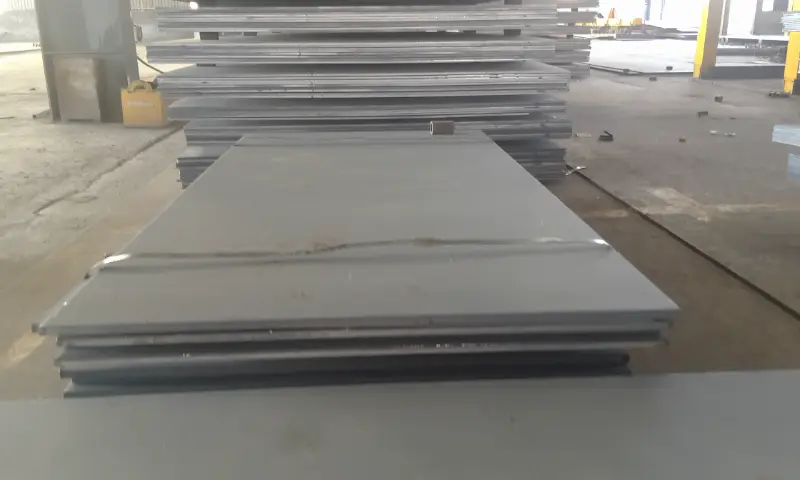
ASTM A516 Gr70 + 410 Stainless Steel Clad Plate
ASTM A516 Gr70 + 410 Stainless Steel Clad Plate: Chemical, Mechanical & Physical Properties
Comprehensive material data for ASTM A516 Grade 70 carbon steel explosively or roll-bonded with 410 martensitic stainless steel cladding. All values are based on ASTM A263/A516/A240 standards, including international equivalents and application guidance.
Hot rolling, cold forming, machining, welding (with appropriate procedures), bending, shearing
- Phone : +8618037372205
- Email : [email protected]
- WhatsApp: Contact via Whtsapp
- WeChat: +8618037372205
ASTM A516 Gr70 + 410 Stainless Steel Clad Plate Introduction
ASTM A516 Gr70 + 410 clad plate is a bimetallic composite material consisting of a structural base layer of pressure vessel quality carbon steel ASTM A516 Grade 70 and a corrosion-resistant 410 martensitic stainless steel cladding. It combines the high strength and cost-effectiveness of carbon steel with the moderate corrosion and erosion resistance of 410 stainless steel. Manufactured to ASTM A263 (Standard Specification for Stainless Chromium Steel-Clad Plate), this material is widely used in petroleum refining, chemical processing, and power generation equipment. The base metal provides the required mechanical integrity, while the clad layer protects against aggressive media. Typical applications include pressure vessels, heat exchangers, and storage tanks operating in mildly corrosive environments. The clad plate is available in various thicknesses with a cladding thickness ratio typically 5-20% of the total thickness. Bond integrity is ensured by ultrasonic examination. The product is usually delivered in normalized condition for the base metal, with the cladding as-bonded or heat treated according to customer requirements.
ASTM A516 Gr70 + 410 Stainless Steel Clad Plate Chemical Composition
The chemical composition is reported separately for the base metal (ASTM A516 Grade 70) and the clad metal (ASTM A240 Type 410). During manufacture, the clad plate must meet the individual chemical requirements of each layer. Values below represent cast or product analysis limits according to the relevant ASTM standards. Residual elements such as Cu, Ni, Cr, Mo are limited in the base metal to ensure weldability and toughness.
| Chemical Element | Base Metal (A516 Gr70) | Cladding Metal (410 SS) | Remarks |
|---|---|---|---|
| Carbon (C) | ≤0.31 (≤1 in thickness); ≤0.33 (>1 in) | 0.08–0.15 | Base: max 0.31 for plates 12.5 mm and under, else 0.33 |
| Manganese (Mn) | 0.80–1.20 (≤1 in); 0.85–1.20 (>1 in) | ≤1.00 | Base: ranges vary with thickness, also for >1 in Mn 0.85–1.20, with min 0.85 |
| Phosphorus (P) | ≤0.035 | ≤0.040 | |
| Sulfur (S) | ≤0.035 | ≤0.030 | |
| Silicon (Si) | 0.15–0.40 (≤1 in); 0.15–0.40 (>1 in) | ≤1.00 | Base: Si range for all thicknesses 0.15–0.40 |
| Chromium (Cr) | ≤0.25 (residual) | 11.50–13.50 | Base: unintentional alloying element; clad: key corrosion resistance element |
| Copper (Cu) | ≤0.35 | — | Base: residual limit |
| Nickel (Ni) | ≤0.25 | ≤0.75 | Base: residual limit |
| Molybdenum (Mo) | ≤0.08 | — | Base: residual limit |
| Niobium (Nb) | ≤0.02 | — | |
| Vanadium (V) | ≤0.02 | — | |
| Titanium (Ti) | ≤0.03 | — |
ASTM A516 Gr70 + 410 Stainless Steel Clad Plate Physical Properties – Typical Reference Values
Physical properties are provided separately for the base metal (A516 Gr70 carbon steel) and the cladding (410 stainless steel) because the clad plate is a composite. Overall thermal expansion and thermal conductivity of the composite depend on the cladding ratio and temperature. The table lists representative values at ambient or specified temperatures from reliable sources and standard reference data. Density and electrical resistivity are for comparison; in-service behavior may differ slightly.
| Property | Base Metal (A516 Gr70) | Cladding Metal (410 SS) | Unit | Test Condition |
|---|---|---|---|---|
| Density (ρ) | 7.85 | 7.70 | g/cm³ | 20°C |
| Elastic Modulus (E) | 200–210 | 200 | GPa | Tension, room temperature |
| Shear Modulus (G) | 80 | 77 | GPa | Typical isotropic approximation |
| Poisson's Ratio (ν) | 0.29 | 0.28 | — | Room temperature |
| Thermal Expansion Coefficient (α) | 12.5 | 11.0 | 10⁻⁶/K | 20–100°C |
| Thermal Conductivity (λ) | 50 | 25 | W/(m·K) | 100°C |
| Specific Heat Capacity (cp) | 0.49 | 0.46 | J/(g·K) | 0–200°C range |
| Electrical Resistivity (ρe) | 0.15 | 0.60 | µΩ·m | 20°C |
ASTM A516 Gr70 + 410 Stainless Steel Clad Plate Mechanical Properties – Clad Plate
Tensile properties are based on the full thickness of the clad plate and must meet the requirements of the base metal specification ASTM A516 Grade 70. Yield strength, tensile strength, and elongation are evaluated using full-thickness specimens. Shear strength tests the bond integrity. Impact properties are tested from the base metal side. Bending tests are performed to verify ductility and bond soundness. Values below are minimum or range as specified by ASTM A263 and ASTM A516 when applicable.
| Property | Standard Requirement Value | Unit | Test Condition / Remark |
|---|---|---|---|
| Yield Strength (ReH) | ≥ 260 (38) | MPa (ksi) | 0.2% offset; transverse specimen |
| Tensile Strength (Rm) | 485–620 (70–90) | MPa (ksi) | Full thickness; standard gauge |
| Elongation (A) | ≥ 21 | % | 50 mm (2 in) gauge length; depends on thickness – minimum for plates ≤12.5 mm |
| Shear Strength (clad interface) | ≥ 140 (20) | MPa (ksi) | Minimum shear strength per ASTM A263 |
| Bend Test (180° bend) | No cracks or separation | — | Bend diameter = 3T (T=plate thickness), or as specified; outer surface inspected |
| Charpy Impact (KV2) | ≥ 27 (base metal, longitudinal) | J (ft·lbf) | -30°C (-22°F); optional requirement per ASTM A516 supplementary requirement S5 or as agreed |
| Brinell Hardness (Base) | ≤ 200 | HB | Typical for normalized A516 Gr70 |
ASTM A516 Gr70 + 410 Stainless Steel Clad Plate Completely Equivalent Material Standards & Substitutable Grades
| Country/Region | Standard | Designation/Grade | Remarks |
|---|---|---|---|
| Europe | EN 10355 | P355GH + X12Cr13 (1.4006) | Hot rolled clad plate for pressure purposes; base EN 10028-3, clad EN 10088-2 |
| Japan | JIS G3601 | SPV355 + SUS410 | Stainless-clad steel for pressure vessels and general use |
| China | GB/T 8165 | Q345R + S41008 (0Cr13) | Stainless clad steel plate for pressure vessels; base equivalent to A516 Gr70 |
| Korea | KS D 3610 | SPVA355 + STS410 | Parallel to JIS; cladding STS410 corresponds to 410 |
ASTM A516 Gr70 + 410 Stainless Steel Clad Plate Application Introduction
A516 Gr70 + 410 clad plate is primarily used in industries where a combination of structural strength from the carbon steel base and moderate corrosion resistance from the martensitic stainless steel cladding is required. It reduces costs compared to solid stainless steel while providing long service life. Key considerations for use: ensure correct welding procedures (post-weld heat treatment may be needed), avoid prolonged exposure to temperatures above 400°C where the cladding may sensitize, and select the clad thickness based on the expected corrosion rate.
Product Applications: Process columns and towers, Reactors and pressure vessels, Heat exchangers (shell & tube, plate), Storage tanks (API 650 tanks with corrosive linings), Separators and knock-out drums, Ducting and expansion bellows
Processed into products: Vessel shells, heads, and manways, Tube sheets and baffles, Flanges and reinforcement pads, Internal trays and supports, Piping and fittings (lined), Erosion shields and wear plates
Application industries: Oil & Gas (upstream, refining), Petrochemical and Chemical Processing, Power Generation (fossil fuel, nuclear auxiliary), Desalination Plants, Pulp & Paper (digesters, recovery boilers), Marine and Offshore
ASTM A516 Gr70 + 410 Stainless Steel Clad Plate Similar / Alternative Clad Materials for Comparable Service
| Country/Region | Standard | Designation/Grade | Remarks |
|---|---|---|---|
| International | ASTM A263 / A264 | A516 Gr70 + 410S (low carbon 410) | Lower carbon 410S improves weldability and corrosion resistance over 410 |
| International | ASTM A263 / A264 | A516 Gr70 + 304L | Higher corrosion resistance; suitable for more aggressive environments |
| Europe | EN 10355 | P355GH + X6CrNiTi18-10 (1.4541) | Austenitic stainless cladding; for wide range of chemical applications |
| Japan | JIS G3601 | SPV355 + SUS304L | Alternative when 410 is insufficient for corrosion requirements |
Notes:
Manufacturing methods: The clad plate is typically produced by explosion bonding or roll bonding, both meeting the shear strength requirements of ASTM A263. Inspection: Ultrasonic examination (UT) is mandatory to ensure 100% bonding. Dimensional limitations: Total thickness up to approximately 200 mm, clad thickness from 2 mm to 25 mm; width and length controlled by the manufacturing process. Welding: Transition joints require proper filler metal selection (e.g., E309 or E310 type) to avoid dilution-induced cracking. Post-weld heat treatment (PWHT) is carried out based on the base metal requirements; the cladding properties may be altered by PWHT and should be evaluated. For detailed design, refer to ASME Boiler and Pressure Vessel Code Section VIII Div.1/2.
- Share



