
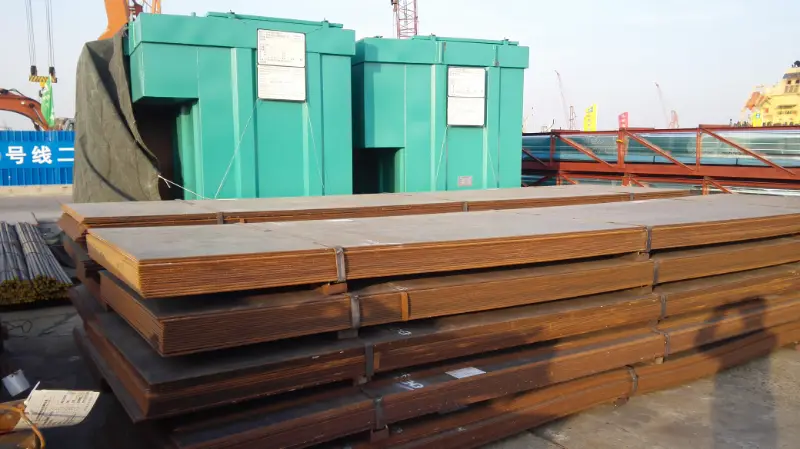
A516 Gr.70 (NACE) + 410 Clad Steel Plate
A516 Gr.70 (NACE) + 410 Clad Steel Plate - HIC-Resistant Pressure Vessel Clad Material
Overview of ASTM A516 Grade 70 carbon steel plate with NACE MR0175/ISO 15156 compliance, roll-bonded with a 410 martensitic stainless steel cladding for corrosion resistance in wet H2S environments.
Hot rolling (roll bonding), explosion cladding, weld overlay; subsequent fabrication: welding (with matching filler metals), hot forming (controlled), cold forming (with consideration for HIC resistance), machining
- Phone : +8618037372205
- Email : [email protected]
- WhatsApp: Contact via Whtsapp
- WeChat: +8618037372205
A516 Gr.70 + 410 Clad Steel Plate Introduction
A516 Gr.70 (NACE) + 410 clad steel plate is a composite material consisting of a backer (base) layer of ASTM A516 Grade 70 pressure vessel quality carbon steel that meets the metallurgical and hardness requirements of NACE MR0175/ISO 15156 for sour service, and a cladding layer of Type 410 (UNS S41000) martensitic stainless steel providing moderate corrosion and erosion resistance. The clad plate is produced by hot rolling, explosion bonding, or weld overlay, achieving a metallurgical bond. The base metal provides structural strength (min YS 260 MPa, TS 485–620 MPa) while the 410 cladding (nominally 12% Cr) offers resistance to sulfide stress cracking in upstream and refinery environments. This material is widely utilized in pressure vessels, separators, and heat exchangers operating in wet H2S service where both mechanical integrity and surface corrosion protection are required.
A516 Gr.70 + 410 Clad Steel Plate Chemical Composition
The chemical composition of the base metal ASTM A516 Gr.70 (detailed below) is in accordance with ASTM A516/A516M. For NACE MR0175 compliance, additional restrictions are commonly applied: S ≤ 0.010% (often ≤0.002%), P ≤ 0.015%, and CE (IIW) limited to 0.43 max to ensure weldability and SSC resistance. The 410 cladding composition conforms to ASTM A240/A240M. The clad plate's overall chemical properties are governed by the base metal; the cladding is for surface contact only.
| Chemical Element | Base (A516 Gr.70) Standard Value | Cladding (410) Standard Value | Remarks |
|---|---|---|---|
| Carbon (C) | ≤ 0.28 (heat analysis) ≤ 0.27 (product) | 0.08–0.15 | Lower C in base preferred for NACE (often ≤0.20). 410 cladding ensures high hardness. |
| Manganese (Mn) | 0.85–1.20 (for thickness ≤12.5 mm); 0.85–1.20 for other thickness ranges per ASTM | ≤ 1.00 | Base Mn may be adjusted to 1.00–1.50 for heavier sections; NACE often limits Mn to ≤1.35. |
| Silicon (Si) | 0.15–0.40 (heat analysis) | ≤ 1.00 | Standard ranges. For NACE, Si typically not modified. |
| Phosphorus (P) | ≤ 0.035 | ≤ 0.040 | NACE typically requires ≤ 0.015% in base. |
| Sulfur (S) | ≤ 0.035 | ≤ 0.030 | NACE requires low S, often ≤ 0.002% (HIC-resistant). Base steel must be clean calcium treated. |
| Chromium (Cr) | ≤ 0.30 (residual) | 11.5–13.5 | Cladding provides Cr content for corrosion resistance. |
| Nickel (Ni) | ≤ 0.30 (residual) | ≤ 0.75 | Ni content in base may be restricted for NACE (typically ≤1.0%). |
| Molybdenum (Mo) | ≤ 0.12 (residual) | – | Not specified in 410; sometimes small additions for sulfide stress cracking resistance. |
| Copper (Cu) | ≤ 0.35 (residual) | – | Cu may be limited per NACE. |
| Nitrogen (N) | – | – | Not intentionally added; base N limited. |
| CE (IIW) | ≤ 0.45 typically | – | NACE compliant base often has CE ≤ 0.43. |
A516 Gr.70 + 410 Clad Steel Plate Thermal and Electrical Physical Properties
Physical properties are predominantly governed by the base material (A516 Gr.70 carbon steel) because the cladding represents ~3–10% of total thickness. The data below correspond to carbon steel at ambient temperature unless otherwise noted. The 410 cladding has similar thermal expansion but slightly lower thermal conductivity. These values are typical for design calculations and are not mandatory in the material specification.
| Property | Standard Reference Value | Unit | Test Condition / Remarks |
|---|---|---|---|
| Density (ρ) | 7.85 (carbon steel); 7.75 (410 cladding) | g/cm³ | Ambient temperature; slight variation with thickness. |
| Modulus of Elasticity (E) | 200 | GPa | Room temperature; decreases at elevated temperatures (e.g., ~190 GPa at 200°C). |
| Shear Modulus (G) | 79.3 | GPa | Room temperature. |
| Poisson's Ratio (ν) | 0.3 | – | Elastic range. |
| Thermal Expansion Coefficient (α) | 11.7 (20–100°C); 12.9 (20–200°C); 13.7 (20–300°C) | 10^-6 /K | Mean coefficient for carbon steel base; 410 cladding ~10.3 (20–100°C), ~11.1 (20–200°C). |
| Thermal Conductivity (λ) | 52 (at 20°C); 42 (at 200°C) | W/(m·K) | Carbon steel base; 410 cladding ~25 W/(m·K) at 20°C. |
| Specific Heat Capacity (cp) | 486 (at 20°C); 532 (at 200°C) | J/(kg·K) | Carbon steel base; 410 cladding ~460 J/(kg·K) at 20°C. |
| Electrical Resistivity (ρe) | ~0.15 (carbon steel) | Ω·mm²/m | At room temperature; 410 cladding ~0.60 Ω·mm²/m. |
A516 Gr.70 + 410 Clad Steel Plate Mechanical Properties
The table lists the tensile and impact properties of the base metal A516 Gr.70 in normalized condition, which also define the structural strength of the clad plate. For NACE MR0175 compliance, maximum hardness is restricted to 22 HRC (249 HBW) in the base metal and heat-affected zones. Clad plate additionally requires a minimum shear strength between base and cladding as per ASTM A263. Impact properties are often specified at low temperature (e.g., -46°C). Charpy V-notch values vary with test temperature and plate thickness; typical values are listed.
| Property | Standard Required Value | Unit | Test Condition / Remarks |
|---|---|---|---|
| Tensile Strength (Rm) | 485–620 | MPa | Full thickness base metal tensile test, transverse; cladding not included in thickness for strength calculation. |
| Yield Strength (ReH/Lower Yield, ReL) | ≥ 260 | MPa | For plates ≤ 200 mm thickness. For NACE applications, actual YS typically 290–380 MPa. |
| Elongation (A) in 50 mm (2 in) | ≥ 21 (for thickness > 50 mm); ≥ 24 (for ≤ 50 mm) | % | Gauge length L0=50 mm. Reference ASTM A516 Table 2. |
| Elongation (A) in 200 mm (8 in) | ≥ 17 (for thickness > 50 mm); ≥ 20 (for ≤ 50 mm) | % | Alternative gauge length per ASTM. |
| Bend Test (Guided Bend) | No cracks after 180° bending | – | Bend diameter = 1.5× plate thickness (t) for base metal; clad plate tested as per ASTM A263, bend diameter 2t to 4t depending on cladding ratio. |
| Charpy Impact Energy (KV) | ≥ 27 (typical), often ≥ 40–50 J specified | J | Tested on base metal at design temperature (e.g., -46°C); NACE may require ≥ 27 J at -46°C or lower. |
| Hardness (Base Metal) | ≤ 22 HRC (249 HBW) | – | NACE MR0175/ISO 15156 requirement. Measures on base metal, HAZ, and weld metal. |
| Shear Strength (Clad Plate) | ≥ 140 (tight bond) | MPa | Per ASTM A263, minimum shear strength for roll-bonded clad plate of this combination. Usually tested on specimen per ASTM A264. |
A516 Gr.70 + 410 Clad Steel Plate Completely Equivalent Material Standards and Replaceable Grade Recommendations
| Country/Region | Standard | Grade / Designation | Remarks |
|---|---|---|---|
| USA / International | ASTM A263 (Clad Plate) | A516 Gr.70 / 410 (Type 410 Cladding) | Roll-bonded or explosion clad; base includes NACE requirements by supplementary specification. |
| Europe | EN 13445 / EN 10028-2 (Base) | P355GH + 1.4006 (410) clad | P355GH is equivalent to A516 Gr.70; 1.4006 is the 410 martensitic stainless steel. Must specify sour service requirements. |
| Japan | JIS G 3103 (Base); JIS G 3601 (Clad) | SB480 + SUS410 | Similar pressure vessel base material; SUS410 cladding. |
| China | NB/T 47002.1 (Explosion Clad) | Q345R (or SA516 Gr70) + 06Cr13 (S41010) | Equivalent clad plate standard; Q345R is common base but can be substituted with A516 Gr.70. |
| International | ISO 15405 (Clad Plate) | A516 Gr.70 + SS410 | Designation similar to ASTM A263; less commonly used. |
A516 Gr.70 + 410 Clad Steel Plate Application Introduction
A516 Gr.70 (NACE) + 410 clad plate is designed for critical pressure-retaining items in sour environments (H₂S-containing) where carbon steel on its own would be susceptible to hydrogen-induced cracking and sulfide stress cracking. The 410 cladding provides a thin, corrosion-resistant barrier that can withstand low to moderate chloride levels and abrasive media. Typical service conditions: pH down to 3.5, H₂S partial pressure up to 10 bar, temperatures up to 400°C (intermittent). The clad plate is used primarily in the fabrication of welded vessels and heat exchangers after successfully passing HIC, SSC, and ultrasonic bond tests.
Product Applications: Separator drums (high pressure, sour gas/liquid separation), Scrubbers and knockout drums, Heat exchanger shells and channels (shell & tube type), Reactor vessels for hydrotreating/hydrodesulfurization, Amine contactors and regenerators, Sour water strippers
Processed into products: Cylindrical shell courses (rolled from clad plate), Hemispherical or ellipsoidal heads (hot formed or fabricated from clad segments), Tube sheets (with thin 410 clad weld overlay on faces), Nozzle forgings (with 410 weld overlay internal surface), Flanges (clad ring or weld overlay on face and inner diameter), Baffles and support plates (if corrosion required on both sides)
Application industries: Oil & Gas (upstream and downstream), Chemical and Petrochemical Processing, Refining (hydroprocessing units, amine systems), Power Generation (geothermal sour steam), Seawater processing equipment (limited to low chloride)
A516 Gr.70 + 410 Clad Steel Plate Similar / Alternative Clad Plate Materials for Sour Service
| Country/Region | Standard | Grade / Description | Remarks |
|---|---|---|---|
| USA | ASTM A263 | A516 Gr.70 + 304L (or 316L) | Austenitic stainless steel cladding offers better corrosion resistance but is more expensive; not always suitable for sour service with high chlorides due to SCC risk. |
| USA | ASTM A263 | A516 Gr.70 + 2205 (Duplex) | Duplex stainless cladding provides excellent resistance to sulfide stress cracking and pitting; cost and fabrication complexity higher. |
| Europe | EN 10028-2 / EN 13445 | P355GH + 1.4003 (UNS S40977) | Stabilized 11-12% Cr ferritic stainless steel cladding; economical alternative for mild sour applications without high temperature. |
| USA | ASTM A387 / A263 | ASTM A387 Gr.11 (1.25Cr-0.5Mo) + 410 cladding | Base metal with elevated temperature strength; cladding same as 410; used when vessel operates at higher temperatures and hydrogen service. |
| All | Weld Overlay | A516 Gr.70 with weld deposited 410NiMo (UNS S41500) | Weld overlay alternative with similar corrosion performance and better toughness in the overlay when Ni is added. |
Notes:
- NACE MR0175/ISO 15156 compliance requires additional testing and documentation: HIC test per NACE TM0284 (Solution A), SSC susceptibility test per NACE TM0177, and hardness surveys on base, HAZ, and weld metal (max 250 HV or 22 HRC). The base steel is usually supplied in normalized condition with fine grain practice and calcium treatment for inclusion shape control.
- Cladding thickness generally ranges from 1.5 mm to 5 mm; must be specified. For ASTM A263, the shear strength test must be performed on a sample with full cladding thickness; the product is typically ultrasonically inspected for unbonded areas (Acceptance per ASTM A578 Level I, Class A).
- Welding: Requires qualified procedures for dissimilar welding. Typically, the base side uses E7018 or ER70S-6 filler; the transition layer with ER309L; the cladding layer with ER410 filler. Post-weld heat treatment (PWHT) may be required for service conditions and must not degrade the cladding's corrosion resistance.
- Maximum service temperature for the cladding: 410 retains strength up to 600°C but scaling resistance decreases above 650°C. Sour service limits often restrict maximum metal temperature to 232°C (450°F) for carbon steel per NACE unless qualified.
- Share



