
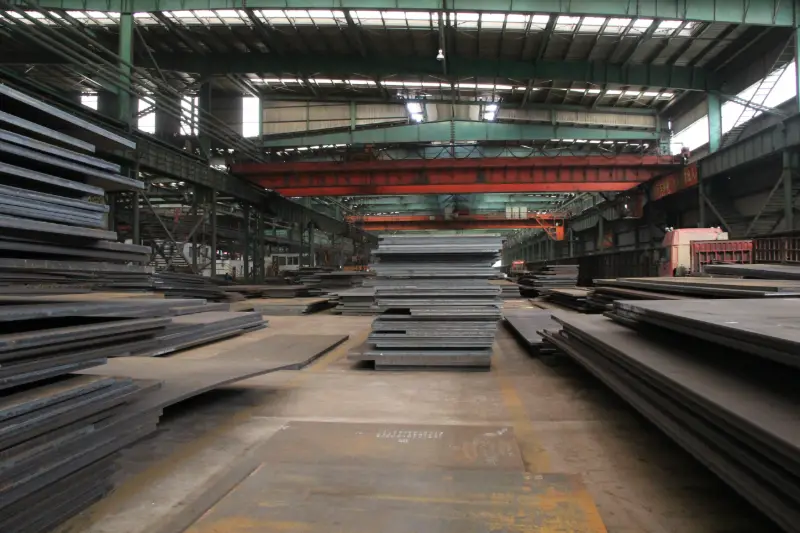
P265GH+410 Clad Steel Plate
P265GH+410 Clad Steel Plate: High-Temperature Strength & Corrosion Resistance for Pressure Vessels
P265GH+410 clad steel plate combines the elevated-temperature strength of carbon steel P265GH with the corrosion resistance of martensitic stainless steel 410.
Hot rolling, explosion bonding, roll bonding, normalizing; cutting, forming, welding, machining
- Phone : +8618037372205
- Email : [email protected]
- WhatsApp: Contact via Whtsapp
- WeChat: +8618037372205
P265GH+410 Clad Steel Plate Introduction
P265GH+410 clad steel plate is a metallurgically bonded composite plate consisting of a base layer of pressure vessel steel P265GH (EN 10028-2) and a cladding layer of 410 (1.4006) stainless steel. The base provides excellent weldability, high-temperature strength, and cost-effectiveness, while the 410 cladding offers good corrosion resistance in mildly aggressive environments, including resistance to atmospheric corrosion, steam, and many organic chemicals. The clad plate is manufactured through explosion bonding or hot-roll bonding, ensuring a strong interface with shear strength typically exceeding 140 MPa.
Key features:
- Combines structural integrity of P265GH with surface integrity of 410
- Normalized base material guarantees consistent mechanical properties up to 400°C
- Cladding thickness can be tailored (typically 1.5–5 mm) to match corrosion allowance
- Excellent forming and welding characteristics, suitable for large pressure vessels
- Cost-effective alternative to solid stainless steel constructions
Typical applications include heat exchangers, reactors, and storage tanks in chemical, petrochemical, and power generation industries where one-side corrosion protection is required.
P265GH+410 Clad Steel Plate Chemical Composition
The clad plate combines the composition of the base P265GH (non-alloy pressure vessel steel) and the 410 martensitic stainless steel cladding. All values are as per EN 10028-2 and EN 10088-2.
| Element | Standard Value | Remarks |
|---|---|---|
| C (Base) | ≤0.20 | P265GH per EN 10028-2; ≤0.22 for t>150mm |
| C (Clad) | 0.08–0.15 | 410 (1.4006) per EN 10088-2 |
| Si (Base) | ≤0.40 | P265GH |
| Si (Clad) | ≤1.00 | 410 |
| Mn (Base) | 0.50–1.40 | P265GH |
| Mn (Clad) | ≤1.50 | 410 |
| P (Base) | ≤0.025 | P265GH |
| P (Clad) | ≤0.040 | 410 |
| S (Base) | ≤0.015 | P265GH |
| S (Clad) | ≤0.015 | 410 |
| Alt (Base) | ≥0.020 | P265GH, acid-soluble Al |
| Cr (Base) | ≤0.30 | P265GH |
| Cr (Clad) | 11.5–13.5 | 410 |
| Cu (Base) | ≤0.30 | P265GH |
| Mo (Base) | ≤0.08 | P265GH |
| Nb (Base) | ≤0.010 | P265GH |
| Ni (Base) | ≤0.30 | P265GH |
| Ni (Clad) | ≤0.75 | 410 |
| Ti (Base) | ≤0.030 | P265GH |
| V (Base) | ≤0.020 | P265GH |
| Nb+Ti+V (Base) | ≤0.12 | P265GH |
P265GH+410 Clad Steel Plate Thermal & Electrical Physical Properties
Physical properties are given separately for the base P265GH (carbon steel) and clad 410 (stainless steel). Composite properties depend on relative thicknesses; contact our engineering team for specific composite values.
| Property | Typical Value | Unit | Material / Condition |
|---|---|---|---|
| Density (ρ) | 7.85 | g/cm³ | Base P265GH, 20°C |
| Density (ρ) | 7.7 | g/cm³ | Clad 410, 20°C |
| Elastic Modulus (E) | 210 | GPa | Base P265GH, 20°C |
| Elastic Modulus (E) | 200 | GPa | Clad 410, 20°C |
| Shear Modulus (G) | 81 | GPa | Base P265GH, estimated |
| Shear Modulus (G) | 77 | GPa | Clad 410, estimated |
| Poisson's Ratio (ν) | 0.3 | Both materials | |
| Thermal Expansion (α) | 12.0 | 10⁻⁶/K | Base, 20–100°C |
| Thermal Expansion (α) | 11.0 | 10⁻⁶/K | Clad 410, 20–100°C |
| Thermal Conductivity (λ) | 51 | W/m·K | Base, 100°C |
| Thermal Conductivity (λ) | 25 | W/m·K | Clad 410, 100°C |
| Specific Heat Capacity (cp) | 460 | J/kg·K | Both materials, 20°C |
| Electrical Resistivity (ρe) | 0.25 | µΩ·m | Base P265GH, 20°C |
| Electrical Resistivity (ρe) | 0.57 | µΩ·m | Clad 410, 20°C |
P265GH+410 Clad Steel Plate Mechanical Properties
Tensile and impact properties are governed by the base steel P265GH (normalized). Clad plate also has minimum bond shear strength. Properties depend on thickness; values representative of standard EN 10028-2 and ASTM A263.
| Property | Required Value | Unit | Test Condition |
|---|---|---|---|
| Yield Strength (ReH) | ≥265 | MPa | Base thickness ≤16 mm, ambient temp. |
| Yield Strength (ReH) | ≥255 | MPa | Base thickness 16–40 mm, ambient |
| Yield Strength (ReH) | ≥245 | MPa | Base thickness 40–60 mm, ambient |
| Yield Strength (ReH) | ≥215 | MPa | Base thickness 60–100 mm, ambient |
| Yield Strength (ReH) | ≥200 | MPa | Base thickness 100–150 mm, ambient |
| Yield Strength (ReH) | ≥185 | MPa | Base thickness 150–250 mm, ambient |
| Tensile Strength (Rm) | 410–530 | MPa | Base thickness ≤60 mm |
| Tensile Strength (Rm) | 400–530 | MPa | Base thickness 60–100 mm |
| Tensile Strength (Rm) | 390–530 | MPa | Base thickness 100–150 mm |
| Tensile Strength (Rm) | 380–530 | MPa | Base thickness 150–250 mm |
| Elongation (A) | ≥22 | % | Basis gauge length 5.65√S₀, t≤60 mm |
| Elongation (A) | ≥22 | % | t >60–100 mm° |
| Impact Energy (KV) | ≥27 | J | Transverse, 0°C, t ≤100 mm |
| Impact Energy (KV) | ≥27 | J | Longitudinal, 0°C (option) |
| Impact Energy (KV) | ≥27 | J | -20°C (option available for P265GH) |
| Bend Test (180°) | d=3a (no crack) | Base metal; a=specimen thickness | |
| Bend Test (180°) | d=4a (no separation) | Clad side; cladding must not crack | |
| Shear Strength (Clad Bond) | ≥140 | MPa | Per ASTM A263, minimum for clad plate |
| Hardness (Base, typical) | ≤155 | HB | After normalizing |
| Hardness (Clad, typical) | ≤200 | HB | Annealed 410 |
P265GH+410 Clad Steel Plate Fully Equivalent Material Standards & Substitutable Grades
| Region | Standard | Grade / Designation | Remarks |
|---|---|---|---|
| Europe | EN 10028-2 + EN 10088-2 (clad per EN 13445) | P265GH + 1.4006 | Identical base/clad combination; normalized base |
| USA | ASTM A263 / ASME SA-263 | Clad plate, Grade 410 clad with SA-516 Gr. 60 or 65 base | SA-516 Gr.60 (Rm 60 ksi) matches P265GH strength; shear test per A263 |
| China | GB/T 8165 | Q245R + S11306 (cladding 410 equivalent) | Base Q245R corresponds to P265GH; clad S11306 (12Cr13) very close to 410 |
| Japan | JIS G3601 | SGV410 or SB410 base + SUS410 clad | Similar properties; with optional bend and shear tests |
P265GH+410 Clad Steel Plate Application Introduction
P265GH+410 clad steel plate is engineered for pressure-containing equipment where the process fluid contacts only one side and requires moderate corrosion resistance, while the other side is exposed to the environment or a less aggressive fluid. The material is ideal for large-scale fabrication, reducing the overall cost compared to solid stainless steel construction without sacrificing integrity. Typical design temperatures range from -20°C to 400°C, and the clad side withstands many organic acids, steam, and mild alkaline solutions.
Key design considerations:
- Clad thickness selected based on corrosion allowance (usually 1.5–3 mm)
- Welding procedures must include a transition layer (e.g., E309Mo filler) before filling with carbon steel electrodes
- Post-weld heat treatment (PWHT) may be required depending on thickness and code (e.g., ASME VIII)
- Clad restoration after welding uses matching 410 or 309/410 overlays
Product Applications: Pressure vessels (ASME VIII Div.1/2, EN 13445), Shell-and-tube heat exchangers (tube sheets, shells, channels), Reactors (catalytic, polymerization), Atmospheric storage tanks (API 650, cladding on bottom or shell), Boilers (shells, heads, steam drums), Columns and towers (distillation, absorption)
Processed into products: Dished heads (ellipsoidal, torispherical) with integral clad, Shell courses (rolled and welded), Tube sheets with clad overlay (explosion bonded or weld overlay), Blind flanges and nozzles with clad facing, Internal baffles and support rings (clad one side), Expansion joints and bellows (thin clad on carbon steel)
Application industries: Oil & Gas (separators, knock-out drums, glycol contactors), Petrochemical (cracking units, reformer shells, heat exchangers), Chemical Processing (storage of organic acids, mild corrosive chemicals), Power Generation (boiler drums, deaerators, feedwater heaters), Water Treatment (desalination flash chambers, brine heaters), Pulp & Paper (digester vessels, black liquor tanks)
P265GH+410 Clad Steel Plate Similar / Near-Equivalent Clad Plate Options
| Region | Standard | Grade / Description | Remarks |
|---|---|---|---|
| International | Same base P265GH, clad 304 (1.4301) | P265GH + 304 | Higher overall corrosion resistance but similar base properties; suitable for food/pharma |
| International | Same base, clad 316L (1.4404) | P265GH + 316L | Excellent pitting and crevice corrosion resistance; used in chloride environments |
| International | Same base, clad Duplex 2205 | P265GH + 1.4462 | Higher strength and superior stress corrosion cracking resistance than 410 |
| International | Solid 410 stainless steel plate | EN 10088-2 1.4006 | Used where full corrosion resistance needed but less structural economy |
| International | Carbon steel with organic coating | P265GH + epoxy/phenolic lining | For less severe service; lower cost but limited temperature and abrasion resistance |
Notes:
Additional Information:
- Inspection: Clad plates are supplied with ultrasonic testing (UT) to ASTM A578 Level C to ensure full bond. Shear strength is certified per EN 13445 or ASTM A263.
- Welding: Special Welding Procedure Specification (WPS) required. Transition layer welding uses E309Mo or E410NiMo electrodes; final welding uses matching E7018 or similar for carbon steel side.
- Heat Treatment: Normalizing the base before bonding; stress relieving after forming may be needed. Excessive temperatures >650°C can cause carbon diffusion at interface, so controlled cycles are recommended.
- Corrosion Testing: Per customer specification, intergranular corrosion test (ASTM A262 Practice E) or pitting tests can be performed.
- Dimensional Range: Plate thicknesses up to 250 mm (base), clad thickness up to 5 mm, widths up to 4000 mm, lengths up to 12000 mm.
- Certification: EN 10204 Type 3.1 or 3.2 certificates available.
- Share



