
ASTM A387 Grade 22 Class 2 (A387GR22CL2) Cr
ASTM A387 Grade 22 Class 2 (A387GR22CL2) Cr-Mo Alloy Steel Plate for Pressure Vessels & Boilers
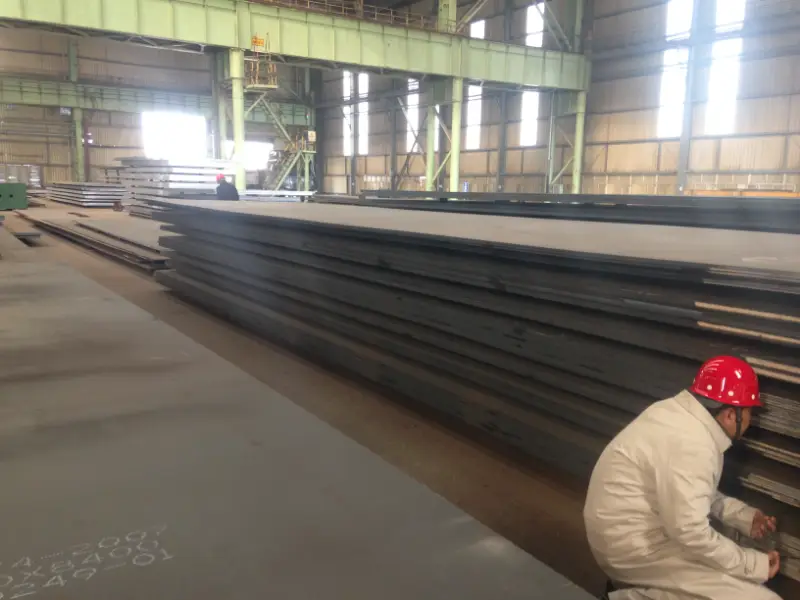
ASTM A387 Grade 22 Class 2 is a chromium-molybdenum alloy steel plate designed for elevated temperature service in welded pressure vessels and boilers. It offers excellent creep strength, hydrogen resistance, and weldability, making it ideal for high-temperature, high-pressure applications.
Hot rolling, normalizing, tempering, quenching and tempering; suitable for welding, forming, cutting (plasma, laser, oxy-fuel), and machining.
- Phone : +8618037372205
- Email : [email protected]
- WhatsApp: Contact via Whtsapp
- WeChat: +8618037372205
ASTM A387 Grade 22 Class 2 Cr Introduction
ASME/ASTM A387 Grade 22 Class 2 (2.25Cr-1Mo) is a low-alloy steel plate primarily used for pressure vessels and industrial boilers operating at high temperatures. This material exhibits superior mechanical properties under sustained heat, including high tensile strength (515–690 MPa), good creep rupture strength, and excellent resistance to hydrogen attack, sulfide stress cracking, and oxidation. It is supplied in normalized and tempered, or quenched and tempered condition, ensuring a fine-grained bainitic/martensitic microstructure. Typical thickness ranges from 6 mm to 150 mm, with strict compliance to chemical composition (Cr 2.00–2.50%, Mo 0.90–1.10%) and mechanical requirements. Welding procedures require careful preheat and post-weld heat treatment (PWHT) to avoid cracking and ensure toughness.
ASTM A387 Grade 22 Class 2 Cr Chemical Composition
The chemical composition of ASTM A387 Grade 22 Class 2 is strictly controlled to ensure optimal elevated-temperature strength and resistance to hydrogen and oxidation. Main alloying elements: Chromium (2.00–2.50%) provides high-temperature strength and oxidation resistance; Molybdenum (0.90–1.10%) enhances creep resistance and hardenability. Impurity limits: Phosphorus (max 0.025%) and Sulfur (max 0.025%) are kept low to maintain ductility and weldability.
| Chemical Element | Standard Value (wt%) | Remarks |
|---|---|---|
| Carbon (C) | 0.05–0.15 | Ladle analysis range |
| Silicon (Si) | ≤ 0.50 | For killed steel; may be lower for improved toughness |
| Manganese (Mn) | 0.30–0.60 | Typically balanced for deoxidation and strength |
| Phosphorus (P) | ≤ 0.025 | Max limit ensures ductility |
| Sulfur (S) | ≤ 0.025 | Max limit for hot workability and weld quality |
| Chromium (Cr) | 2.00–2.50 | Principal alloy for oxidation and creep strength |
| Molybdenum (Mo) | 0.90–1.10 | Key element for elevated-temperature strength |
ASTM A387 Grade 22 Class 2 Cr Thermal and Electrical Physical Properties
The following data represent typical engineering values for ASTM A387 Grade 22 Class 2 material, based on published literature and industrial references. These properties are not mandatory per ASTM A387 but are widely used for design calculations. Variations may occur with specific heat treatment and temperature. All values at room temperature unless noted.
| Property | Standard Value (Typical) | Unit | Test Condition / Remarks |
|---|---|---|---|
| Density (ρ) | 7.85 | g/cm³ | At 20 °C |
| Elastic Modulus (E) | 210 | GPa | At 20 °C; decreases with temperature |
| Shear Modulus (G) | 81 | GPa | Approximate, derived from E and Poisson's ratio |
| Poisson's Ratio (ν) | 0.3 | Typical for steel | |
| Thermal Expansion Coefficient (α) | 11.2 | 10⁻⁶/°C | 20–100 °C |
| Thermal Expansion Coefficient (α) | 12.5 | 10⁻⁶/°C | 20–600 °C |
| Thermal Conductivity (λ) | 35 | W/(m·K) | At 20 °C; decreases slightly at higher temperatures |
| Specific Heat Capacity | 460 | J/(kg·K) | At 20 °C |
| Electrical Resistivity (ρ_e) | 0.25 | µΩ·m | At 20 °C |
ASTM A387 Grade 22 Class 2 Cr Mechanical Properties
The following mechanical properties are specified for plates in normalized and tempered or quenched and tempered condition, tested at room temperature. Elongation requirements differ based on gauge length: for a 200 mm gauge length, minimum 18%; for a 50 mm gauge length, minimum 22%. Bend test is often specified as a supplementary requirement and typically involves a 180° bend over a diameter equal to 3 times the specimen thickness without cracking.
| Property | Standard Required Value | Unit | Test Condition / Remarks |
|---|---|---|---|
| Yield Strength (ReH) | ≥ 310 | MPa | 0.2% offset, room temperature; thickness ≤ 100 mm |
| Tensile Strength (Rm) | 515–690 | MPa | Room temperature; thickness ≤ 100 mm |
| Elongation (A) | ≥ 18 | % | Gauge length 200 mm (8 in.) |
| Elongation (A) | ≥ 22 | % | Gauge length 50 mm (2 in.) |
| Bend Test | 180°; d = 3t (typical) | When specified; no cracks allowed; d = mandrel diameter, t = specimen thickness |
ASTM A387 Grade 22 Class 2 Cr Exact Equivalent Material Standards & Substitutable Grades
| Country/Region | Standard | Grade | Remarks |
|---|---|---|---|
| USA | ASME SA387/SA387M | Grade 22 Class 2 | Identical to ASTM A387; adopted for ASME Boiler & Pressure Vessel Code construction |
| Europe | EN 10028-2 | 10CrMo9-10 (1.7380) | Similar composition and mechanical properties; widely used for pressure vessels |
| Japan | JIS G4109 | SCMV4-2 | Comparable Cr-Mo plate for boilers and pressure vessels |
| China | GB/T 713 | 12Cr2Mo1R | Corresponding Chinese grade with same alloy content and comparable strength; used in boiler & pressure vessel manufacturing |
ASTM A387 Grade 22 Class 2 Cr Application Introduction
ASTM A387 Grade 22 Class 2 plates are engineered for critical applications in high-temperature and hydrogen-bearing environments. The material's 2.25% Cr and 1% Mo content provide an excellent balance of creep strength, oxidation resistance, and tolerance to hydrogen attack. Typical operating temperatures range from 450 °C to 600 °C. Welding must be executed with low-hydrogen procedures, preheating (200–300 °C) and post-weld heat treatment (690–730 °C) to restore toughness and relieve stress. Forming is usually conducted in hot condition (normalizing temperature or above) or with intermediate stress-relief.
Product Applications: Hydroprocessing reactors (hydrocrackers, hydrotreaters), Catalytic reforming vessels, Ammonia converters, High-temperature heat exchangers and waste heat boilers, Boiler drums and superheater headers, Steam separators and steam drums
Processed into products: Shell plates and courses of pressure vessels, Dished heads / ellipsoidal heads, Tube sheets and flanges, Reactor nozzles and manways, Skirts and support rings, Baffles and internal trays
Application industries: Oil & Gas (refining, petrochemicals), Power Generation (fossil fuel and nuclear steam boilers), Chemical Processing (high-temperature reactors, gasifiers), Shipbuilding (boiler drums for marine use), Pressure Vessel Fabrication (general industrial)
ASTM A387 Grade 22 Class 2 Cr Similar / Alternative Materials with Close Performance
| Country/Region | Standard | Grade | Remarks |
|---|---|---|---|
| USA | ASTM A387/A387M | Grade 22 Class 1 | Lower strength version (yield ≥ 205 MPa, tensile 415–585 MPa); same Cr-Mo base but softer; suitable where strength can be compromised for ductility |
| USA | ASTM A387/A387M | Grade 21 Class 2 | 3Cr-1Mo alloy; offers better high-temperature strength and hydrogen resistance but with reduced weldability; used in hydrocrackers |
| USA | ASTM A387/A387M | Grade 11 Class 2 | 1.25Cr-0.5Mo steel; lower creep strength; suitable for moderate temperatures up to 500 °C; often used in heat exchangers and piping |
Notes:
Supplementary requirements (S1 to S18 of ASTM A387) may be invoked for additional testing, such as Charpy V-notch impact tests, ultrasonic examination, or simulated post-weld heat treatment (SPWHT). Heat treatment: plates are normally supplied in the normalized and tempered condition; for thicknesses above 100 mm, accelerated cooling (quenching) is common. Storage and handling: store in dry conditions to avoid surface corrosion; rust preventive oils are recommended before long-term outdoor storage. Welding consumables must match the base metal chemistry (typically ER90S-B3 or E9018-B3). All fabrication should follow relevant codes (e.g., ASME Section VIII, PD 5500, EN 13445).
- Share



