
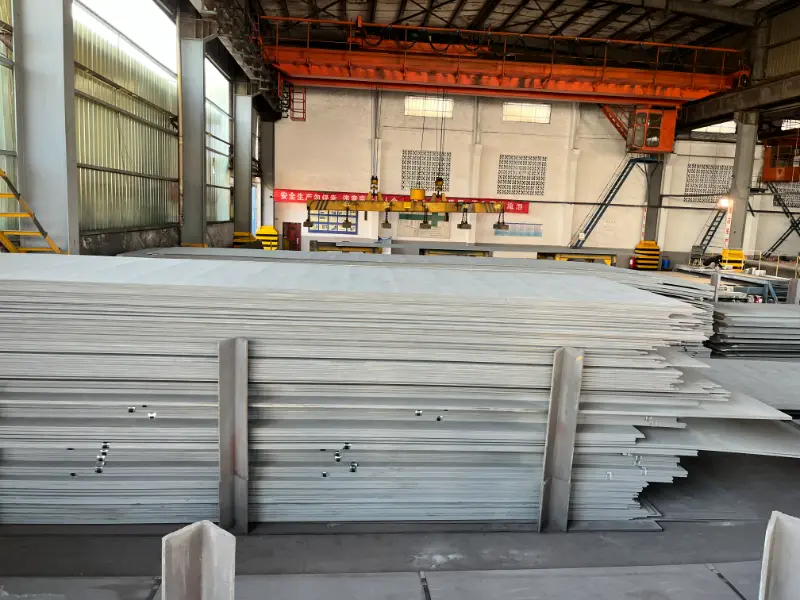
ASTM A387 Grade 5 Class1 Alloy Steel Plate for Pressure Vessels & Boilers
ASTM A387 Grade 5 Class 1 (A387GR5CL1) Pressure Vessel Steel Plate – Complete Data Sheet
ASTM A387 Grade 5 Class 1 is a chromium-molybdenum alloy steel plate intended for elevated temperature service in pressure vessels and boilers. This data sheet provides chemical composition, mechanical and physical properties, international equivalents, and application guidance strictly based on official standards.
Hot rolling, normalising, tempering, welding, machining, cold forming (in limited thickness), hot forming
- Phone : +8618037372205
- Email : [email protected]
- WhatsApp: Contact via Whtsapp
- WeChat: +8618037372205
ASTM A387 Grade 5 Class1 Alloy Steel Plate for Pressure Vessels & Boilers Introduction
ASTM A387 Grade 5 Class 1 (A387GR5CL1) is a 5% chromium – 0.5% molybdenum alloy steel plate produced to the requirements of ASTM A387/A387M specification for pressure vessel plates. It is designed for welded boilers and pressure vessels suitable for high-temperature service. The alloy provides excellent resistance to hydrogen attack and high-temperature corrosion, making it a preferred choice in petrochemical and power generation industries.
Key characteristics include:
- Good creep strength up to approximately 600 °C (1110 °F).
- Superior resistance to hydrogen embrittlement in high-temperature, high-pressure hydrogen environments (Nelson curve applications).
- Excellent weldability with proper preheating and post-weld heat treatment.
- Available in normalised and tempered condition (Class 1 delivers moderate strength levels).
The material is widely used for fabricating reformer tubes, heat exchangers, pressure vessels, and components exposed to hot hydrogen, sulfur-containing atmospheres, and high-temperature steam. Typical delivery condition is normalised and tempered with a maximum thickness of 150 mm (6 in.) for Class 1, offering a balanced combination of strength and toughness.
ASTM A387 Grade 5 Class1 Alloy Steel Plate for Pressure Vessels & Boilers Chemical Composition
The chemical composition meets ASTM A387/A387M for Grade 5 Class 1. All values are maximum unless a range is given. The balance is iron (Fe). The alloy is characterised by a deliberate addition of chromium (4.00–6.00%) and molybdenum (0.45–0.65%) to enhance high-temperature properties and resistance to hydrogen attack.
| Element | Required Value (weight %) | Remarks |
|---|---|---|
| Carbon (C) | 0.15 max | — |
| Manganese (Mn) | 0.30 – 0.60 | Heat analysis |
| Phosphorus (P) | 0.025 max | — |
| Sulfur (S) | 0.025 max | — |
| Silicon (Si) | 0.50 max | — |
| Chromium (Cr) | 4.00 – 6.00 | — |
| Molybdenum (Mo) | 0.45 – 0.65 | — |
ASTM A387 Grade 5 Class1 Alloy Steel Plate for Pressure Vessels & Boilers Physical Properties
Physical properties are typical for 5Cr-0.5Mo steel in the normalised and tempered condition. Data are sourced from ASME BPVC Section II Part D (Mandatory and Nonmandatory appendices) and published literature. They are not check items in ASTM A387 but serve as design guide.
| Property | Typical Value | Unit | Test Condition / Reference |
|---|---|---|---|
| Density (ρ) | 7.80 | g/cm³ | Room temperature |
| Modulus of Elasticity (E) | 190 – 210 | GPa | At 20 °C (68 °F) |
| Shear Modulus (G) | 73 – 81 | GPa | Estimated from E and Poisson's ratio |
| Poisson's Ratio (ν) | 0.30 | — | At room temperature, typical for alloy steel |
| Mean Coefficient of Thermal Expansion (α) | 11.0 (20–100 °C) | µm/m·°C | ASME II Part D Table TE-1 |
| Mean Coefficient of Thermal Expansion (α) | 12.1 (20–400 °C) | µm/m·°C | ASME II Part D Table TE-1 |
| Mean Coefficient of Thermal Expansion (α) | 13.0 (20–600 °C) | µm/m·°C | ASME II Part D Table TE-1 |
| Thermal Conductivity (λ) | 36 | W/m·K | At 20 °C |
| Thermal Conductivity (λ) | 34 | W/m·K | At 300 °C |
| Specific Heat Capacity (c_p) | 460 | J/kg·K | At 20 °C (typical range 450–480) |
| Electrical Resistivity (ρ_e) | 0.55 | µΩ·m | At room temperature, typical |
ASTM A387 Grade 5 Class1 Alloy Steel Plate for Pressure Vessels & Boilers Tensile Requirements
The mechanical properties are conforming to ASTM A387/A387M, tested after normalising and tempering heat treatment. Values apply to plates in the normalised and tempered condition. The test specimens are taken in the transverse direction.
| Property | Required Value | Unit | Test Condition / Remarks |
|---|---|---|---|
| Tensile Strength (Rm) | 415 – 585 | MPa | Normalised and tempered, transverse specimen |
| Yield Strength (ReH, 0.2% offset) | ≥ 205 | MPa | Normalised and tempered, transverse specimen |
| Elongation (A) in 200 mm (8 in.) | ≥ 18 | % | For plate thickness ≤ 5/8 in. (16 mm) adjusted per standard |
| Elongation (A) in 50 mm (2 in.) | ≥ 22 | % | For plate thickness ≤ 3/4 in. (20 mm) adjusted per standard |
| Bend Test (d = mandrel diameter, a = specimen thickness) | d = 2a | — | For thickness ≤ 25.4 mm (1 in.), bend 180° |
| Bend Test | d = 3a | — | For thickness > 25.4 mm to 50 mm (≥1 in. to 2 in.), bend 180° |
| Charpy Impact Energy (KV) | Not specified in base standard (supplementary S5 may be applied by agreement) | J | — |
ASTM A387 Grade 5 Class1 Alloy Steel Plate for Pressure Vessels & Boilers International Equivalent Standards & Substitutable Grades
| Country / Region | Standard | Grade / Designation | Remarks |
|---|---|---|---|
| USA | ASTM A387 / ASME SA387 | Grade 5 Class 1 | Identical; SA387 is the ASME Boiler and Pressure Vessel Code adoption. |
| European Union | EN 10028-2 | 12CrMo19-5 (1.7362) | Chemically equivalent; check mechanical and impact requirements for full equivalence. |
| Japan | JIS G4109 | SCMV5 | Cr-Mo alloy steel plates for boilers and pressure vessels; comparable chemical and tensile properties. |
| China | GB/T 150.2 (Pressure Vessels) & reference to GB/T 713 or GB 245 | 12Cr5MoI (1.7362) / 12Cr5Mo | Similar composition; verify design limits per Chinese pressure vessel code. |
| Germany (superseded) | DIN 17155 | 12CrMo19-5 | Withdrawn, replaced by EN 10028-2, but historically identical. |
ASTM A387 Grade 5 Class1 Alloy Steel Plate for Pressure Vessels & Boilers Application Introduction
ASTM A387 Grade 5 Class 1 plate is tailored for fabrication of stationary pressure equipment operating under high-temperature and high-pressure hydrogen services. Its 5% chromium content provides a balance of creep strength, resistance to hydrogen attack, and resistance to oxidation in flue gas atmospheres. The Class 1 condition (lower strength) offers better toughness and is often easier to form and weld compared to Class 2.
Key considerations for application:
- Suitable for hydrogen partial pressure and temperature ranges defined by the API RP 941 Nelson curves.
- Preheat (typically 200–300 °C) and post-weld heat treatment (PWHT at 660–700 °C) are essential to avoid cold cracking and stress corrosion.
- Not recommended for sustained operation above 650 °C due to microstructural degradation.
- Commonly used in accordance with ASME Section VIII Division 1 and 2, and other international pressure vessel codes.
Product Applications: Fired heater tubes and headers, Hydroprocessing reactors and high-pressure separators, Steam superheater and reheater tubing (sets), Boiler drums and steam/water separators, Heat exchanger shells and channels, High-temperature piping and fittings (in welded plate form)
Processed into products: Reactor walls and shells for hydrogen service, Tube sheets for heat exchangers, Flanges and blind flanges (cut from plate), Cylindrical vessel sections (rolled and welded), Manway covers and nozzles, Transition pieces between carbon steel and stainless steel systems, Support skirts and internal structural parts exposed to hot process gases
Application industries: Petroleum refining (hydrocrackers, hydrotreaters, catalytic reformers), Chemical processing (ammonia and methanol synthesis converters), Power generation (boiler drums, superheater headers, steam separators), Nuclear (secondary side heat exchangers) - limited applications, Fertiliser plants (high-temperature process equipment)
ASTM A387 Grade 5 Class1 Alloy Steel Plate for Pressure Vessels & Boilers Similar Alternative Materials with Performance Overlap
| Country/Region | Standard | Grade | Remarks |
|---|---|---|---|
| USA | ASTM A387 | Grade 5 Class 2 | Higher strength class of the same steel; same corrosion resistance, but different mechanical properties (Rm 515–690 MPa). Not interchangeable without recalculations. |
| USA | ASTM A387 | Grade 22 Class 1 (2.25Cr-1Mo) | Widely used chromium-molybdenum steel for elevated temperature; lower Cr content provides lower hydrogen attack resistance but is more economical. Suitable for many services with less severe hydrogen partial pressure. |
| USA | ASTM A387 | Grade 9 Class 1 (9Cr-1Mo) | Higher chromium content for improved oxidation resistance; used in higher-temperature environments but requires more demanding welding procedures. |
| EU | EN 10028-2 | 13CrMo4-5 (1.7335) | 1Cr-0.5Mo steel, lower creep strength and hydrogen resistance, often selected for lower-cost applications in moderate temperatures. |
| EU | EN 10028-2 | 10CrMo9-10 (1.7380) | 2.25Cr-1Mo, alternative to Grade 22, widely used in refineries and power plants. |
Notes:
1. Supplementary requirements (e.g., impact testing, ultrasonic examination) in ASTM A20/A20M must be specified at the time of ordering if needed.
2. For very thick sections (>100 mm), alloy segregation and hydrogen-induced disbonding may require additional hydrogen bake-out treatments.
3. Welding consumables matching the 5Cr-0.5Mo chemistry (e.g., AWS E8016-B6 or ER80S-B6) should be used to preserve service performance.
4. Maximum service temperature under ASME Section II Part D depends on thickness; for 5Cr-0.5Mo, allowable stresses are provided up to 650 °C (1200 °F).
5. Always verify the current edition of the standard and local regulatory requirements before final material selection.
- Share



