
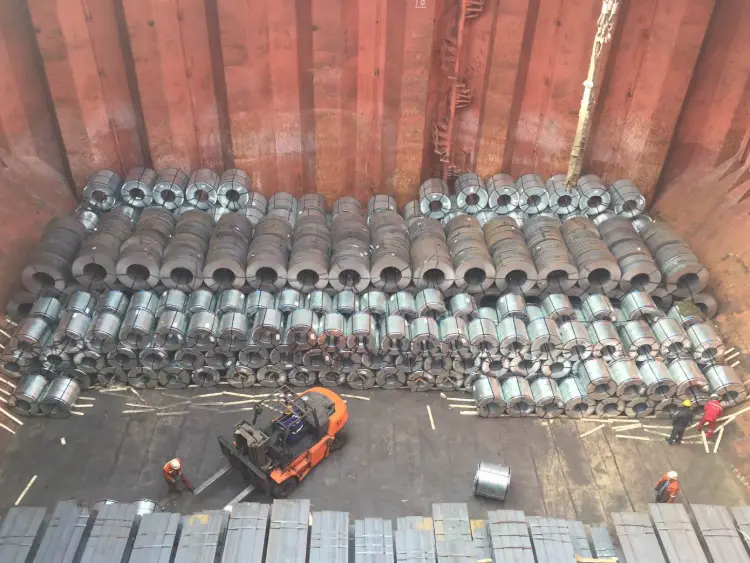
ASTM A36 Carbon Structural Steel Coil
ASTM A36 Carbon Structural Steel Coil: Comprehensive Material Data and Equivalent Grades
Detailed material analysis for ASTM A36 steel coil including chemical composition, mechanical and physical properties, international equivalents, and application guidance.
Hot rolling, cold forming, welding (all common processes), machining, punching, stamping, forging, galvanizing, painting
- Phone : +8618037372205
- Email : [email protected]
- WhatsApp: Contact via Whtsapp
- WeChat: +8618037372205
ASTM A36 Carbon Structural Steel Coil Introduction
ASTM A36 is a widely used carbon structural steel grade defined under ASTM A36/A36M standard. It is primarily supplied in hot-rolled coil, plate, bar, and structural shapes. Known for its excellent weldability, good machinability, and adequate strength, A36 is the workhorse material for general construction and structural applications. Key characteristics:
- Minimum yield strength of 250 MPa (36 ksi) in thicknesses up to 200 mm.
- Tensile strength range of 400–550 MPa, providing a good balance between strength and ductility.
- Elongation values typically above 20%, ensuring good formability.
- Excellent weldability using all common welding methods without requiring preheating in most cases.
- Moderate corrosion resistance; often galvanized or painted for enhanced durability.
The chemical composition is controlled to maximize weldability and toughness: carbon is limited to 0.26% max, manganese up to 1.20%, with low phosphorus and sulfur content. The steel is not intended for high-temperature service or where high wear resistance is needed, but it serves exceptionally well in ambient and moderate environments. It is commonly used in building frames, bridges, storage tanks, machinery parts, and general fabrication. The coil form allows for efficient processing in stamping, roll forming, and cutting operations. International equivalents include EN S235JR, JIS SS400, and ISO E235B, making it globally recognized and easily substituted.
ASTM A36 Carbon Structural Steel Coil Chemical Composition
The chemical composition of ASTM A36 is designed to ensure good weldability and structural integrity. Carbon is maintained at a moderate level to balance strength and toughness, while manganese is added to improve hot workability and counteract sulfur. Phosphorus and sulfur are limited to avoid brittleness and hot cracking. The composition may vary slightly based on product form and thickness, with plate and structural shapes having permissible ranges. Remarks: For thicknesses over 20mm, carbon content may be slightly higher as per the standard; the values listed are typical for coil products up to 20 mm thickness. Copper may be present as a residual element or added to improve atmospheric corrosion resistance.
| Element | Standard Value | Remarks |
|---|---|---|
| Carbon (C) | ≤0.26% | Maximum; for thickness ≤20mm; may be ≤0.25% in some product forms; up to 0.29% for thicker sections allowed. |
| Manganese (Mn) | 0.80–1.20% | For structural shapes; for plates, range can be 0.80–1.20%. Lower Mn for thinner sheet may be permitted. |
| Phosphorus (P) | ≤0.040% | Maximum |
| Sulfur (S) | ≤0.050% | Maximum |
| Silicon (Si) | ≤0.40% | Maximum for shapes; for plates, 0.15–0.40% typical. Not always specified for coil. |
| Copper (Cu) | ≤0.20% | Minimum when copper steel is specified (optional); otherwise residual, typically ≤0.20%. |
| Iron (Fe) | Balance | Remainder |
ASTM A36 Carbon Structural Steel Coil Thermal and Electrical Physical Properties
Physical properties for ASTM A36 are typical for plain carbon steel. These values are not specified in the standard but are widely accepted engineering data at room temperature. Density, elastic modulus, and thermal expansion are essential for structural design calculations. Thermal conductivity and specific heat are relevant for heat transfer analysis, while electrical resistivity may be considered for certain applications. All values are approximate and can vary with temperature and processing history. For precise design, consult material supplier or conduct testing under actual service conditions.
| Property | Typical Value | Unit | Test Condition |
|---|---|---|---|
| Density (ρ) | 7850 | kg/m³ | at 20°C |
| Elastic Modulus (E) | 200 | GPa | at 20°C |
| Shear Modulus (G) | 79.3 | GPa | Calculated from E and ν (typical) |
| Poisson's Ratio (ν) | 0.29 | Typical for carbon steel | |
| Thermal Expansion Coefficient (α) | 11.7 × 10⁻⁶ | /K | Linear, at 20–100°C |
| Thermal Conductivity (λ) | 51.9 | W/(m·K) | at 20°C |
| Specific Heat Capacity | 486 | J/(kg·K) | at 20°C |
| Electrical Resistivity (ρ_e) | 0.142 | μΩ·m | at 20°C |
ASTM A36 Carbon Structural Steel Coil Mechanical Properties
Mechanical properties are determined according to ASTM A370 test methods unless otherwise specified. The standard specifies minimum yield strength of 36 ksi (250 MPa) and tensile strength within 58–80 ksi (400–550 MPa) for all thicknesses up to 200 mm. Elongation requirements vary with thickness and gauge length; typical values for coil sheet are given. Bend tests are optional or specified in supplementary requirements. Charpy V-notch impact testing is not mandatory in the base specification but can be added through supplementary order S1, S2, etc. The values presented are representative and may be subject to variation based on actual production lot and processing.
| Property | Standard Requirement / Typical Value | Unit | Test Condition |
|---|---|---|---|
| Yield Strength (ReH) | ≥250 | MPa | For thickness ≤200mm |
| Tensile Strength (Rm) | 400–550 | MPa | For thickness ≤200mm |
| Elongation (A) in 200mm gauge | ≥20 | % | For sheet/strip thickness <6mm |
| Elongation (A) in 50mm gauge | ≥23 | % | For plate thickness ≤20mm |
| Elongation (A) in 50mm gauge | ≥20 | % | For plate thickness >20mm |
| Bend Test (Optional) | No cracks on outside of bend | Bend 180° around a pin diameter equal to specimen thickness (typical supplementary requirement). | |
| Charpy Impact (KV) – Longitudinal | Typically ≥27 J at 21°C | J | When ordered as supplementary requirement (S1); value depends on agreement. Not mandatory in base spec. |
ASTM A36 Carbon Structural Steel Coil Equivalent Standards and Replaceable Grades
| Country/Region | Standard | Grade | Remarks |
|---|---|---|---|
| USA | ASTM A36/A36M | A36 | Original standard |
| Europe | EN 10025-2 | S235JR | Equivalent structural steel; yield ≥235 MPa, tensile 360–510 MPa. Comparable composition (C ≤0.19%, Mn ≤1.50%). Acceptable substitute for A36 in most static applications. |
| Japan | JIS G3101 | SS400 | Equivalent; yield ≥245 MPa, tensile 400–510 MPa. Slight differences in composition but generally interchangeable. |
| China | GB/T 700 | Q235B | Equivalent; yield ≥235 MPa, tensile 375–500 MPa. Carbon ≤0.22%, Mn 0.30–0.80% (may be adjusted). Widely used as direct replacement. |
| International | ISO 630-2 | E235B | Equivalent structural steel; yield 235 MPa, tensile 340–500 MPa. Similar weldability and toughness. |
ASTM A36 Carbon Structural Steel Coil Application Introduction
ASTM A36 is the most commonly used structural steel in North America and is globally recognized. Its versatility, cost-effectiveness, and availability in a wide range of shapes make it suitable for countless industrial and construction applications. It can be easily cut, welded, and formed, allowing for efficient fabrication.
Product Applications: Structural beams, columns, angles, channels, and hollow sections, Bridge components (girders, stiffeners, diaphragms), Storage tanks, silos, and pressure vessels (ambient temperature, limited pressure), General fabricated metal frameworks, Sheet metal parts (brackets, enclosures, panels), Piping supports and pipeline accessories
Processed into products: Gusset plates and stiffeners, Base plates and mounting brackets, Welded frames and chassis, Anchor bolts (when specified as A36 grade), Stamped and pressed parts (mild forming), Roll-formed profiles and sections, Machinery bases and equipment housings, Fasteners and hardware in non-critical applications
Application industries: Construction & Infrastructure, Heavy Machinery Manufacturing, Automotive & Transportation, Shipbuilding & Marine (non-critical structures), Energy (wind tower bases, storage tanks, support structures), Agricultural Equipment, General Metal Fabrication
ASTM A36 Carbon Structural Steel Coil Similar or Substitutable Materials
| Country/Region | Standard | Grade | Remarks |
|---|---|---|---|
| USA | ASTM A283 | Grade C / Grade D | Carbon steel plates of structural quality with slightly lower strength. Grade C: yield 205 MPa, tensile 380–515 MPa. Grade D: yield 230 MPa, tensile 415–550 MPa. May be used in less demanding applications. |
| USA | ASTM A572 | Grade 50 | High-strength low-alloy steel (yield 345 MPa). Offers higher strength with good weldability; suitable for weight reduction or higher loads but requires attention to forming and welding parameters. |
| Europe | EN 10025-2 | S275JR | Higher strength (yield 275 MPa) than S235JR. Can replace A36 where greater load capacity is needed without major design changes; weldability remains excellent. |
| Japan | JIS G3106 | SM400A | Welded structural steel with yield ≥245 MPa, tensile 400–510 MPa. Good toughness and weldability; often used in building and bridge structures, equivalent to A36 in most respects. |
Notes:
ASTM A36 steel is not recommended for elevated temperature service (above ~400°C prolonged) or for abrasive wear environments. Impact toughness, if required, must be specified by supplementary requirements (e.g., S1 at 21°C, S2 at 0°C, S3 at -20°C, etc.). The material is readily weldable by SMAW, GMAW, FCAW, and SAW processes; preheating is typically only needed for very thick sections or when low-hydrogen practices are specified. For coil form, common dimensions are thickness 1.5–25 mm, width up to 2000 mm. Surface conditions: hot-rolled, pickled and oiled (P&O), or blast cleaned. The steel can be hot-dip galvanized per ASTM A123 for enhanced corrosion resistance. For design purposes, refer to the AISC Steel Construction Manual or respective national codes.
- Share



