
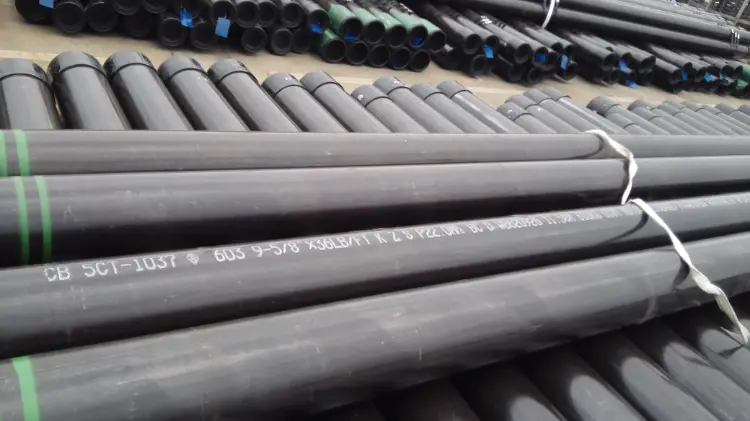
API 5CT C90 Oil Special Pipe
API 5CT C90 Oil Special Pipe: High-Strength Sour Service Casing & Tubing
Comprehensive material data sheet for API 5CT C90, a high-strength low-alloy steel designed for oil and gas wells in sour (H₂S-containing) environments. Includes chemical composition, mechanical properties, thermal & electrical data, international equivalents, and application guidelines.
Hot rolling, heat treatment (quenching and tempering), threading, upsetting, welding (for attachments only, not for the pipe body)
- Phone : +8618037372205
- Email : [email protected]
- WhatsApp: Contact via Whtsapp
- WeChat: +8618037372205
API 5CT C90 Oil Special Pipe Introduction
API 5CT C90 is a quenched and tempered martensitic steel grade specifically developed for oil country tubular goods (OCTG) used in sour service conditions. It combines a minimum yield strength of 90 ksi (620 MPa) with resistance to sulfide stress cracking (SSC) in environments containing hydrogen sulfide.
- Excellent resistance to hydrogen embrittlement due to controlled chemical composition and hardness.
- Designed for deep, high-pressure wells with H₂S, offering a balance of strength and toughness.
- Tight limits on elements like sulfur, phosphorus, and hardness to ensure SSC resistance as per NACE MR0175/ISO 15156.
- Typical delivery condition: quenched and tempered (Q&T).
API 5CT C90 Oil Special Pipe Chemical Composition
The chemical composition limits for API 5CT C90 are defined by the standard. Only elements with specified maximum or range limits are shown; other alloying additions (Cr, Mo, Ni, Cu, etc.) are at the manufacturer's discretion within the constraints of mechanical properties and carbon equivalent (CE) requirements for sour service per NACE MR0175/ISO 15156.
- Maximum sulfur and phosphorus levels are strictly controlled to ensure cleanliness and SSC resistance.
- Carbon equivalent values (typically CEIIW ≤ 0.43 or as agreed) are applied to ensure weldability and resistance to hardening in heat-affected zones.
| Chemical Element | Standard Value | Remarks |
|---|---|---|
| Carbon (C) | ≤ 0.35% | Product analysis limit per API 5CT Table C.4 |
| Manganese (Mn) | ≤ 1.00% | Product analysis limit |
| Silicon (Si) | ≤ 0.45% | Product analysis limit; typical range 0.20–0.35% |
| Phosphorus (P) | ≤ 0.020% | Maximum acceptable for sour service |
| Sulfur (S) | ≤ 0.010% | Maximum acceptable for sulfide stress cracking resistance |
| Chromium (Cr) | Not specified (by manufacturer) | Typically 0.80–1.20% for hardenability and corrosion resistance |
| Molybdenum (Mo) | Not specified (by manufacturer) | Typically 0.15–0.30% to enhance temper resistance and SSC resistance |
| Nickel (Ni) | ≤ 1.00% (by agreement) | Nickel can be added up to 1.00% but limits determined by CE; typical ≤ 0.25% |
| Copper (Cu) | ≤ 0.35% (if added) | Optional; copper can improve corrosion resistance but is usually limited |
| Aluminum (Al) | 0.010–0.050% (typical) | Grain refining agent; total Al usually in this range |
API 5CT C90 Oil Special Pipe Thermal and Electrical Physical Properties
These physical property values are typical for low-alloy quenched and tempered steels similar to C90. The actual values may vary slightly depending on the exact heat treatment and chemical composition.
- Density is practically constant for this class of steel.
- Thermal expansion and thermal conductivity are representative for chromium-molybdenum steels.
- Electrical resistivity is typical for ferritic steel at room temperature.
| Property | Typical Value | Unit | Condition |
|---|---|---|---|
| Density (ρ) | 7.85 | g/cm³ | At 20°C |
| Modulus of Elasticity (E) | 205 | GPa | At 20°C, longitudinal |
| Shear Modulus (G) | 79.3 | GPa | Calculated from E and Poisson's ratio |
| Poisson's Ratio (ν) | 0.30 | – | Room temperature |
| Thermal Expansion Coefficient (α) | 12.0 | 10⁻⁶/°C | Between 20°C and 100°C |
| Thermal Conductivity (λ) | 45 | W/(m·K) | At 20°C |
| Specific Heat Capacity (c) | 460 | J/(kg·K) | At 20°C |
| Electrical Resistivity (ρₑ) | 0.20 | μΩ·m | At 20°C |
API 5CT C90 Oil Special Pipe Mechanical Properties
The mechanical properties of API 5CT C90 are verified by tensile tests, hardness tests, and Charpy V-notch impact tests. The values below represent the minimum/maximum requirements from the standard.
- Yield strength range reflects both minimum and maximum limits to ensure a balance between strength and SSC resistance.
- Elongation is calculated using the API formula: e = 625,000 × A0.2 / U0.9, where A is cross-sectional area (in²) and U is specified minimum tensile strength (psi). Typical minimum elongation values around 15% (longitudinal) for standard specimens.
- Impact toughness is required for C90; test temperature usually 0°C (32°F) unless otherwise specified by the purchaser. Average absorbed energy values provided are for full-size (10×10 mm) specimens.
| Property | Standard Requirement | Unit | Test Condition |
|---|---|---|---|
| Yield Strength (ReH) | 620 – 724 (90 – 105) | MPa (ksi) | 0.2% offset, room temperature |
| Tensile Strength (Rm) | ≥ 689 (100) | MPa (ksi) | Room temperature |
| Elongation (A) | Determined by formula (typ. ≥ 15%) | % | In 50 mm (2 in) gauge, longitudinal, depends on wall thickness and yield strength |
| Hardness | ≤ 25.4 HRC (≤ 255 HBW) | HRC (HBW) | At any location; ensures SSC resistance per NACE MR0175 |
| Charpy Impact Energy (KV) | ≥ 27 avg / ≥ 20 single (longitudinal) | J | At 0°C (32°F); 10×10 mm specimen |
| Charpy Impact Energy (KV) | ≥ 20 avg / ≥ 15 single (transverse) | J | At 0°C (32°F); 10×10 mm specimen |
| Bend Test (Guided Bend) | No cracks or defects | – | D = 3t (180°), where D is bend diameter and t is specimen thickness; for materials ≥ 0.25 in wall thickness |
API 5CT C90 Oil Special Pipe Directly Equivalent Material Standards and Substitutable Grades
| Country/Region | Standard | Grade | Remarks |
|---|---|---|---|
| International (ISO) | ISO 11960 | C90 | Identical to API 5CT C90; same chemical and mechanical requirements |
| European Union | EN ISO 11960 | C90 | Adopted ISO standard; equivalent in all respects |
| Canada | CAN/CSA Z245.1 | Grade 414 (C90) | Comparative grade; may have slight variations but interchangeable for sour service |
| Russia | GOST R 53366 | К90 (K90) | Equivalent strength and H₂S resistance; typically used in accordance with GOST specifications |
API 5CT C90 Oil Special Pipe Application Introduction
API 5CT C90 is specifically engineered for downhole oil and gas tubular applications in environments containing wet hydrogen sulfide (H₂S), where sulfide stress cracking (SSC) is a major risk. It is the material of choice when a higher strength level than standard L80 is required while maintaining sour service compliance.
- Commonly used in production tubing and casing strings in high-pressure, high-temperature (HPHT) wells.
- Must comply with NACE MR0175/ISO 15156 for regions with partial pressure of H₂S > 0.3 kPa.
- Excellent weldability with proper preheat and post-weld heat treatment, making it suitable for attachments and repairs.
Product Applications: Production tubing strings, Casing strings (intermediate, production, and liner), Premium threaded connections with integral or coupled designs, Pup joints and crossover subs, Landing nipples, flow couplings, and blast joints
Processed into products: Tubing hanger necks, Packers bore receptacles, Seal assemblies for packers, Downhole safety valves and mandrels, Chemical injection mandrels, Instrument housings and gauge carriers, Perforating gun carriers (in sour wells), Workover and completion strings
Application industries: Upstream oil and gas exploration and production, Offshore drilling and subsea completions, Onshore HPHT and sour gas fields, Geothermal energy extraction (if H₂S present), Petrochemical refining (for specific downhole components)
API 5CT C90 Oil Special Pipe Similar / Comparable Alternative Material Recommendations
| Country/Region | Standard | Grade | Remarks |
|---|---|---|---|
| International | API 5CT | T95 | Higher strength grade (95–110 ksi) with similar sour service resistance; requires careful process control to avoid exceeding hardness limits |
| International | API 5CT | L80 Type 1 or 9Cr/13Cr | L80 has lower strength (80 ksi) and is widely used for sour service; 9Cr and 13Cr offer improved CO₂ resistance but limited H₂S tolerance |
| International | API 5CT | C110 | Higher strength (110 ksi) sour service grade suitable where higher loads are encountered; more restrictive chemistry and heat treatment |
| International | API 5CT | C95 (non-standard) | Often a proprietary grade offering 95 ksi minimum yield; can be an alternative if available from manufacturers |
Notes:
Hardness control is critical for SSC resistance; the maximum allowable hardness of 25.4 HRC must be strictly maintained throughout the pipe body, welds, and heat-affected zones. NACE MR0175/ISO 15156 compliance is mandatory for C90 when used in H₂S-containing environments. Supplementary testing such as sulfide stress cracking tests (method A or D of NACE TM0177) is often required by end users. Product specification level (PSL) can be PSL-1 or PSL-2 (more stringent) as per API 5CT; PSL-2 includes additional requirements for traceability, non-destructive testing, and impact testing. Careful selection of coupling stock is necessary to match strength, toughness, and corrosion resistance.
- Share



