
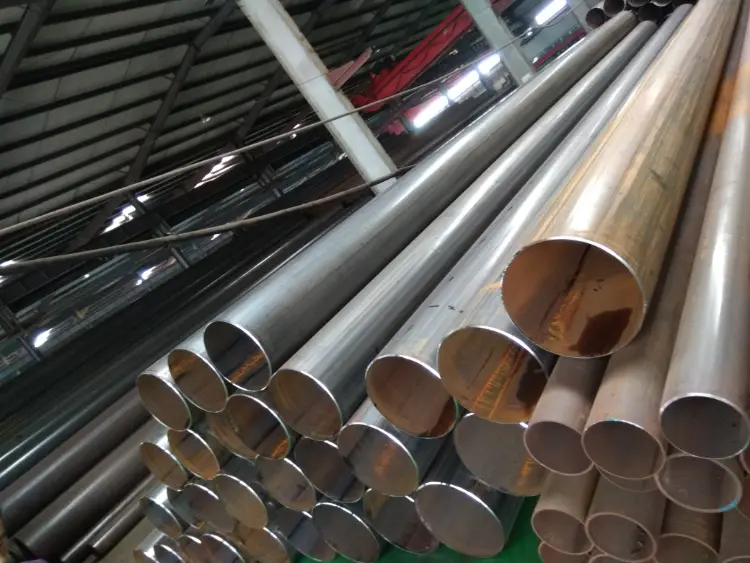
ASTM A240 410 Stainless Steel Pipe for Shipbuilding
ASTM A240 410 Stainless Steel Pipe for Shipbuilding: Properties & Equivalents
Complete data sheet for ASTM A240 410 stainless steel used in shipbuilding pipe applications. Covers chemical composition, mechanical and physical properties, international equivalents, and application guidance.
Hot forming, cold forming, machining, welding (preheat and post-weld heat treatment recommended), heat treatment (quenching and tempering)
- Phone : +8618037372205
- Email : [email protected]
- WhatsApp: Contact via Whtsapp
- WeChat: +8618037372205
ASTM A240 410 Stainless Steel Pipe for Shipbuilding Introduction
ASTM A240 410 is a martensitic stainless steel with a minimum chromium content of 11.5%, providing moderate corrosion resistance, high strength, and good hardness after heat treatment. It is widely used in shipbuilding for components such as valve stems, pump shafts, and fasteners, where a combination of wear resistance and resistance to mild marine environments is required. This grade can be hardened by quenching and tempering, achieving tensile strengths well above 700 MPa. In the annealed condition, it offers good ductility and machinability. When fabricated into pipes per ASTM A268 or similar specifications, it serves in high-strength, corrosion-resistant piping systems on vessels.
ASTM A240 410 Stainless Steel Pipe for Shipbuilding Chemical Composition
The chemical composition limits for ASTM A240 410 stainless steel are as follows. These values are in accordance with ASTM A240/A240M for plates and are also applicable to pipe products when manufactured from this material. Iron is the balance.
| Element | Standard Value | Remarks |
|---|---|---|
| Carbon (C) | ≤ 0.15 | |
| Manganese (Mn) | ≤ 1.00 | |
| Phosphorus (P) | ≤ 0.040 | |
| Sulfur (S) | ≤ 0.030 | |
| Silicon (Si) | ≤ 1.00 | |
| Chromium (Cr) | 11.5 - 13.5 | |
| Nickel (Ni) | ≤ 0.75 | Not intentionally added |
| Iron (Fe) | Balance |
ASTM A240 410 Stainless Steel Pipe for Shipbuilding Physical Properties
Physical properties of 410 stainless steel are provided below. These values are typical for annealed material at room temperature unless otherwise indicated. Thermal and electrical conductivity data may vary slightly with heat treatment and temperature.
| Property | Typical Value | Unit | Test Condition |
|---|---|---|---|
| Density (ρ) | 7.75 | g/cm³ | 20°C |
| Elastic Modulus (E) | 200 | GPa | 20°C |
| Shear Modulus (G) | 77 | GPa | Estimated from E and ν |
| Poisson's Ratio (ν) | 0.27 - 0.30 | - | |
| Thermal Expansion Coefficient (α) | 9.9 (0–100°C); 11.1 (0–315°C); 11.5 (0–540°C) | µm/m·°C (10⁻⁶/°C) | Mean coefficient |
| Thermal Conductivity (λ) | 24.9 (at 100°C); 26.1 (at 300°C); 28.7 (at 500°C) | W/m·K | |
| Specific Heat Capacity | 460 | J/kg·K | 0–100°C |
| Electrical Resistivity (ρ_e) | 5.7 x 10⁻⁷ (57) | Ω·m (µΩ·cm) | 20°C |
ASTM A240 410 Stainless Steel Pipe for Shipbuilding Mechanical Properties
Mechanical properties for ASTM A240 410 stainless steel in the annealed condition, as required by ASTM A240/A240M. For pipe applications, ASTM A268 TP410 lists similar minimum values. Higher strengths can be achieved through quenching and tempering; these are not specified in A240 but are commonly used.
| Property | Standard Requirement | Unit | Test Condition |
|---|---|---|---|
| Tensile Strength (Rm) | ≥ 450 (65) | MPa (ksi) | Annealed at 815–900°C, slow cooling |
| Yield Strength (ReH, 0.2% offset) | ≥ 205 (30) | MPa (ksi) | Annealed |
| Elongation (A) in 50 mm (2 in.) | ≥ 20 | % | Annealed |
| Hardness | ≤ 217 HB or ≤ 96 HRB | - | Annealed |
ASTM A240 410 Stainless Steel Pipe for Shipbuilding Complete Equivalent Standards and Substitutable Grades
| Country/Region | Standard | Grade | Remarks |
|---|---|---|---|
| USA | ASTM A268 / A268M | TP410 | Seamless and welded tubular products; same UNS S41000 |
| USA | AISI | 410 | Historic designation, technically equivalent |
| Europe | EN 10088-2 / EN 10088-3 | 1.4006 (X12Cr13) | Chemical and mechanical equivalence; used for sheet, plate, bar |
| Japan | JIS G4304 / G4305 | SUS410 | Equivalent stainless steel grade |
| China | GB/T 4237 / GB/T 1220 | S41010 (1Cr13) | Domestic equivalent |
| UK | BS 970 Part 1 | 410S21 | Obsolete but equivalent |
ASTM A240 410 Stainless Steel Pipe for Shipbuilding Application Introduction
ASTM A240 410 is utilized in shipbuilding where a balance of strength, hardness, and moderate corrosion resistance is required. It is not intended for highly corrosive seawater immersion without coatings or cathodic protection, but is excellent for internal parts, fasteners, and components exposed to atmospheric marine conditions. Typical heat treatment for final use: quench from 980°C and temper according to required hardness.
Product Applications: Ship propeller shafts (for small craft or with protective coatings), Hydraulic piping systems in vessels, Marine deck equipment components, Boiler and heat exchanger tubes (for less corrosive media), Structural pipes for offshore platforms (with appropriate corrosion protection)
Processed into products: Valve stems, seats, and discs, Pump shafts and impellers, Bolts, nuts, and studs for high-strength joints, Steam turbine buckets and blading, Fasteners for marine hardware (cleats, bollards), Guide rails and wear plates
Application industries: Shipbuilding and marine engineering, Oil & gas (topsides and mild sour service), Power generation (steam turbine blades), Food processing equipment (non-critical parts), Pump and valve manufacturing
ASTM A240 410 Stainless Steel Pipe for Shipbuilding Similar / Alternative Material Recommendations
| Country/Region | Standard | Grade | Remarks |
|---|---|---|---|
| USA | ASTM A240 | 420 (UNS S42000) | Higher carbon (≥0.15%) for increased hardness and wear resistance; useful for cutlery and surgical instruments in marine environments |
| USA | ASTM A276 / A479 | 416 (UNS S41600) | Free-machining version with added sulfur; slightly lower corrosion resistance but excellent machinability for fasteners |
| USA | ASTM A276 | 431 (UNS S43100) | Higher chromium (~16%) and nickel (~2%) for improved corrosion resistance and toughness; used in pump shafts and marine hardware |
| Europe | EN 10088-3 | 1.4021 (X20Cr13) | Higher carbon martensitic stainless; used for springs and parts requiring higher hardness after heat treatment |
Notes:
Welding: 410 stainless steel can be welded, but preheating (200–300°C) and post-weld heat treatment (tempering at 650–760°C) are recommended to avoid cracking and restore ductility. Corrosion resistance: Best in the hardened and tempered condition. Not resistant to chloride-induced stress corrosion cracking; avoid use in stagnant seawater unless cathodically protected. Ship classification societies: For load-bearing structural applications, approval from relevant class societies (e.g., DNV, ABS, LR) may be required. ASTM A240 410 material normally meets the minimum mechanical requirements but must be certified for the specific application.
- Share



