
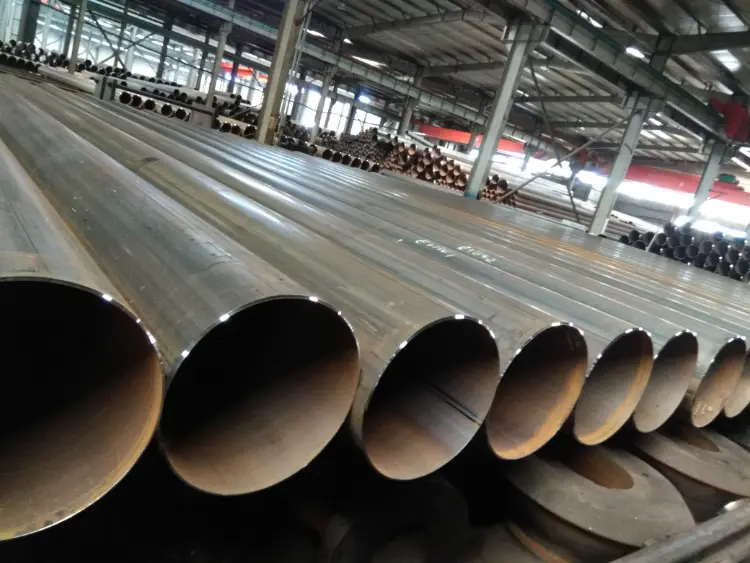
00Cr17Ni14Mo2 (316L) Shipbuilding Steel Pipe
00Cr17Ni14Mo2 (316L) Shipbuilding Steel Pipe: Properties, Equivalents, and Marine Applications
In-depth analysis of 00Cr17Ni14Mo2 shipbuilding steel pipe per GB/T 1220, including chemical composition, mechanical and thermal properties, international equivalents, and application guide for marine engineering.
Hot rolling, Cold rolling, Cold drawing, Forging, Machining, Welding (TIG, MIG, SAW, PAW)
- Phone : +8618037372205
- Email : [email protected]
- WhatsApp: Contact via Whtsapp
- WeChat: +8618037372205
00Cr17Ni14Mo2 Shipbuilding Steel Pipe Introduction
00Cr17Ni14Mo2 is an ultra-low carbon austenitic stainless steel grade specified in GB/T 1220, widely recognized as the Chinese equivalent to AISI 316L. The designation "00Cr" indicates an extra-low carbon content (C ≤ 0.03%), which significantly enhances intergranular corrosion resistance after welding. The addition of Molybdenum (2.0-3.0%) improves resistance to pitting and crevice corrosion in chloride environments, making it ideal for shipbuilding steel pipes and marine hardware. This material is non-magnetic in the annealed condition, exhibits excellent toughness at cryogenic temperatures, and possesses superior weldability without the need for post-weld annealing. Typical delivery involves solution annealing to achieve optimal corrosion resistance and ductility. Its balanced composition of Chromium and Nickel ensures reliable performance under aggressive seawater and chemical processing conditions.
00Cr17Ni14Mo2 Shipbuilding Steel Pipe Chemical Composition
The chemical composition of 00Cr17Ni14Mo2 is carefully balanced to ensure corrosion resistance and weldability. The extra-low carbon content (C ≤ 0.03%) minimizes chromium carbide precipitation at grain boundaries, while Molybdenum enhances resistance to chlorides. Nickel stabilizes the austenitic structure, and Chromium provides the passive layer for corrosion protection.
| Element | Standard Value (Mass %) | Remarks |
|---|---|---|
| Carbon (C) | ≤ 0.03 | Ultra-low carbon grade for welding without sensitization |
| Silicon (Si) | ≤ 1.00 | Deoxidizer; enhances oxidation resistance |
| Manganese (Mn) | ≤ 2.00 | Austenite stabilizer; improves hot working properties |
| Phosphorus (P) | ≤ 0.045 | Impurity; kept low for toughness |
| Sulfur (S) | ≤ 0.030 | Impurity; enhances machinability but limits deoxidization |
| Chromium (Cr) | 16.00 - 18.00 | Primary ferrite former; provides passivity |
| Nickel (Ni) | 12.00 - 15.00 | Austenite stabilizer; enhances ductility and toughness |
| Molybdenum (Mo) | 2.00 - 3.00 | Critical for pitting and crevice corrosion resistance in Cl- |
00Cr17Ni14Mo2 Shipbuilding Steel Pipe Physical and Thermal Properties
The physical and thermal properties of 00Cr17Ni14Mo2 are crucial for thermal cycling and heat transfer applications in shipbuilding. The material has a slightly higher thermal expansion rate compared to carbon steel, which must be considered during welding dissimilar joints. Its relatively high electrical resistivity and thermal stability make it suitable for electrical heating elements and heat exchanger tubing.
| Property | Typical Value | Unit | Test Condition / Remarks |
|---|---|---|---|
| Density (ρ) | 7.98 | g/cm³ | At 20°C |
| Melting Range | 1375 - 1400 | °C | Liquidus/Solidus temperature |
| Specific Heat Capacity (Cp) | 500 | J/(kg·K) | At 20°C |
| Thermal Conductivity (λ) | 16.3 | W/(m·K) | At 100°C |
| Thermal Conductivity (λ) | 21.5 | W/(m·K) | At 500°C |
| Thermal Expansion Coefficient (α) | 16.0 | 10⁻⁶/K | Range 20-100°C |
| Thermal Expansion Coefficient (α) | 17.5 | 10⁻⁶/K | Range 20-500°C |
| Modulus of Elasticity (E) | 200 | GPa | At 20°C |
| Modulus of Elasticity (E) | 172 | GPa | At 400°C |
| Shear Modulus (G) | 74 | GPa | At 20°C |
| Poisson's Ratio (ν) | 0.30 | — | Elastic deformation range |
| Electrical Resistivity (ρₑ) | 0.74 | μΩ·m | At 20°C |
00Cr17Ni14Mo2 Shipbuilding Steel Pipe Mechanical Properties
The mechanical testing for 00Cr17Ni14Mo2 shipbuilding pipes follows GB/T 1220 and GB/T 228.1 standards. Properties can vary based on section size and manufacturing process. This material exhibits a high elongation (A ≥ 40%), making it suitable for complex forming and high-pressure piping systems. The non-proportional extension strength Rp0.2 limits are defined for structural design.
| Property | Standard Requirement Value | Unit | Test Condition / Remarks |
|---|---|---|---|
| Tensile Strength (Rₘ) | ≥ 480 | MPa | Longitudinal; Solution annealed at 1010-1150°C |
| Yield Strength (Rp0.2) | ≥ 175 | MPa | Longitudinal; 0.2% offset method |
| Elongation after Fracture (A) | ≥ 40 | % | Gauge length 50mm (A50) |
| Reduction of Area (Z) | ≥ 60 | % | Indicative of high ductility |
| Hardness (HBW) | ≤ 187 | HBW | For plates and heavy sections |
| Hardness (HRB) | ≤ 90 | HRB | For thin sheets and pipes |
| Hardness (HV) | ≤ 200 | HV | Microhardness or thin sections |
| Impact Energy (KV₂) | ≥ 60 (long.) / ≥ 40 (trans.) | J | At -196°C (Cryogenic toughness) |
00Cr17Ni14Mo2 Shipbuilding Steel Pipe Completely Equivalent Material Standards and Substitutable Grades
| Country/Region | Standard | Grade Designation | Remarks |
|---|---|---|---|
| International | ISO 15510 | X2CrNiMo17-12-2 | Identical chemical and mechanical profile |
| European Union | EN 10088-1/3 | X2CrNiMo17-12-2 (1.4404) | Full equivalent for pressure vessel and piping |
| USA | ASTM A312 / A240 | TP316L / UNS S31603 | Widely used standard for seamless/welded pipes |
| Japan | JIS G4303/G4304 | SUS316L | Equivalent in Japanese industrial standards |
| China | GB/T 20878 / GB/T 12771 | 022Cr17Ni12Mo2 | Unified numerical code S31603 |
| Germany | DIN 17440/17456 | X2CrNiMo17-13-2 (1.4404) | Legacy German standard equivalent |
| UK | BS 970-1 / BS EN 10088 | 316S11 / 316S31 | British equivalent grades for 316L |
00Cr17Ni14Mo2 Shipbuilding Steel Pipe Application Introduction
00Cr17Ni14Mo2 shipbuilding steel pipe excels in marine atmospheres and submerged seawater service. Its low carbon content ensures the integrity of welded joints in ballast water systems, scrubber wash water pipes, and hydraulic tubing on offshore supply vessels. The material's resistance to pitting and crevice corrosion prevents premature failure in stagnant seawater conditions.
Product Applications: Seamless and Welded Shipbuilding Pipes (Class LR, DNV, ABS certified), Ballast Water Treatment System Piping, Exhaust Gas Scrubber (EGCS) Discharge Pipes, LNG/ LPG Ship Cryogenic Transfer Pipes, Marine Hydraulic Cylinders and Accumulator Tubes, Fire Fighting and Sprinkler System Pipes, Heat Exchanger Tubes and Tube Sheets, Bollards, Fairleads, and Deck Structural Hardware
Processed into products: Welded pipe spools and flanges (Slip-on, Weld Neck, Blind), Bends, elbows (Long radius, Short radius), and reducers, Tees (Equal and Reducing) and Crosses, Seawater intake and discharge gratings, Instrumentation tubes and compression fittings (Double ferrule type), Butterfly and Ball Valve bodies and stems, Custom machined flanges and couplings, Expansion bellows and flexible joints
Application industries: Shipbuilding and Marine Engineering, Offshore Oil and Gas Platforms (Topside and Subsea), Chemical Tanker Construction (Cargo and Vapor Lines), Desalination and Water Treatment Plants, Coastal Power Plant Cooling Systems, Food Processing and Pharmaceutical (Clean-in-Place Systems)
00Cr17Ni14Mo2 Shipbuilding Steel Pipe Similar / Closely Related Materials and Performance Analysis
| Country / Region | Standard | Grade | Comparison and Analysis |
|---|---|---|---|
| China / EU | GB/T 1220 / EN 10088 | 0Cr17Ni12Mo2 / 1.4401 (316) | Standard 316 grade without the ultra-low carbon restriction. Higher C max (0.08%) reduces weldability and intergranular corrosion resistance compared to 00Cr17Ni14Mo2. Post-weld annealing is recommended for heavy sections. |
| China | GB/T 1220 | 00Cr19Ni13Mo3 / 317L | Contains higher Ni and Mo content for superior corrosion resistance in extreme acidic/chloride environments. Suitable for pulp and paper industry, but may be over-designed for standard shipbuilding piping. |
| EU / USA | EN 1.4571 / AISI 316Ti | X6CrNiMoTi17-12-2 / 316Ti | Titanium stabilized version to prevent sensitization. Exhibits slightly higher high-temperature strength but is more prone to surface defects (Ti stringers) during polishing, and welding requires specific filler metals. |
| USA | ASTM A312 | TP304L / UNS S30403 | An economic alternative without Mo alloying. Excellent in oxidizing environments but significantly weaker resistance to pitting (PREN ≈ 18) compared to 316L (PREN ≈ 24). Not recommended for direct seawater contact. |
| Japan / China | JIS / GB | SUS317L / 022Cr19Ni13Mo3 | Higher Mo content (3.0-4.0%) provides enhanced resistance to sulfurous acid compounds and chlorides, but higher cost and strength limit its substitution unless required by strict corrosion specifications. |
Notes:
Welding Considerations: Use ER316L or ER317L filler for TIG/MIG welding. Interpass temperature should be kept below 150°C to avoid carbide precipitation despite the low carbon content. Heat Treatment: Solution annealing at 1050-1100°C followed by water quenching is mandatory for restoring full corrosion resistance after hot working. Certification: For shipbuilding applications, pipes must carry class certificates (e.g., DNV-GL, ABS, LR, BV, CCS) in addition to the GB/T 1220 material certificate. Surface Finish: Passivation with nitric acid or citric acid is recommended to restore the passive chromium oxide layer after grinding or machining.
- Share



