
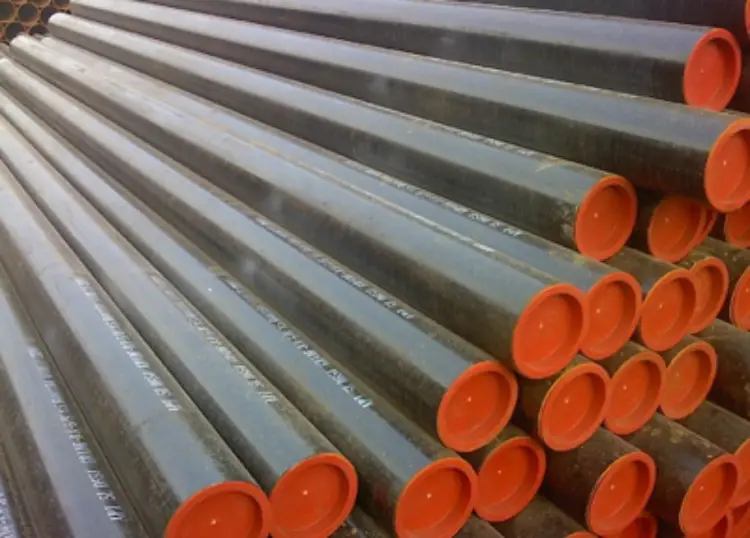
GB/T 5312 Grade 320 Shipbuilding Steel Pipe
GB/T 5312 Grade 320 Shipbuilding Steel Pipe - Chemical & Mechanical Data
Detailed material specification for GB/T 5312 Grade 320 seamless carbon-manganese steel pipe used in marine piping systems. Includes chemical composition, mechanical and physical properties.
Hot-finished or cold-finished seamless pipe, suitable for welding, bending, flanging, and threading
- Phone : +8618037372205
- Email : [email protected]
- WhatsApp: Contact via Whtsapp
- WeChat: +8618037372205
GB/T 5312 Grade 320 Shipbuilding Steel Pipe Introduction
GB/T 5312 Grade 320 is a carbon–manganese seamless steel pipe specifically designed for shipbuilding piping applications, such as steam, water, oil, and air service. This grade offers a minimum yield strength of 320 MPa and excellent weldability, making it suitable for high-pressure shipboard systems. The steel is typically supplied in normalized or hot-rolled condition and meets the requirements of classification societies. The input 'A240 320' likely refers to this Chinese shipbuilding pipe grade, as ASTM A240 does not include a 320 grade; therefore, this analysis is based on the established national standard GB/T 5312-2009.
GB/T 5312 Grade 320 Shipbuilding Steel Pipe Chemical Composition
The following chemical composition is specified in GB/T 5312-2009 for grade 320. The steel is a plain carbon–manganese grade with controlled residual elements to ensure good weldability and toughness. The low carbon content (<0.16%) promotes excellent field welding without preheat in normal shipyard practice.
| Element | Specified Value (%) | Remarks |
|---|---|---|
| Carbon (C) | ≤ 0.16 | Mandatory |
| Silicon (Si) | ≤ 0.35 | Mandatory |
| Manganese (Mn) | 0.40 – 0.70 | Mandatory |
| Phosphorus (P) | ≤ 0.025 | Mandatory |
| Sulfur (S) | ≤ 0.020 | Mandatory |
| Chromium (Cr) | ≤ 0.25 | Residual |
| Nickel (Ni) | ≤ 0.30 | Residual |
| Copper (Cu) | ≤ 0.30 | Residual |
| Molybdenum (Mo) | ≤ 0.10 | Residual |
| Aluminum (Al) | ≥ 0.020 (if added for fine grain) | Optional for grain refinement |
GB/T 5312 Grade 320 Shipbuilding Steel Pipe Thermal and Electrical Physical Properties
The following physical properties are typical for carbon–manganese steel of this type at room temperature unless otherwise noted. They are not mandatory requirements of GB/T 5312 but are useful for design calculations in marine engineering.
| Property | Typical Value | Unit | Test Condition / Remarks |
|---|---|---|---|
| Density (ρ) | 7.85 | g/cm³ | At 20 °C |
| Modulus of Elasticity (E) | 200 – 210 | GPa | At 20 °C |
| Shear Modulus (G) | 80 – 81 | GPa | At 20 °C |
| Poisson's Ratio (ν) | 0.29 – 0.30 | — | At 20 °C |
| Thermal Expansion Coefficient (α) | 11.8 – 12.3 × 10⁻⁶ | K⁻¹ | 20 – 200 °C |
| Thermal Conductivity (λ) | 50 – 55 | W/(m·K) | At 20 °C |
| Specific Heat Capacity | 440 – 480 | J/(kg·K) | At 20 °C |
| Electrical Resistivity (ρₑ) | 0.18 – 0.22 | μΩ·m | At 20 °C |
GB/T 5312 Grade 320 Shipbuilding Steel Pipe Mechanical Properties
Mechanical properties are determined on samples taken from finished pipes in the delivery condition. The values below meet the minimum requirements of GB/T 5312-2009 for grade 320. Testing includes tensile, impact, and bend tests. Impact testing is performed at 0 °C in the longitudinal direction.
| Property | Standard Requirement | Unit | Test Condition |
|---|---|---|---|
| Yield Strength (ReH) | ≥ 320 | MPa | Room temperature |
| Tensile Strength (Rm) | 440 – 590 | MPa | Room temperature |
| Elongation, longitudinal (A) | ≥ 22 | % | Gauge length 5.65√S₀ |
| Elongation, transverse (A) | ≥ 20 | % | Gauge length 5.65√S₀, for strip specimens |
| Impact Energy (KV₂) at 0 °C, longitudinal | ≥ 27 | J | V-notch, 10×10 mm specimen |
| Bend Test (180°) | No cracks | — | Mandrel diameter = 4×wall thickness |
GB/T 5312 Grade 320 Shipbuilding Steel Pipe Fully Equivalent Standards and Replaceable Grades
| Region / Country | Standard | Grade | Remarks |
|---|---|---|---|
| — | — | — | There is no direct international equivalent with identical chemical and mechanical property requirements. The closest marine structural steel plates (AH32, etc.) differ in product form and pipe-specific requirements. |
GB/T 5312 Grade 320 Shipbuilding Steel Pipe Application Introduction
GB/T 5312 Grade 320 pipes are specifically engineered for ship and offshore platform piping systems. With a nominal minimum yield strength of 320 MPa, they offer a balanced combination of strength, toughness, and weldability required for marine environments. The material is approved by many classification societies and is commonly used in newbuilding and repair projects.
Product Applications: Main steam pipes and exhaust lines, Fuel oil transfer and supply lines, Bilge, ballast, and fire-fighting piping networks, Compressed air and service air systems, Hydraulic and lubrication oil piping, Fresh water and sanitary water piping
Processed into products: Straight seamless pipe sections and spools, Pipe bends, elbows, and reducers (hot or cold formed), Flanges and welding necks machined from pipe stock, Stub ends, tees, and wyes, Threaded pipe nipples and couplings, Pressure vessel nozzles and headers (when fabricated)
Application industries: Shipbuilding and ship repair, Offshore oil and gas (topside piping), Marine engineering and platform construction, Port and harbor machinery, Power generation (auxiliary steam/water lines on ships)
GB/T 5312 Grade 320 Shipbuilding Steel Pipe Similar or Alternative Materials for Reference
| Region / Country | Standard | Grade | Remarks |
|---|---|---|---|
| International (IACS) | ABS / DNV / LR Rules | AH32 (yield 315 MPa) | Shipbuilding plate material; similar strength but different product standard and chemical composition (higher Mn, may include Nb/V). Not a direct pipe substitute. |
| USA | ASTM A106 | Grade C | Seamless carbon steel pipe for high-temperature service; yield 275 MPa (lower than 320), tensile ≥ 485 MPa. Requires check for marine approval. |
| Europe | EN 10216-2 | P355N / P355NH | Non-alloy quality steel seamless tube; minimum yield 355 MPa (over-match). Can be used as an enhanced substitution if permitted by classification society. |
| Japan | JIS G 3454 | STPG 410 | Carbon steel pressure pipe; yield ≥ 245 MPa. Lower strength – not a direct substitute without wall thickness adjustment. |
| China | GB/T 8163 | 20 (Grade 20) | Seamless steel pipe for fluid service; yield ≥ 245 MPa. Lower strength; use only if design allows. |
Notes:
Additional information: Although this grade is primarily a Chinese national standard, major classification societies (CCS, ABS, DNV, LR, BV, etc.) may accept it under their respective rules when supplementary impact testing and inspection are carried out. Mill certificates must include the specified chemical composition, tensile properties, and impact energy at 0 °C. For high-temperature service, the maximum operating temperature is typically limited to 400 °C. Welding consumables should be selected to match the base metal strength (e.g., AWS E7018-1 or equivalent).
- Share



