
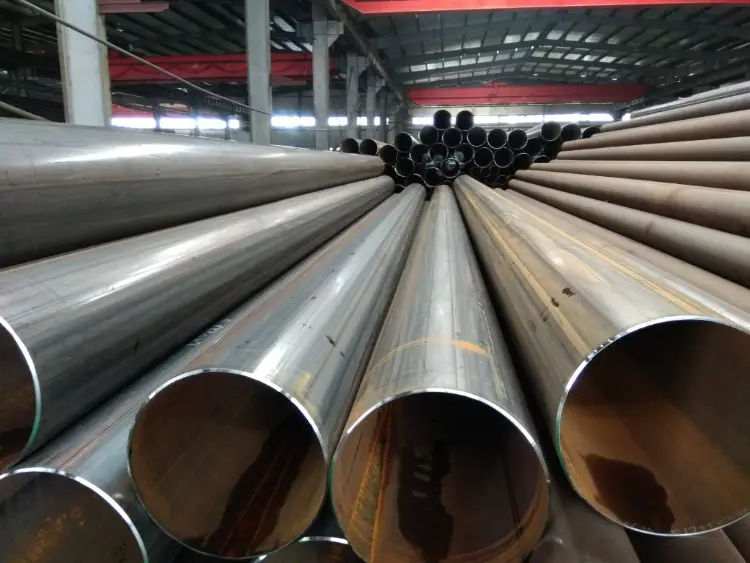
ABS Grade AH36 Shipbuilding Steel Pipe
ABS Grade AH36 Shipbuilding Steel Pipe: High-Strength Structural Alloy for Marine Applications
Comprehensive technical reference for ABS Grade AH36 shipbuilding steel pipe, including chemical composition, mechanical and physical properties, international equivalents, and application guidance.
Hot rolling, normalizing, thermomechanical controlled rolling (TMCP), welding, bending, machining
- Phone : +8618037372205
- Email : [email protected]
- WhatsApp: Contact via Whtsapp
- WeChat: +8618037372205
ABS Grade AH36 Shipbuilding Steel Pipe Introduction
ABS Grade AH36 is a high-strength hull structural steel widely used in the shipbuilding and offshore industries. It is classified as a higher-strength grade by the American Bureau of Shipping (ABS) and commonly supplied in the form of pipes, plates, and sections. Key characteristics include:
- Minimum yield strength of 355 MPa (51 ksi) in thicknesses up to 50 mm, enabling reduced structural weight while maintaining robustness.
- Excellent weldability and formability due to controlled carbon equivalent and fine-grain practices.
- Good low-temperature toughness, certified for impact testing at 0°C with minimum absorbed energy of 34 J (longitudinal).
- Applied in critical marine structures such as hulls, decks, bulkheads, and piping systems exposed to dynamic loads and corrosive environments.
The material is typically delivered in normalized or thermomechanically controlled rolled (TMCP) condition, ensuring uniform mechanical properties across sections.
ABS Grade AH36 Shipbuilding Steel Pipe Chemical Composition
Chemical limits according to ABS Rules for Higher Strength Hull Structural Steels. Microalloying elements such as Nb, V, Ti may be added singly or in combination to achieve fine grain size and high strength. Carbon equivalent (CEV) is typically ≤ 0.38% to ensure good weldability without preheating in moderate thicknesses. Residual elements are kept low to avoid embrittlement.
| Element | Specified Value (max, min if indicated) | Remarks |
|---|---|---|
| Carbon (C) | ≤ 0.18% | For product thickness ≤ 12.5 mm; ≤ 0.20% for >12.5 mm |
| Manganese (Mn) | 0.90 – 1.60% | Lower bound may be reduced to 0.70% for some products |
| Silicon (Si) | 0.10 – 0.50% | Typical deoxidizer |
| Phosphorus (P) | ≤ 0.035% | |
| Sulfur (S) | ≤ 0.035% | Low sulfur for weldability and toughness |
| Aluminum (Al, acid-soluble) | ≥ 0.015% | For fine grain practice; total Al may also be specified |
| Niobium (Nb) | 0.02 – 0.05% | Optional grain refiner |
| Vanadium (V) | 0.05 – 0.10% | Optional strengthening agent |
| Titanium (Ti) | 0.007 – 0.05% | When used for grain refinement; may be specified |
| Nitrogen (N) | ≤ 0.012% | If Al and/or Ti used for grain refinement |
| Nickel (Ni) | ≤ 0.40% | Residual, unless added intentionally |
| Chromium (Cr) | ≤ 0.20% | Residual |
| Copper (Cu) | ≤ 0.35% | Residual |
| Molybdenum (Mo) | ≤ 0.08% | Residual |
ABS Grade AH36 Shipbuilding Steel Pipe Thermal and Electrical Physical Properties
The following physical properties are typical for standard carbon-manganese structural steels with similar composition and are applicable to AH36. Precise values may vary slightly depending on the exact chemistry and microstructure; however, these are widely accepted design data. Density is used for weight calculation, and thermal expansion governs dimensional changes under temperature loads.
| Property | Nominal Value | Unit | Test Condition / Reference |
|---|---|---|---|
| Density (ρ) | 7.85 | kg/dm³ (or g/cm³) | At 20°C |
| Elastic Modulus (E) | 200 | GPa | Typical for all structural steels |
| Shear Modulus (G) | 80 | GPa | Calculated from E and ν |
| Poisson's Ratio (ν) | 0.30 | dimensionless | Within elastic range |
| Thermal Expansion Coefficient (α) | 11.5 | 10⁻⁶·K⁻¹ | 20–100°C |
| Thermal Expansion Coefficient (α) | 12.3 | 10⁻⁶·K⁻¹ | 20–200°C |
| Thermal Expansion Coefficient (α) | 13.2 | 10⁻⁶·K⁻¹ | 20–300°C |
| Thermal Conductivity (λ) | 50 | W/(m·K) | At 20°C |
| Thermal Conductivity (λ) | 47 | W/(m·K) | At 100°C |
| Specific Heat Capacity (cp) | 460 | J/(kg·K) | Room temperature |
| Electrical Resistivity (ρe) | 0.15 – 0.20 | µΩ·m | at 20°C, depending on alloys |
ABS Grade AH36 Shipbuilding Steel Pipe Mechanical Properties
Tensile and impact properties are based on ABS requirements for AH36 steel in the normalized or TMCP condition, valid for product thickness up to 50 mm. Bend test is performed over a former diameter of 3× thickness (180°) for quality assessment. Impact toughness is verified at 0°C on Charpy V-notch specimens; longitudinal values are given below. Transverse impacts may have lower minimum values.
| Property | Specified Value | Unit | Test Condition |
|---|---|---|---|
| Yield Strength (ReH) | ≥ 355 | MPa | Upper yield or 0.2% proof stress, as rolled/thickness ≤ 50 mm |
| Tensile Strength (Rm) | 490 – 620 | MPa | Room temperature |
| Elongation (A5) | ≥ 21 | % | Gauge length 5.65√So; for thickness up to 50 mm |
| Charpy Impact Energy (KV2) | ≥ 34 (longitudinal) | J | At 0°C, 10×10 mm specimen |
| Bend Test (Diameter) | 3t | — | 180° bend, no cracking; t = specimen thickness |
ABS Grade AH36 Shipbuilding Steel Pipe Fully Equivalent Material Standards and Replaceable Grades
| Country / Region | Standard / Rule | Grade | Remarks |
|---|---|---|---|
| International (ABS) | ABS Rules for Materials and Welding | AH36 | Original base grade |
| International (DNV) | DNVGL RU SHIP Pt.2 Ch.2 | NV A36 | Identical strength and toughness at 0 °C |
| United Kingdom (LR) | Lloyd's Register Rules | A36 / AH36 | Equivalent grade |
| France (BV) | Bureau Veritas Rules | A36 | Same specification |
| Germany (DNV-GL) | GL Rules (now merged) | GL-A36 | Historically identical |
| China (CCS) | CCS Rules for Materials | AH36 | Direct equivalent |
| China (GB) | GB 712 | AH36 | National standard for ship steel |
| South Korea (KR) | KR Rules | AH36 | Equivalent |
| Japan (NK) | ClassNK Rules | AH36 | Equivalent |
| Italy (RINA) | RINA Rules | AH36 | Equivalent |
| India (IRS) | IRS Rules | AH36 | Equivalent |
ABS Grade AH36 Shipbuilding Steel Pipe Application Introduction
ABS Grade AH36 steel pipe is engineered for shipbuilding and offshore construction where high strength, good weldability, and reliable low-temperature toughness are essential. Its application spans from large structural members to process piping. Typical processing routes include cold forming, welding, and normalizing heat treatment to restore properties after fabrication. Design considerations:
- AH36 pipe meets classification society requirements for hull structural and pressure piping.
- Carbon equivalent is controlled to permit welding without preheating for moderate thicknesses.
- Impact properties are certified at 0°C, making it suitable for general marine environments, while D and E grades should be selected for colder climates.
Product Applications: Ship hull stiffeners and frames, Deck plates and hatch covers, Ballast water pipe systems, Cargo and ballast tank pipework, Helideck and equipment support structures, Seawater cooling lines
Processed into products: Straight and bent seamless/welded piping spools, Pipe tees, elbows, and flanges, Longitudinal and transverse girders, Bulkhead stools and stiffeners, Column and bracing elements for offshore structures, Subsea pipeline riser clamps and supports
Application industries: Commercial and naval shipbuilding, Offshore oil and gas platforms, Marine engineering and harbor construction, Pressure vessel and boiler manufacturing (with supplementary approval), Wind turbine foundations and transition pieces
ABS Grade AH36 Shipbuilding Steel Pipe Similar / Alternative Material Recommendations
| Country / Region | Standard / Rule | Grade | Remarks |
|---|---|---|---|
| International (ABS) | ABS Rules | DH36 | Improved low-temperature toughness: impact test at -20°C, min 34 J; suitable for thicker and colder-service structures |
| International (ABS) | ABS Rules | EH36 | Superior toughness: impact test at -40°C, min 34 J; for arctic or critical applications |
| International (ABS) | ABS Rules | AH40 | Higher strength grade: yield ≥ 390 MPa, tensile 510–650 MPa; for weight-sensitive designs |
| European (EN) | EN 10025-3 / EN 10025-4 | S355M / S355ML | Thermomechanical rolled structural steel; equivalent strength but may require adaptation for marine classification |
| Japan (JIS) | JIS G 3106 | SM490YA | Weldable structural steel with similar strength; used in general structures, validation required for ship rules |
| China (GB) | GB/T 1591 | Q355C / Q355D | Low alloy high strength structural steel with optional impact requirements; close mechanical properties |
Notes:
Special considerations:
- AH36 pipe intended for pressure service must comply with additional ABS rules for pressure piping (e.g., ABS Rules for Building and Classing Steel Vessels Under 90 Meters or Part 4). Supplementary requirements for nondestructive testing (UT, RT) may apply.
- Corrosion allowance should be considered in design; the material is not inherently corrosion-resistant; protective coatings or cathodic protection are typically used.
- For welded pipe, the base metal and weld seam must both meet mechanical requirements, and the weld is usually subjected to normalizing to restore toughness.
- When ordering, it is crucial to specify the product type (seamless or welded), dimensions, intended service temperature (class 0°C for AH36), and any supplementary impact or Z-direction requirements if critical through-thickness properties are needed.
- Share



