
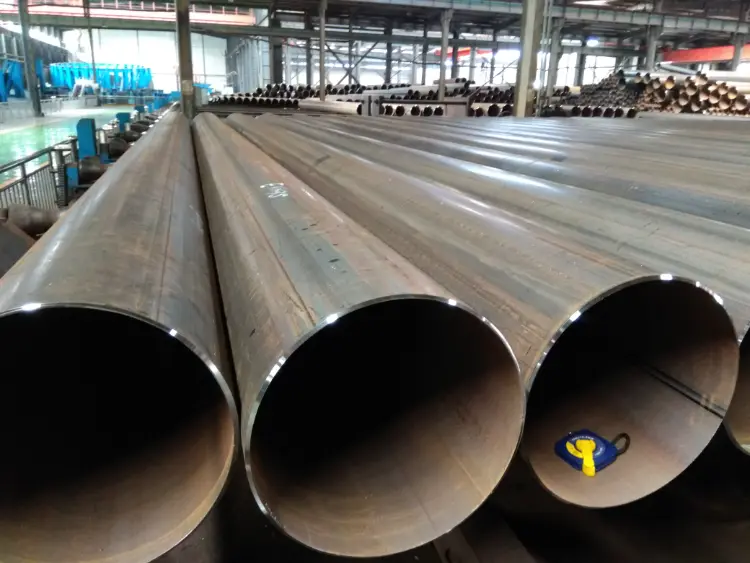
0Cr18Ni9Ti Stainless Steel for Shipbuilding Pipes
0Cr18Ni9Ti Stainless Steel for Shipbuilding Pipes: Composition, Properties and Equivalents
Comprehensive technical data for 0Cr18Ni9Ti (equivalent to 321) stainless steel, including chemical composition, mechanical and physical properties, international equivalents, and application guidance, especially for shipbuilding pipes.
Hot rolling, cold rolling, cold drawing, forging, welding, solution annealing, pickling
- Phone : +8618037372205
- Email : [email protected]
- WhatsApp: Contact via Whtsapp
- WeChat: +8618037372205
0Cr18Ni9Ti Stainless Steel for Shipbuilding Pipes Introduction
0Cr18Ni9Ti is a titanium-stabilized austenitic stainless steel originally defined in China under GB/T 1220 for stainless steel bars. It corresponds to 06Cr19Ni10Ti in the current GB/T 20878 designation and is widely known internationally as 321 (AISI) or 1.4541 (EN). The addition of titanium prevents intergranular corrosion after exposure to temperatures in the chromium carbide precipitation range (427°C–816°C). This grade offers good high-temperature strength, excellent resistance to oxidation, and superior weldability.
In shipbuilding applications, it is frequently used for seamless or welded pipes carrying corrosive fluids, exhaust systems, and heat exchangers, where resistance to sensitization during welding or elevated-temperature service is critical. Despite being referenced under bar standard GB/T 1220, the material is also produced as pipes per standards such as GB/T 14976 for fluid transport and can meet classification society requirements for marine use.
0Cr18Ni9Ti Stainless Steel for Shipbuilding Pipes Chemical Composition
The chemical composition of 0Cr18Ni9Ti (06Cr19Ni10Ti) is defined according to GB/T 1220 for bars and GB/T 14976 for pipes. The titanium content must be at least five times the carbon content to ensure full stabilization against intergranular corrosion. Trace elements are controlled to ensure weldability and corrosion resistance.
| Element | Standard Value (wt%) | Remarks |
|---|---|---|
| Carbon (C) | ≤0.08 | Lower carbon improves resistance to intergranular attack. |
| Silicon (Si) | ≤1.00 | Typical residual from deoxidation. |
| Manganese (Mn) | ≤2.00 | Austenite former. |
| Phosphorus (P) | ≤0.035 | Impurity, controlled for weldability. |
| Sulfur (S) | ≤0.030 | Impurity, kept low for corrosion resistance. |
| Chromium (Cr) | 17.00–19.00 | Provides passivity and corrosion resistance. |
| Nickel (Ni) | 8.00–11.00 | Stabilizes austenitic microstructure. |
| Titanium (Ti) | 5×(C%)–0.70 | Stabilizing element; excess prevents Cr-carbide formation. |
| Iron (Fe) | Balance | Base element. |
0Cr18Ni9Ti Stainless Steel for Shipbuilding Pipes Thermal and Electrical Physical Properties
Physical properties at room temperature and elevated temperatures for 0Cr18Ni9Ti (321 austenitic stainless steel). These values are averages over typical product forms and conditions. The titanium addition does not significantly alter the intrinsic physical constants compared to 304 stainless steel.
- Thermal properties are essential for design of piping in high-temperature ship systems such as exhausts.
| Property | Typical Value | Unit | Test Condition |
|---|---|---|---|
| Density (ρ) | 7.93 | g/cm³ | 20°C |
| Elastic Modulus (E) | 193 | GPa | 20°C, tension |
| Shear Modulus (G) | 77 | GPa | 20°C, calculated from E and ν |
| Poisson's Ratio (ν) | 0.27 | — | 20°C |
| Thermal Expansion Coefficient (α) | 16.5 | 10⁻⁶/K | 0–100°C |
| Thermal Expansion Coefficient (α) | 17.2 | 10⁻⁶/K | 0–315°C |
| Thermal Expansion Coefficient (α) | 18.4 | 10⁻⁶/K | 0–540°C |
| Thermal Conductivity (λ) | 16.3 | W/(m·K) | 100°C |
| Thermal Conductivity (λ) | 21.5 | W/(m·K) | 500°C |
| Specific Heat Capacity (c) | 500 | J/(kg·K) | 0–100°C |
| Electrical Resistivity (ρ_e) | 0.73 | μΩ·m | 20°C |
0Cr18Ni9Ti Stainless Steel for Shipbuilding Pipes Mechanical Properties
Mechanical properties for 0Cr18Ni9Ti in solution-annealed condition according to GB/T 1220 (bars) and GB/T 14976 (pipes). For shipbuilding pipes, the minimum elongation is slightly lower than for bars. These values ensure the material can withstand forming, welding, and service loads in marine environments.
- Solution annealing temperature: 1000°C–1100°C, followed by rapid cooling.
- Values apply to room temperature tests unless otherwise noted.
| Property | Standard Requirement | Unit | Test Condition | |
|---|---|---|---|---|
| Tensile Strength (Rm) | ≥520 | MPa | Room temperature, transverse/longitudinal specimen | |
| Yield Strength (Rp0.2 | ReH)-longitudinal | ≥205 | MPa | Room temperature |
| Elongation after Fracture (A) | ≥40 (for bars) | % | Standard gauge length L₀=5.65√S₀ | |
| Elongation after Fracture (A) | ≥35 (for pipes) | % | Standard gauge length, wall thickness ≤6.5 mm | |
| Hardness (HB) | ≤187 | HB | Brinell hardness, 10 mm ball, 3000 kg | |
| Hardness (HRB) | ≤90 | HRB | Rockwell B scale, optional | |
| Hardness (HV) | ≤200 | HV | Vickers hardness, optional | |
| Bend Test (bending angle) | 180° | degrees | Mandrel diameter = 2 × thickness (for bars) | |
| Charpy Impact Energy (KV₂) | ≥100 (typical, not always mandatory) | J | At room temperature, V-notch |
0Cr18Ni9Ti Stainless Steel for Shipbuilding Pipes Fully Equivalent Material Standards and Replaceable Grade Recommendations
The following international standards and grades are directly equivalent to 0Cr18Ni9Ti (06Cr19Ni10Ti/321). They can be used for shipbuilding pipes and other applications that require the same chemical composition and corrosion resistance, subject to approval by the relevant classification society.
| Country/Region | Standard | Grade | Remarks |
|---|---|---|---|
| China | GB/T 1220 (bars), GB/T 14976 (pipes) | 0Cr18Ni9Ti / 06Cr19Ni10Ti | Original designation; new designation 06Cr19Ni10Ti |
| United States | ASTM A276, ASTM A312 | 321 (UNS S32100) | Most common equivalent; double stabilized version 321H also available |
| European Union | EN 10088-3, EN 10216-5 | 1.4541 (X6CrNiTi18-10) | Titanium-stabilized austenitic grade |
| Japan | JIS G4303, JIS G3459 | SUS321 | Equivalent to AISI 321 |
| International | ISO 15510 | X6CrNiTi18-10 | ISO harmonized designation |
| Germany (obsolete) | DIN 17440 | X6CrNiTi18-10 (1.4541) | Superseded by EN standards but chemically identical |
0Cr18Ni9Ti Stainless Steel for Shipbuilding Pipes Application Introduction
Owing to its excellent intergranular corrosion resistance at moderate temperatures and good weldability, 0Cr18Ni9Ti is widely used in shipbuilding and marine engineering. The material can be formed into various components and is suitable for a range of fabricating processes.
Product Applications: Seamless and welded shipbuilding pipes for cooling water, lube oil, fuel oil, and hydraulic systems, Exhaust gas pipes and dry mufflers, Boiler and superheater tubes, Chemical tanker cargo piping, Condenser tubes in marine engines, Structural profiles for deck equipment
Processed into products: Pipe spools and flanges for marine piping systems, Expansion bellows and flexible hoses, Heat exchanger tube bundles and tube sheets, Furnace combustion chamber covers, Forged fittings (elbows, tees, reducers), Bolting and fasteners for high-temperature joints
Application industries: Shipbuilding and offshore platforms, Chemical and petrochemical processing, Power generation (boiler tubes, superheaters), Aerospace (exhaust systems, thrust reversers), Food and pharmaceutical processing, Heat exchanger manufacturing
0Cr18Ni9Ti Stainless Steel for Shipbuilding Pipes Similar/Alternative Material Recommendations
| Country/Region | Standard | Grade | Remarks |
|---|---|---|---|
| China | GB/T 1220, GB/T 14976 | 0Cr18Ni9 / 304 (06Cr19Ni10) | Lower cost, no Ti; susceptible to sensitization if welded and used above 400°C |
| China | GB/T 1220, GB/T 14976 | 00Cr19Ni10 / 304L (022Cr19Ni10) | Extra-low carbon for improved as-welded intergranular corrosion resistance; not for high temperature creep |
| United States | ASTM A276, A312 | 316L (UNS S31603) | Mo-bearing for better pitting resistance in chloride environments; stabilized with low carbon |
| Japan | JIS G4303 | SUS321J1 | Higher Ti content variant, rarely used but similar |
| Europe | EN 10088-3 | 1.4571 (X6CrNiMoTi17-12-2) | Molybdenum-alloyed, titanium-stabilized; better corrosion resistance, often used for shipbuilding pipes in aggressive seawater |
Notes:
Shipbuilding classification societies (e.g., LR, DNV, ABS) often require additional testing for pipes, such as flattening tests, flange tests, and intergranular corrosion tests (e.g., ASTM A262 Practice E). For welded pipes, the base material and weld zone must meet the same corrosion resistance criteria. The titanium-stabilized grade is preferred when service temperatures are in the sensitization range (450–850°C) and post-weld heat treatment is not feasible.
Note: GB/T 1220 is a bar standard; for shipbuilding pipes, refer to GB/T 14976 (seamless stainless steel pipes for fluid transport) or GB/T 12771 (welded pipes), both of which include this grade with similar chemical and mechanical properties. Ensure the chosen standard meets flag state requirements.
- Share



